
Loading…
Loading…
Cue robots (1 per group)
tablets or compatible devices (1 per group)
meter sticks or measuring tapes (1 per group)
masking tape (1 roll per class)
blank paper (1 sheet per group)
pencils (1 per group)
Before this lesson, it is recommended that students:
be able to accurately identify and measure distances and angles.
practice programming loops in the Cue app.
Fully charge the devices and robots.
Install the Wonder Workshop Cue app on each device.
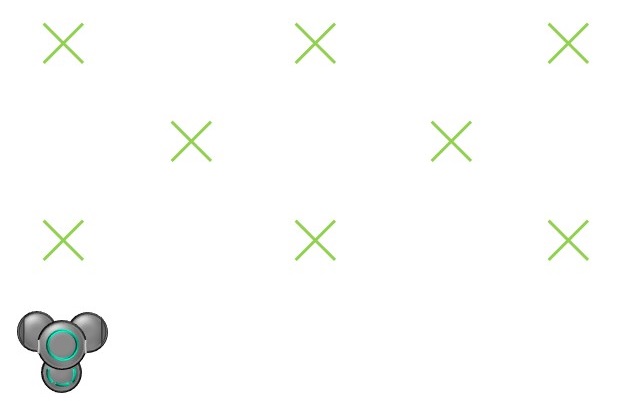
Create space and mark spots on the classroom floor with tape as shown below for the ecosystem interactions game. To limit the amount of waiting for students to test, mark one of these areas for every four students.
1. Ask, “What is a habitat?”
Sample response: “A habitat is the natural environment in which an organism lives.”)
2. Ask, “In biology, what is the difference between an individual, population, and community?”
Sample response: “An individual refers to a single organism, a population refers to all the members of the same species that occupy the same habitat or location, and a community refers to an interacting group of more than one species.”
3. Ask, “What is a food chain?”
Sample response: “A group of organisms in which each uses the next lowest member of the series as a food source. A food chain maps out who eats who in a community.”
4. Say, “Today we will explore several different types of interactions between organisms in an ecosystem.”
Ask, “What is a loop?” (Sample response: “A set of instructions programmed to repeat x number of times.”)
Ask, “Why can it be helpful to use loops in your programs?” (Sample response: “They can make my programs shorter and more efficient.”)
Ask, “How would you program a loop in the Cue app?” (Sample response: “I would place the blocks I want to loop inside the repeat X block and set X to the number of times I want the code to repeat.”)
1. Ask, “What is an ecosystem?”
Sample response: “An ecosystem encompasses a community of interacting organisms and their environment.”
2. Ask, “Are nonliving things part of an ecosystem?”
Sample response: Yes. The term ‘ecosystem’ refers to living organisms as well as non-living aspects of the environment.”)
3. Say, “An ecologist is a scientist who studies the interactions between living and nonliving things in an ecosystem. Ecologists use the term biotic to describe the living aspects of an ecosystem and the term abiotic to describe the nonliving aspects of an ecosystem.”
Ask, “What are some biotic aspects of an ecosystem?” (Sample response: “Plants, animals, algae, fungi, and bacteria.”)
Ask, “What are some abiotic aspects of an ecosystem?” (Sample response: The abiotic aspects of an ecosystem are the physical environment. For example, water and soil, water/soil chemistry, temperature, and landscape (lakes, rivers, sandy deserts, etc.)”
4. Say, “Interactions between living organisms in an ecosystem are called biotic interactions. These occur between individuals of the same species as well as between individuals of different species. Though ecosystems across the globe can be wildly different in their biotic and abiotic composition, there are three main types of biotic interactions that are common to all biological communities across ecosystems.”
5. Discuss the three main types of biotic interactions and elicit or provide examples.
Predation: Where one organism uses another organism as prey (i.e., as a resource) and harms the prey organism. Thus, the predator benefits from the interaction but the prey is harmed. This includes carnivorous interactions (where the organism eats animals), herbivory (where the organism eats plants), and parasitism (where the predator is harmful to the prey but does not kill it). Examples: Wolves are carnivorous and eat deer and other small mammals. Deer are herbivorous and eat leaves and other vegetation to the detriment of the plant. The “beef tapeworm” is a common parasite that lives in the intestines of large mammals (such as cattle and humans) and causes a range of harmful symptoms.
Competition: Where organisms both require a limited resource and interact with one another to harm both organisms. Common examples include competition for food, space, and mates.
Mutualism: This is an interaction in which both organisms benefit from the actions of the other. A common example of a mutualistic interaction between plants and animals is the plant-pollinator relationship, in which pollinators (e.g., bees and butterflies) obtain nectar from flowers, and in doing so, distribute pollen between individual plants, a process which is necessary for the production of seeds (plant reproduction).
What is a biotic interaction? (Sample response: “An interaction between two or more living organisms in an ecosystem.”)
How are parasitism and carnivorous interactions similar? How are they different? (Sample response: “Parasitism and herbivory are both examples of a biotic interaction: predation. The difference is that in a carnivorous interaction, the predator benefits at the expense of another animal by killing and eating it, whereas in parasitism, the predator benefits at the expense of another animal but does not kill it.”)
Give an example of an abiotic aspect of an ecosystem (Sample response: “The landscape, temperature, and weather patterns are all example of abiotic aspects of an ecosystem.”)
1. Say, “Today you will use Cue to explore mutualism and competition in greater detail in a resource-collection ecosystem activity. In this activity, each Cue robot in the classroom represents an organism (species name: Makewonderae cue). Your challenge will be to program a different behavior for your organism depending on the type of biotic interaction in question.’
2. Say, “You will be creating a program which has your robot maneuver between different resource spots on the floor, which are marked with tape.” Point out the taped areas on the floor.
Say, “During each activity, your program must have Cue move between each resource spot in a straight line.”
3. Project your device’s screen and open the Cue app.
Navigate to the Code with Block & JavaScriptⓇ section.
4. Highlight the tabs and blocks that will be necessary to create a foraging program:
Actions: set wheel speeds, sounds, turn angle, colors
Control: repeat
5. Project the image for the 90-degree turn, shown below.
90-degree turn:
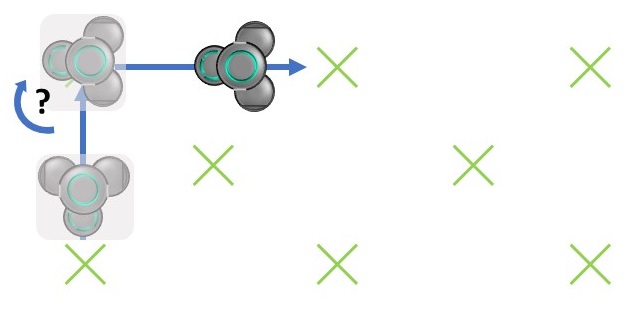
Say, “In order to program your Cue organism to navigate the ecosystem activity, you will need a good understanding of which angles are needed for each type of turn. Let’s practice together to get a feel for how Cue responds to different angled turns that we can program. What is the angle we would need to program to have Cue complete this turn?”
Place Cue in the starting location on the floor. Invite a student volunteer to program Cue to complete the turn while keeping the code hidden from the class.
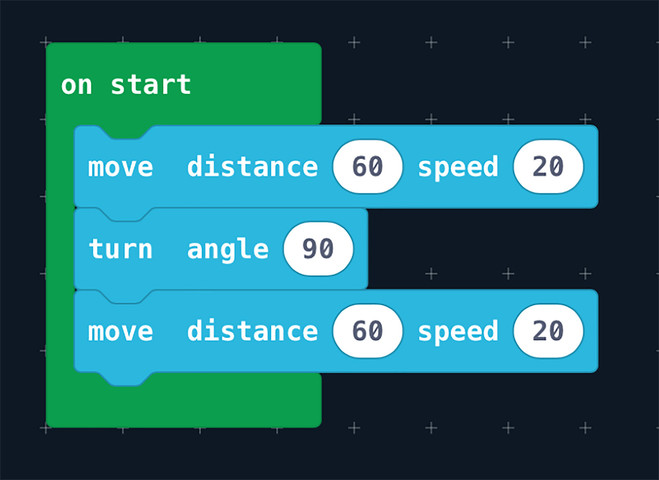
Sample response: “A 90 degree turn is necessary.”
Sample Program:
6. Project the image for the 135-degree turn, shown below.
135-degree turn:
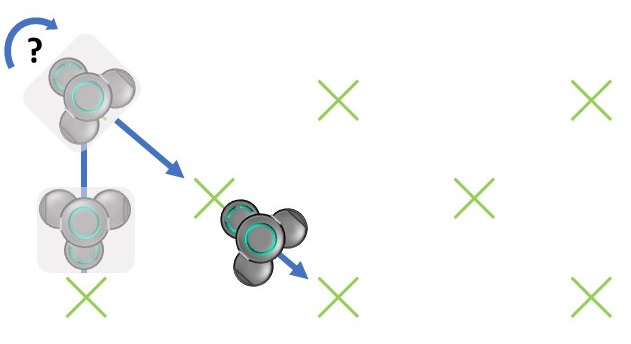
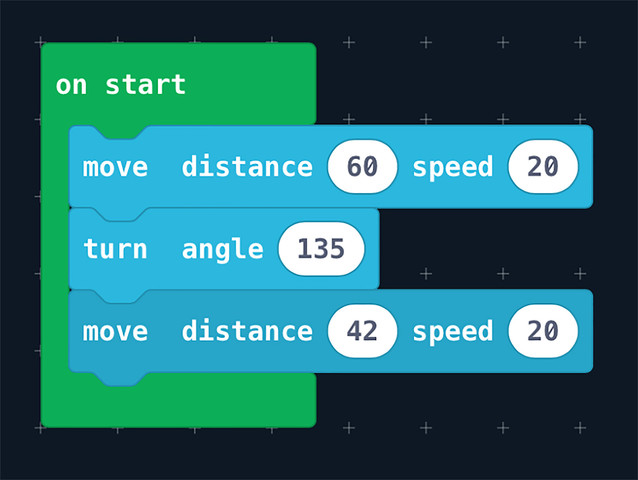
Ask, “What angle would we need to program to have Cue to complete this turn?”
Invite a student volunteer to program Cue to complete the turn while keeping the code hidden from the class.
Sample response: “A 135-degree turn is necessary.”
Sample Program:
1. Project the two mutualism path images, shown below.
Mutualism:
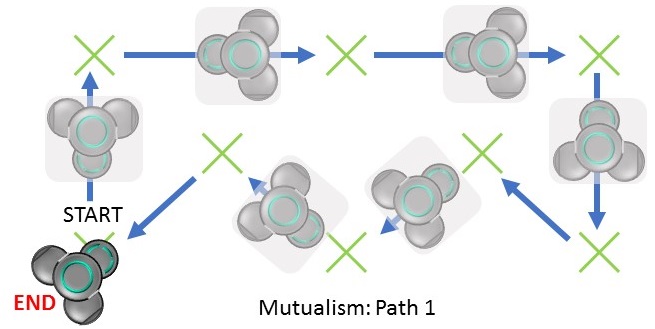
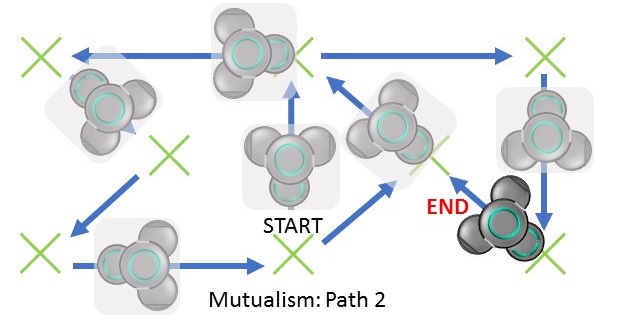
Say, “For the first activity, you will program Cue to follow a mutualistic interaction with the resource spots, much like a bee collecting nectar while distributing pollen between individual plants. Your goal is to create as many connections between individual resource spots as possible, without retracing any connections. You can land on resource spots more than once, as long as connected paths are not retraced.”
“Say, “In this example, Path 2 is better than Path 1 because it creates several spots with 3 or 4 connections, rather than only 2 connections for each spot. “
2. Pair students.
Distribute robots, devices, paper, and pencils.
Encourage students to plan their best path before programming by drawing out different paths on the sheet of paper. Allow time for students to create their mutualistic foraging programs and to experiment with different paths.
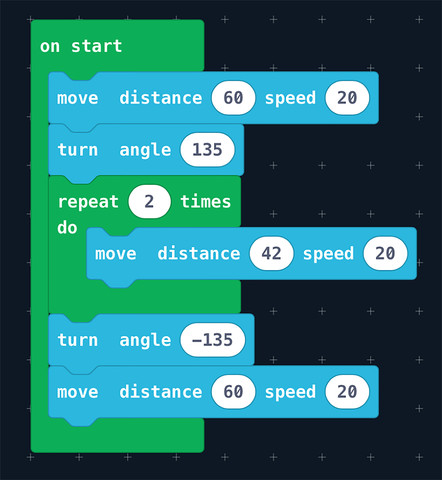
Example Solution:
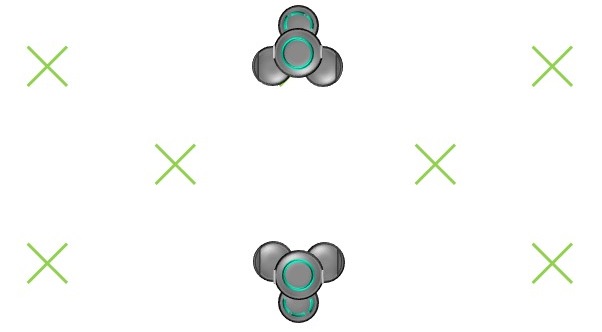
1. Say, “For the second activity, you will program Cue to engage in a competitive interaction with another group’s Cue as both ‘organisms’ forage for limited resources. Your goal is to have Cue reach as many resource spots as possible before running into the other Cue. Each resource spot can only be visited once. Once two Cues meet at a resource spot or all of the resources have been visited, the round is over.”
Project the competition image, shown below. Each Cue should begin in as shown in the image.
2. Pair each group with another group. Each group will compete for resources against the other group.
Groups should plan their routes separately, without seeing the opponent group’s code or communicating with them.
Allow groups to play several rounds against one another, with an opportunity to modify their code between rounds.
Note: The code for Activity 2 (Competition) will closely resemble the Activity 1 solution, using some combination of moving forward and turning at the correct angle, looping code where necessary.
Have students change the color of their Cue bot as they obtain more resources.
Have students create a custom “foraging” sound for each time they reach a new resource spot.
Experiment with different spatial orientations of resource spots during the mutualism activity.
Experiment with different starting locations for each Cue during the competition activity.
What are the three types of biotic interactions that were discussed? (Sample response: “Predation, competition, and mutualism.”)
Discuss how the spatial pattern of the resources in the activities could be considered abiotic. In nature, the distribution of resources are often determined by physical aspects of the environment, such as the quality of soil and the presence of physical barriers. Changing the orientation of the resources in our activities would change the behaviors that we programmed, as well as when and where our Cue organisms would interact, just like in a natural ecosystem.
Discuss what strategies were most effective during the competition activity. (Most likely, groups got more resources if they attempted to avoid the other group for as long as possible.)
How do you think competitive interactions might shape the behavior of animals in nature? (Sample response: “In nature, organisms that compete for limited resources tend to avoid direct conflict as much as possible because these interactions are often dangerous and cost a great deal of energy.”)
Use our Evaluation Rubric to review students’ work and presentations.
[Optional] Share your students’ work with the world using @logicsacademy and #Cue
MS-LS2-2: Construct an explanation that predicts patterns of interactions among organisms across multiple ecosystems.
CCSS.ELA-LITERACY.RST.6-8.3: Follow precisely a multistep procedure when carrying out experiments, taking measurements, or performing technical tasks.
CCSS.ELA-LITERACY.RST.6-8.4: Determine the meaning of symbols, key terms, and other domain-specific words and phrases as they are used in a specific scientific or technical context relevant to grades 6-8 texts and topics.
CCSS.ELA-LITERACY.RST.6-8.7: Integrate quantitative or technical information expressed in words in a text with a version of that information expressed visually (e.g., in a flowchart, diagram, model, graph, or table).
5c: Break problems into component parts, extract key information, and develop descriptive models to understand complex systems or facilitate problem-solving.
5d: Understand how automation works and use algorithmic thinking to develop a sequence of steps to create and test automated solutions.
6b: Create original works or responsibly repurpose or remix digital resources into new creations.
6c: Communicate complex ideas clearly and effectively by creating or using a variety of digital objects such as visualizations, models or simulations.
1B-AP-10: Create programs that include sequences, events, loops, and conditionals.
1B-AP-15: Test and debug (identify and fix errors) a program or algorithm to ensure it runs as intended.
1B-AP-16: Take on varying roles, with teacher guidance, when collaborating with peers during the design, implementation, and review stages of program development.
2-AP-15: Seek and incorporate feedback from team members and users to refine a solution that meets user needs.
2-AP-13: Decompose problems and subproblems into parts to facilitate the design, implementation, and review of programs.
2-AP-17: Systematically test and refine programs using a range of test cases.
SCIENCE INQUIRY
Students will:
identify one or more ways of finding answers to given questions
identify variables: identify the variable to be manipulated, identify variables to be held constant, identify the variable that will be observed (responding variable)
select appropriate materials and identify how they will be used
modify the procedures as needed
work individually or cooperatively in planning and carrying out procedures
PROBLEM SOLVING THROUGH TECHNOLOGY
General Learner Expectations:
6–3 Design and carry out an investigation of a practical problem, and develop a possible solution.
Students will:
communicate effectively with group members in sharing and evaluating ideas, and assessing progress
evaluate procedures used and identify possible improvements
evaluate a design or product, based on a given set of questions or criteria. The criteria/questions may be provided by the teacher or developed by the students. Example criteria include: effectiveness—Does it work?; reliability—Does it work every time; durability—Does it stand up to repeated use?; effort—Is it easy to construct? Is it easy to use?
CTF is planning, creating, appraising and communicating in response to challenges.
I plan in response to challenges.
I make decisions in response to challenges.
I adapt to change and unexpected events.
I solve problems in response to challenges.
I create products, performances or services in response to challenges.
I appraise the skills, knowledge and technologies used to respond to challenges.
I communicate my learning.
CTF is working independently and with others while exploring careers and technology.
I determine how my actions affect learning.
I develop skills that support effective relationships.
I collaborate to achieve common goals.
Questioning and Predicting:
Demonstrate a sustained curiosity about a scientific topic or problem of personal interest
Make observations in familiar or unfamiliar contexts
Planning and Conducting:
With support, plan appropriate investigations to answer their questions or solve problems they have identified
Use equipment and materials safely, identifying potential risks
Processing and Analyzing Data and Information:
Construct and use a variety of methods, including tables, graphs, and digital technologies, as appropriate, to represent patterns or relationships in data
Identify patterns and connections in data
Compare data with predictions and develop explanations for results
Demonstrate an openness to new ideas and consideration of alternatives
Communicating:
Communicate ideas, explanations, and processes in a variety of ways
Express and reflect on personal, shared, or others’ experiences of place
Applied Technologies:
- Select, and as needed learn about, appropriate tools and technologies to extend their capability to complete a task.
- Identify the personal, social, and environmental impacts, including unintended negative consequences, of the choices they make about technology use.
- Identify how the land, natural resources, and culture influence the development and use of tools and technologies.
Appreciation of Science
422 appreciate the role and contribution of science and technology in our understanding of the world
423 appreciate that the applications of science and technology can have advantages and disadvantages
Interest in Science
425 show a continuing curiosity and interest in a broad scope of science-related fields and issues
Scientific Inquiry
428 consider observations and ideas from a variety of sources during investigations and before drawing conclusions
429 value accuracy, precision, and honesty
430 persist in seeking answers to difficult questions and solutions to difficult problems
Collaboration
431 work collaboratively in carrying out investigations, as well as in generating and evaluating ideas
Grade 7 - Interactions Within Ecosystem
306-3 describe interactions between biotic and abiotic factors in an ecosystem
306-1 describe how energy is supplied to, and how it flows through, a food web
Initiating and Planning
with support (e.g., as a class or in small groups), generates a list of possible solutions to a practical problem and determines which are realistic in the classroom and/or the real world
outlines (individually or in small groups) the steps of a plan, including labelled drawings and/or diagrams, to solve the problem
establishing general criteria for evaluating objects or devices designed to solve the problem
Performing and Recording
carries out the pre-determined plan (individually or in pairs or small groups)
designs, builds, and tests (on the basis of pre-determined criteria) a device or an object to solve the problem
Analyzing and Interpreting
identifies and explains what changes could be made to the plan and how to improve the solution to the problem, and gives reasons for the changes
Communicating
describes orally, and/or using drawings, pictures, and/or simple sentences, the problem and how he or she solved it
Algebra
C3.1 solve problems and create computational representations of mathematical situations by writing and executing code, including code that involves conditional statements and other control structures
C3.2 read and alter existing code, including code that involves conditional statements and other control structures, and describe how changes to the code affect the outcomes and the efficiency of the code
Initiating and Planning
with support (e.g., as a class or in small groups), generates a list of possible solutions to a practical problem and determines which are realistic in the classroom and/or the real world
outlines (individually or in small groups) the steps of a plan, including labelled drawings and/or diagrams, to solve the problem
establishing general criteria for evaluating objects or devices designed to solve the problem
Performing and Recording
carries out the pre-determined plan (individually or in pairs or small groups)
designs, builds, and tests (on the basis of pre-determined criteria) a device or an object to solve the problem
Analyzing and Interpreting
identifies and explains what changes could be made to the plan and how to improve the solution to the problem, and gives reasons for the changes
Communicating
describes orally, and/or using drawings, pictures, and/or simple sentences, the problem and how he or she solved it
2.2 design and construct a model ecosystem (e.g., a composter, a classroom terrarium, a greenhouse), and use it to investigate interactions between the biotic and abiotic components in an ecosystem
2.4 use appropriate science and technology vocabulary, including sustainability, biotic, ecosystem, community, population, and producer, in oral and written communication
3.1 demonstrate an understanding of an ecosystem (e.g., a log, a pond, a forest) as a system of interactions between living organisms and their environment
3.2 identify biotic and abiotic elements in an ecosystem, and describe the interactions between them
3.3 describe the roles and interactions of producers, consumers, and decomposers within an ecosystem
Algebra
C3.1 solve problems and create computational representations of mathematical situations by writing and executing code, including code that involves events influenced by a defined count and/or sub-program and other control structures
C3.2 read and alter existing code, including code that involves events influenced by a defined count and/or sub-program and other control structures, and describe how changes to the code affect the outcomes and the efficiency of the code
Initiating and Planning
with support (e.g., as a class or in small groups), generates a list of possible solutions to a practical problem and determines which are realistic in the classroom and/or the real world
outlines (individually or in small groups) the steps of a plan, including labelled drawings and/or diagrams, to solve the problem
establishing general criteria for evaluating objects or devices designed to solve the problem
Performing and Recording
carries out the pre-determined plan (individually or in pairs or small groups)
designs, builds, and tests (on the basis of pre-determined criteria) a device or an object to solve the problem
Analyzing and Interpreting
identifies and explains what changes could be made to the plan and how to improve the solution to the problem, and gives reasons for the changes
Communicating
describes orally, and/or using drawings, pictures, and/or simple sentences, the problem and how he or she solved it
Algebra
C3.1 solve problems and create computational representations of mathematical situations by writing and executing code, including code that involves the analysis of data in order to inform and communicate decisions
C3.2 read and alter existing code involving the analysis of data in order to inform and communicate decisions, and describe how changes to the code affect the outcomes and the efficiency of the code
Identify examples of science and technology-related careers and workplaces which require an understanding of the diversity of living things (e.g., naturalist, zoo keeper, palaeontologist, and wildlife biologist).
Use appropriate scientific terminology to communicate ideas about the diversity of living things (e.g., biotic, abiotic, kingdom, phylum, monera, protist, fungi, plant, animal, vertebrate, and invertebrate).
Illustrate the ecological organization of life within the biosphere, using specific examples of species, populations, communities, ecosystems, and biomes.
Examine the biotic and abiotic components of distant ecosystems using photographs, videos, or online resources.
Interpret interdependence within natural systems by constructing food chains and food webs to illustrate the interactions among producers, consumers, and decomposers in a particular ecosystem.
304-2 identify the roles of producers, consumers, and decomposers in a local ecosystem, and describe both their diversity and their interactions
306-3 describe interactions between biotic and abiotic factors in an ecosystem
LS1 Explain how different parts of an ecosystem interact and affect each other
7-1-01 Use appropriate vocabulary related to their investigations of interactions within ecosystems.
7-1-03 Identify abiotic and biotic components of ecosystems that allow particular organisms to survive.
P2: Students will be expected to use digital tools to develop ideas and original works in innovative ways.
TOC1: Students will be expected to
safely use many forms of current technology for learning with growing competence
demonstrate conceptual understanding of how information and communication technology, digital tools, and authorized networks support their learning
use terminology related to information and communication technology
Identify the roles of producers, consumers, and decomposers in a local ecosystem and describe both their diversity and their interactions
Describe interactions between biotic and abiotic factors in an ecosystem
GCO1: Students will be expected to design, develop, evaluate, and articulate technological solutions
GCO2: Students will be expected to operate and manage technological systems