
← Back to Library
Lesson PlanFreeEN

CyberPi: Meet the CyberPi

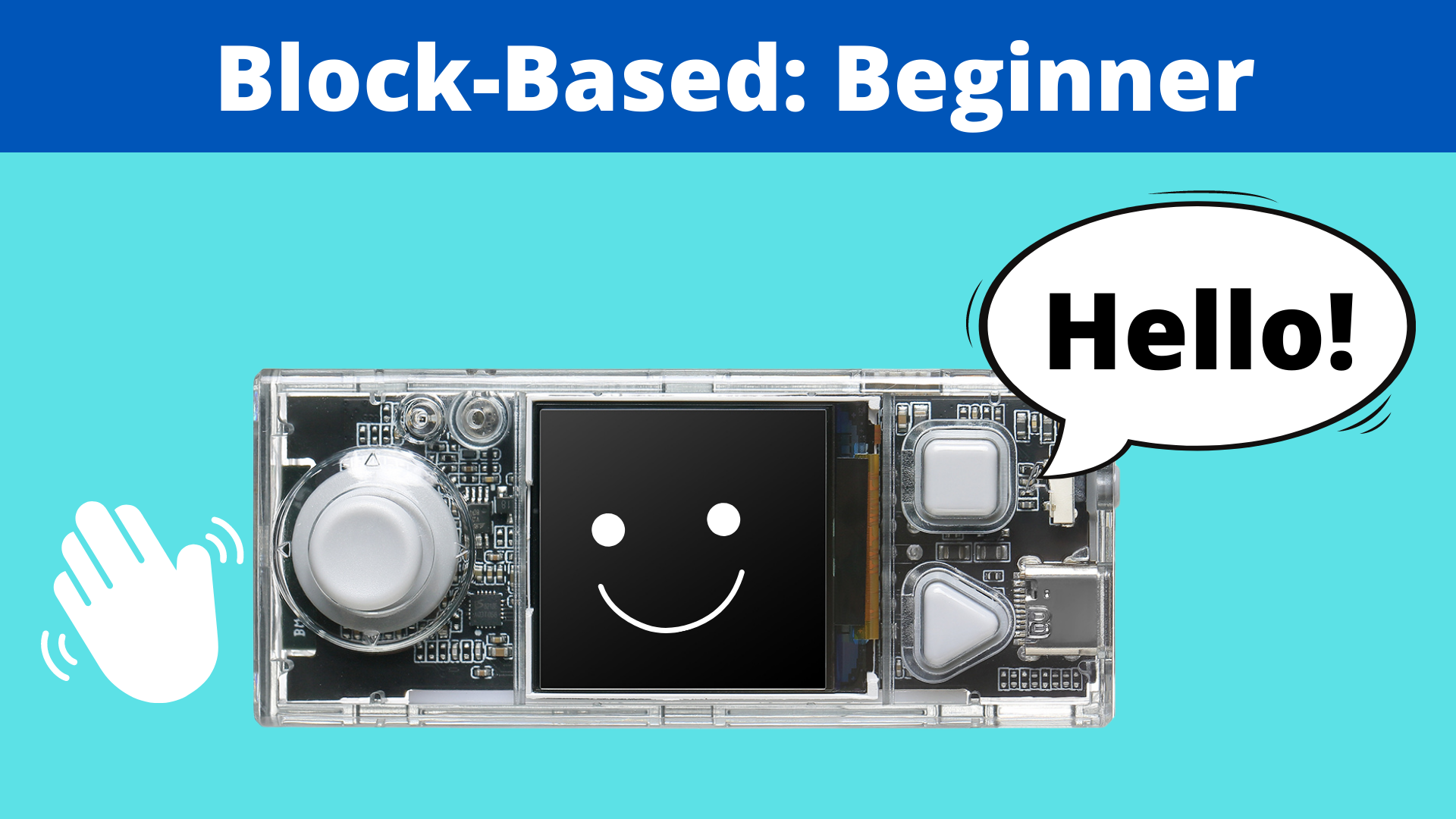
In this lesson, students will meet the CyberPi, a feature-rich micro-controller with a plethora of sensors, buttons and a full-colour screen display. They will discover a variety of key features of CyberPi through an exploration of sample programs in mBlock.
Gr. 6–8
CyberPi: Meet the CyberPi

Lesson

Overview

Description

In this lesson, students will meet the CyberPi, a feature-rich micro-controller with a plethora of sensors, buttons and a full-colour screen display. They will discover a variety of key features of CyberPi through an exploration of sample programs in mBlock.

Objectives

  • Identify key features of the CyberPi.

  • Connect a CyberPi to a computer using mBlock software.

  • Examine example programs for the CyberPi using the mBlock software

Before the Lesson

Preparation

For the teacher and students:

Review

Warm Up

Meet the CyberPi

1. Guide students through an unboxing of the CyberPi. Show the students the following components and have students locate them in their CyberPi Kit:

  • CyberPi

  • USB-C Cable

  • Pocket Shield (not included in Base Kit)

  • mBuild Sensors (not included in Base Kit)

2. Have students read the CyberPi box and the Quick Start Guide. Then, have students write a short summary listing what they have learned so far about the features and capabilities of the CyberPi.

Direct Instruction

Tour of mBlock 5

1. Open the mBlock software or mBlock 5 Web version.

2. Introduce students to the following key areas of the software interface:

Connect the CyberPi

3. Plug the CyberPi into the computer using the included cable. The CyberPi should boot up and the screen will display either the last program uploaded or the Home menu.

4. On the "Devices" tab in mBlock, click the "Add" button. Select CyberPi and click "Ok".

5. Click the "Connect" button. Then, select the USB port and click "Connect".

6. If connected successfully, the button will change to "Disconnect".

Guided Practice

Hands On

1. Notice, the CyberPi is connected in "Live" mode.

2. In the "Block Area", choose the "LED" category.

3. Click the

block. Observe the CyberPi as the LED strip displays the colours indicated.

Explore Example Programs

4. Click "Tutorials" in the upper right corner. Select "Example Programs".

5. Choose the "CyberPi" label to see example programs for the CyberPi.

6. Find and select the "Rainbow Lights" program.

7. Have students read the code and predict what will happen.

8. Connect the CyberPi in "Live" mode.

9. Click the

block. Observe the CyberPi as the LED strip displays the colours indicated. (Note, a glowing yellow border surrounds the script in the Script area indicating the script is running.) Click the blocks to stop the program.

10. Explain to students the difference between "Live" mode and "Upload" mode.

11. Switch the CyberPi to "Upload" mode and click the "Upload" button.

12. The "Upload Progress" window will appear and will disappear when uploading is complete. The CyberPi will reboot and observe the "Rainbow Lights" program. Every time the CyberPi starts up, the "Rainbow Lights" program will run.

Independent Practice

Try It

Explore Example Programs

1. Instruct students to explore 3 of the remainder of the example programs included with mBlock. Some suggestions include:

  • Buzzer

  • Twinkle Twinkle Little Star

  • Voice Reactive Lights

  • Trigger Reminder

  • Simple Timer

  • Step Counter

  • Motion-sensing Chart

2. While they review the projects, have them document the following for each program they explore:

  • Write a description of the program.

  • Identify which components of the CyberPi are used for each task of the program.

  • Make inferences about what portions of the project code does.

Extension

If students need additional support using mBlock, consider having the students complete the mBlock 5 Getting Started Activities. On the top right corner under "Tutorials" you can find pre-built example programs. They are simple mBlock programs with simple explanations that will allow students to explore mBlock in an interactive way.

Wrap Up

Wrap-Up & Quick Check

Reflection & Brainstorming

1. Facilitate a discussion for students to share about their favourite example projects. Encourage students to identify the CyberPi features and capabilities they are most excited to learn about.

2. Have students document what they hope to learn while completing these lessons and any questions they may have.

3. Now that students have seen some examples of the CyberPi in action, encourage them to brainstorm ideas for a problem in their daily life that they want to solve using the CyberPi and mBlock.

Educational Standards

ISTE

ISTE

  • 6a: Students choose the appropriate platforms and tools for meeting the desired objectives of their creation of communication.

K12 CS Framework

K12 CS Framework

  • Practice 2-1: Cultivate working relationships with individuals possessing diverse perspectives, sills, and personalities.

Alberta - Grade 6-8 - CTF

Grade 6-8

CTF

- Planning, creating, appraising and communicating in response to challenges. 

- Working independently and with others while exploring careers and technology.

British Columbia - Grade 6-8 - ADST

Grade 6-7

ADST

• Generate potential ideas and add to others’ ideas 

• Identify and evaluate the skills and skill levels needed, individually or as a group, in relation to a specific task, and develop them as needed 

• Select, and as needed learn about, appropriate tools and technologies to extend their capability to complete a task 

Grade 8

ADST

• Generate potential ideas and add to others’ ideas 

• Make a plan for production that includes key stages, and carry it out, making changes as needed

• Identify and evaluate the skills and skill levels needed, individually or as a group, in relation to a specific task, and develop them as needed

• Select, and as needed learn about, appropriate tools and technologies to extend their capability to complete a task

Manitoba - Grade 6-8 - Science

Grade 6

Science (Overall Skills and Attitudes)

  • 6-0-4a: Carry out procedures that comprise a fair test. Include: controlling variables; repeating measurements to increase accuracy and reliability.

  • 6-0-4c: Work cooperatively with group members to carry out a plan, and troubleshoot problems as they arise.

Grade 7

Science (Overall Skills and Attitudes)

  • 7-0-4a: Carry out procedures that comprise a fair test. Include: controlling variables, repeating experiments to increase accuracy and reliability

  • 7-0-4c: Work cooperatively with team members to carry out a plan, and troubleshoot problems as they arise.

Grade 8

Science (Overall Skills and Attitudes)

  • 8-0-4a: Carry out procedures that comprise a fair test. Include: controlling variables, repeating experiments to increase accuracy and reliability

  • 8-0-4c: Work cooperatively with team members to carry out a plan, and troubleshoot problems as they arise.

New Brunswick - Grade 6-8 - Science

Grade 6-8

Science (Attitude Outcome)

  • 425: show a continuing curiosity and interest in a broad scope of science-related fields and issues

  • 430: persist in seeking answers to difficult questions and solutions to difficult problems

  • 431: work collaboratively in carrying out investigations, as well as in generating and evaluating ideas

Newfoundland & Labrador - Grade 6-8 - Science

Grade 6-8

Science

  • GCO: Skills - Students will develop the skills required for scientific and technological inquiry, for solving problems, for communicating scientific ideas and results, for working collaboratively, and for making informed decisions.

Nova Scotia - Grade 6-8 - Mathematics & ICT/Technology

Grade 6

Mathematics

N09 Students will be expected to explain and apply the order of operations, excluding exponents, with and without technology (limited to whole numbers). 

Performance Indicators: 

N09.01 Demonstrate and explain, with examples, why there is a need to have a standardized order of operations. 

N09.02 Apply the order of operations to solve multi-step problems with or without technology (e.g., computer, calculator). 

PR03 Students will be expected to represent generalizations arising from number relationships using equations with letter variables. 

Performance Indicators: 

SCO PR03 Students will be expected to represent generalizations arising from number relationships using equations with letter variables. [C, CN, PS, R, V] 

PR03.01 Write and explain the formula for finding the perimeter of any regular polygon. 

PR03.02 Write and explain the formula for finding the area of any given rectangle. 

PR03.03 Develop and justify equations using letter variables that illustrate the commutative property of addition and multiplication (e.g., a + b = b + a or a × b = b × a). 

PR03.04 Describe the relationship in a given table using a mathematical expression. 

PR03.05 Represent a pattern rule using a simple mathematical expression, such as 4d or 2n + 1. 

ICT

  • P2: Students will be expected to use digital tools to develop ideas and original works in innovative ways.

  • TOC1: Students will be expected to

* safely use many forms of current technology for learning with growing competence

* demonstrate conceptual understanding of how information and communication technology, digital tools, and authorized networks support their learning

* use terminology related to information and communication technology

Grade 7

Mathematics

PR05 Students will be expected to evaluate an expression given the value of the variable(s). 

Performance Indicator: 

PR05.01 Substitute a value for an unknown in a given expression and evaluate the expression. 

Technology

  • GCO1: Students will be expected to design, develop, evaluate, and articulate technological solutions

  • GCO2: Students will be expected to operate and manage technological systems

Grade 8

Technology

  • GCO1: Students will be expected to design, develop, evaluate, and articulate technological solutions

  • GCO2: Students will be expected to operate and manage technological systems

Ontario - Grade 6-8 - Mathematics

Grade 6

Mathematics

Algebra

  • C3.1 solve problems and create computational representations of mathematical situations by writing and executing code, including code that involves conditional statements and other control structures

Grade 7

Mathematics

Algebra

  • C3.1 solve problems and create computational representations of mathematical situations by writing and executing code, including code that involves events influenced by a defined count and/or sub-program and other control structures

Grade 8

Mathematics

Algebra

  • C3.1 solve problems and create computational representations of mathematical situations by writing and executing code, including code that involves the analysis of data in order to inform and communicate decisions

Prince Edward Island - Grade 6-8 - Science

Grade 6-8

Science

  • GCO: Skills - Students will develop the skills required for scientific and technological inquiry, for solving problems, for communicating scientific ideas and results, for working collaboratively, and for making informed decisions.

Quebec - Grade 6-8 - Science

Grade 6-8

Science (Strategies)

  • Exploring various ways of solving the problem

  • Exchanging information

  • Comparing different possible explanations for or solutions to a problem in order to assess them (e.g. full-group discussion)

Saskatchewan - Grade 6-8 - Science

Grade 6-8

Science (Goals)

  • Develop Scientific and Technological Skills – Students will develop the skills required for scientific and technological inquiry, problem solving, and communicating; for working collaboratively; and for making informed decisions.