Loading…
Loading…
Cue robots (1 per group)
tablets or compatible devices (1 per group)
Cue's Comic Strip (1 per group)
pencils (1 per student)
[Optional] coloured pencils (1 per group)
Before this lesson, it is recommended that students:
review the three main purposes of dialogue.
practice writing each of the three main types of dialogue.
practice recording custom sounds in the Cue app.
practice programming events in the Cue app.
Fully charge the devices and robots.
Install the Wonder Workshop Cue app on each tablet.
Review the three main purposes of dialogue in a narrative piece of writing:
1. To increase the tension in the story. This type of dialogue is often used in a high-action scene. For example:
 "Hey, do you smell smoke?" Bob asked.
 "Yes, and it's coming from under the door!" Jill said as she touched the door
  handle.
 "Ouch! It's hot! I think the house is on fire!"
 "There's only one way out," moaned Bob, looking at the third-floor window.
2. To move the story forward. This type of dialogue can be used in place of narration. Instead of narration that explains that the two children jumped out the window, this information can be shared dialogue. For example:
 "But I'm afraid of heights!" Jill cowered.
 "Don't be afraid. I'll be here. Just hold my hand," said Bob.
 "On the count of three," Jill stuttered.
 "One, two, three!" they both cried as they jumped.
3. To illustrate a character’s personality. In this same scene, Jill and Bob react very differently:
  "But I'm afraid of heights!" Jill cowered.
  "Don't be afraid. I'll be here. Just hold my hand," Bob said.
What can you tell about each of the characters from this dialogue? (Sample responses: Jill is fearful. Bob is brave and caring.)
1. Ask, “What is an event?” (Sample response: “An action that triggers Cue to perform the next statement in a program.”)
Ask, “When would it be useful to program an event?” (Sample response: “When I want to have control over when Cue performs the next statement.”)
Ask, “What blocks are used to program events in the Cue app?” (Sample response: “Obstacle sensors, sound sensors, and buttons.”)
2. Say, “In this lesson, you will program Cue to act out dialogue. What are some blocks from the Actions menu that could help you do this?” (Sample response: “Move distance, turn head, set face pattern, custom sound, and animate blocks.”)
Explain the goal of the lesson: Say, “During this lesson, you will first work with your group to sketch a comic strip of a dialogue between two characters. Then, you or one of your group members will play one character and you will program Cue to play the other. Your dialogue must accomplish at least one of the purposes of dialogue we reviewed: to increase the tension in your story, to move your story forward, or to illustrate the personalities of the characters in your story.”
1. Project Cue's Comic Strip on the whiteboard.
2. Elicit examples from the students to fill in the setting, characters, and problem in a scene. Example: In the park, two students are running away from a dinosaur.
3. Ask: "What should the main purpose of the dialogue in our scene be?" (Sample response: “Increasing the tension in the scene.”)
Write this purpose (and any others) next to “Purpose(s) of dialogue” on Cue’s Comic Strip.
4. Have students help you write the dialogue according to the intended purpose.
Place the dialogue inside of speech bubbles, as in a cartoon strip.
If desired/time permits, model sketching a simple illustration for one of the frames of dialogue.
5. Project your device’s screen and open the Cue app.
Navigate to the Code with Block and JavaScriptⓇ section.
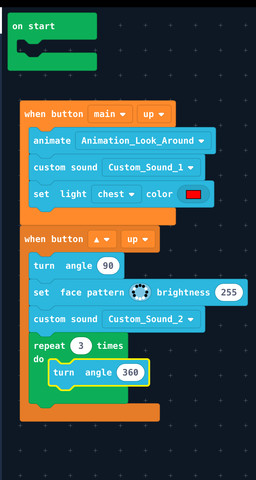
6. Model programming movement and turns using blocks from the Actions menu.
Model recording Cue’s dialogue using custom sounds.
7. Ask students what types of events they could include in their programs. (Sample responses: “Wait until front left obstacle seen, when button main is pressed, wait until clap heard.”)
Model programming Cue to interact with the other character in the scene, using events and/or the waitblock to initiate Cue's dialogue.
Invite students to help you program Cue.
8. Play the program and invite a student volunteer to read/act out the other character’s dialogue with Cue.
What are the three main purposes of dialogue? (Sample response: “To move a story forward, increase tension, or illustrate a character’s personality.”)
What are the objectives of this assignment? (Sample response: “To write a comic strip of a dialogue between two characters based on one of the main purposes of dialogue, and then to program Cue to speak the dialogue of one of those characters.”)
1. Divide students into small groups.
2. Distribute Cue's Comic Strips, pencils, and colored pencils (if using).
3. Have students work together to determine the setting, characters, problem, and purpose of the dialogue.
[Optional] Have students illustrate each dialogue exchange in their comic strip.
Check each pair's comic strip before allowing them to move onto programming.
4. Distribute robots and devices.
5. Have students work together to program Cue. Remind/encourage them to:
record Cue’s dialogue using custom sounds.
use events to initiate Cue’s dialogue.
program lights or movement to further express Cue’s dialogue.
6. Once groups have completed their programs, instruct them to determine roles. Who will be the director? Who will run the program? Who will act with Cue in the scene?
Circulate to assist and assess as students work.
7. Have students practice their scenes.
Have students translate their comic strip into the narrative form using the appropriate conventions and formatting rules of dialogue (e.g., indents, tags, quotation marks).
Have students incorporate weekly vocabulary words into a dialogue that accomplishes one of the three stated purposes.
Have students create an improvisational dialogue. Have them program Cue with a set of random words or phrases. Each time Cue says a random word/phrase, the student must ad lib the next line of dialogue using that word or phrase.
After students are finished programming Cue and practicing their scenes, have each group present their programmed scene to the class.
Encourage groups to give each other positive and constructive feedback on their scenes and programs.
Which type of dialogue is most common in stories?
What types of scenes require dialogue that increases tension? Give examples.
Some writers say, "Show, don't tell" when referring to the best way to write a scene. What do you think this means?
Why is it important to think about a character's nature or personality when writing dialogue?
How do the goals of each character affect his or her dialogue?
Use our Evaluation Rubric to review students’ work and presentations.
[Optional] Share your students’ work with the world using @logicsacademy and #Cue
CCSS.ELA-LITERACY.W.6.3.B: Use narrative techniques, such as dialogue, pacing, and description, to develop experiences, events, and/or characters.
P5.1: Design projects that combine hardware and software components to collect and exchange data.
P5.2: Design and iteratively develop programs that combine control structures, including nested loops and compound conditionals.
P3.2: Decompose problems and subproblems into parts to facilitate the design, implementation, and review of programs.
1A-AP-08: Model daily processes by creating and following algorithms (sets of step-by-step instructions) to complete tasks.
1A-AP-12: Develop a plan that describes a program’s sequence of events, goals, and expected outcomes.
1A-AP-10: Develop programs with sequences and simple loops, to express ideas or address a problem.
MS-ETS1-4: Develop a model to generate data for iterative testing and modification of a proposed object, tool, or process such that an optimal design can be achieved.
1A: Articulate and set personal learning goals, develop strategies leveraging technology to achieve them and reflect on the learning process itself to improve learning outcomes.
1B: Build networks and customize their learning environments in ways that support the learning process.
1C: Use technology to seek feedback that informs and improves their practice and to demonstrate their learning in a variety of ways.
4D: Exhibit a tolerance for ambiguity, perseverance and the capacity to work with open-ended problems.
5A: Formulate problem definitions suited for technology-assisted methods such as data analysis, abstract models and algorithmic thinking in exploring and finding solutions.
5C: Break problems into component parts, extract key information, and develop descriptive models to understand complex systems or facilitate problem-solving.
6C: Communicate complex ideas clearly and effectively by creating or using a variety of digital objects such as visualizations, models or simulations.
6D: Students publish or present content that customizes the message and medium for their intended audiences.
7A: Use collaborative technologies to work with others, including peers, experts or community members, to examine issues and problems from multiple viewpoints.
7C: Contribute constructively to project teams, assuming various roles and responses.
choose life themes encountered in reading, listening and viewing activities, and in own experiences, for creating oral, print and other media texts
use literary devices, such as imagery and figurative language, to create particular effects
determine purpose and audience needs to choose forms, and organize ideas and details in oral, print and other media texts
CTF is planning, creating, appraising and communicating in response to challenges.
I plan in response to challenges.
I make decisions in response to challenges.
I adapt to change and unexpected events.
I solve problems in response to challenges.
I create products, performances or services in response to challenges.
I appraise the skills, knowledge and technologies used to respond to challenges.
I communicate my learning.
CTF is working independently and with others while exploring careers and technology.
I determine how my actions affect learning.
I develop skills that support effective relationships.
I collaborate to achieve common goals.
choose appropriate strategies for generating ideas and focusing topics for oral, print and other media texts
use suspense, exaggeration, foreshadowing, dialogue and description to show rising action and develop conflict
create oral, print and other media texts that are unified by point of view, carefully developed plot and endings consistent with previous events
create a variety of oral, print and other media texts to explore ideas related to particular topics or themes
CTF is planning, creating, appraising and communicating in response to challenges.
I plan in response to challenges.
I make decisions in response to challenges.
I adapt to change and unexpected events.
I solve problems in response to challenges.
I create products, performances or services in response to challenges.
I appraise the skills, knowledge and technologies used to respond to challenges.
I communicate my learning.
CTF is working independently and with others while exploring careers and technology.
I determine how my actions affect learning.
I develop skills that support effective relationships.
I collaborate to achieve common goals.
create oral, print and other media texts related to issues encountered in texts and in own life
choose forms or genres of oral, print or other media texts for the particular affects they will have on audiences and purposes
CTF is planning, creating, appraising and communicating in response to challenges.
I plan in response to challenges.
I make decisions in response to challenges.
I adapt to change and unexpected events.
I solve problems in response to challenges.
I create products, performances or services in response to challenges.
I appraise the skills, knowledge and technologies used to respond to challenges.
I communicate my learning.
CTF is working independently and with others while exploring careers and technology.
I determine how my actions affect learning.
I develop skills that support effective relationships.
I collaborate to achieve common goals.
Comprehend and connect (reading, listening, viewing)
Recognize and appreciate how different features, forms, and genres of texts reflect different purposes, audiences, and messages
Think critically, creatively, and reflectively to explore ideas within, between, and beyond texts
Recognize and identify the role of personal, social, and cultural contexts, values, and perspectives in texts
Recognize how language constructs personal, social, and cultural identity
Construct meaningful personal connections between self, text, and world
Respond to text in personal, creative, and critical ways
Recognize how literary elements, techniques, and devices enhance and shape meaning
Recognize an increasing range of text structures and how they contribute to meaning
Create and communicate (writing, speaking, representing)
Exchange ideas and viewpoints to build shared understanding and extend thinking
Use writing and design processes to plan, develop, and create engaging and meaningful literary and informational texts for a variety of purposes and audiences
Assess and refine texts to improve their clarity, effectiveness, and impact according to purpose, audience, and message
Use an increasing repertoire of conventions of Canadian spelling, grammar, and punctuation
Use and experiment with oral storytelling processes
Select and use appropriate features, forms, and genres according to audience, purpose, and message
Transform ideas and information to create original texts.
Applied Technologies:
- Select, and as needed learn about, appropriate tools and technologies to extend their capability to complete a task.
- Identify the personal, social, and environmental impacts, including unintended negative consequences, of the choices they make about technology use.
- Identify how the land, natural resources, and culture influence the development and use of tools and technologies.
contribute thoughts, ideas, and questions to discussion and compare their own ideas with those of peers and others
ask and respond to questions to seek clarification or explanation of ideas and concepts
contribute to and respond constructively in conversation, small-group and whole-group discussion
make language choices to enhance meaning and achieve interesting effects in imaginative writing and other ways of representing
create written and media texts, using an increasing variety of forms
participate in small-group conversation and whole-class discussion, recognizing that there are a range of strategies that contribute to effective talk
follow instructions and respond to questions and directions
recognize that different situations (interviews, speeches, debates, conversation) require different speaking and listening conventions (questioning techniques, persuasive talk, formal language) appropriate to the situations
demonstrate an ability to integrate interesting effects in imaginative writing and other forms of representation, for example, thoughts and feelings in addition to external descriptions and activities; integrate detail that adds richness and density; identify and correct inconsistencies and avoid extraneous detail; make effective language choices relevant to style and purpose; and select more elaborate and sophisticated vocabulary and phrasing
demonstrate an awareness of how and when to integrate interesting effects in imaginative writing and other ways of representing; include thoughts and feelings in addition to external descriptions and activities; integrate detail that adds richness and density; identify and correct inconsistencies and avoid extraneous detail; make effective language choices relevant to style and purpose, and, when appropriate, select more elaborate and sophisticated vocabulary and phrasing
2.2 demonstrate an increasingly sophisticated understanding of appropriate speaking behaviour in a variety of situations, including paired sharing, dialogue, and small- and large-group discussions
2.4 use appropriate words and phrases from the full range of their vocabulary including inclusive and non-discriminatory language, and stylistic devices appropriate to the purpose and context, to communicate their meaning accurately and engage the interest of their intended audience
1.2 generate ideas about a potential topic and identify those most appropriate for the purpose
3.7 use a range of appropriate elements of effective presentation in the finished product, including print, script, different fonts, graphics, and layout
Algebra
C3.1 solve problems and create computational representations of mathematical situations by writing and executing code, including code that involves conditional statements and other control structures
C3.2 read and alter existing code, including code that involves conditional statements and other control structures, and describe how changes to the code affect the outcomes and the efficiency of the code
1.2 demonstrate an understanding of appropriate listening behaviour by adapting active listening strategies to suit a wide variety of situations, including work in groups
1.1 identify the topic, purpose, and audience for more complex writing forms
1.2 generate ideas about more challenging topics and identify those most appropriate for the purpose
Algebra
C3.1 solve problems and create computational representations of mathematical situations by writing and executing code, including code that involves events influenced by a defined count and/or sub-program and other control structures
C3.2 read and alter existing code, including code that involves events influenced by a defined count and/or sub-program and other control structures, and describe how changes to the code affect the outcomes and the efficiency of the code
1.2 demonstrate an understanding of appropriate listening behaviour by adapting active listening strategies to suit a wide variety of situations, including work in groups
1.1 identify the topic, purpose, and audience for more complex writing forms
1.2 generate ideas about more challenging topics and identify those most appropriate for the purpose
Algebra
C3.1 solve problems and create computational representations of mathematical situations by writing and executing code, including code that involves the analysis of data in order to inform and communicate decisions
C3.2 read and alter existing code involving the analysis of data in order to inform and communicate decisions, and describe how changes to the code affect the outcomes and the efficiency of the code
CC6.2 Select and use the appropriate strategies to communicate meaning before (e.g., identifying purpose and audience), during (e.g., acknowledging sources), and after (e.g., revising to enhance clarity) speaking, writing, and other representing activities.
CC6.4 Create and present a variety of representations that communicate ideas and information to inform or persuade and to entertain an audience, including illustrations, diagrams,posters, displays, and cartoons.
CC7.5 Create and present a variety of representations including visual and multimedia presentations such as displays, illustrations, and videos, and enhance communication withappropriate graphic organizers, charts, circle graphs, timelines, maps, and sound effects.
CC7.6 Use oral language to interact purposefully and appropriately with others in pairs, small groups, and large group situations (e.g., contributing to sustaining dialogue, expressing support for others and their viewpoints, discussing and analyzing ideas and opinions, completing a variety of tasks, and contributing to group consensus building).
CC7.8 Write to describe a person; to narrate an imaginary incident or story; to explain and inform in a news story, a factual account, and a business letter; to persuade in a letter and in interpretation of a text.
CC8.5 Create and present a variety of visual and multimedia presentations including an illustrated report, a role play that ends with a tableau, a dramatization, presentation software, a newscast with adequate detail, clarity, and organization to explain (e.g., an important concept), to persuade (e.g., an opinion on an issue, a mini-debate), and to entertain (e.g., a humourous incident).
CC8.8 Write to describe a landscape scene; to narrate a personal story or anecdote and a historical narrative; to explain and inform in a presentation of findings, a biography, a documented research report, and a résumé and covering letter; and to persuade in a mini-debate and a review.
GCO 4: Students will be expected to select, read, and view with understanding a range of literature, information, media and visual texts.
GCO 5: Students will be expected to interpret, select, and combine information using a variety and strategies, resources, and technologies.
P2: Students will be expected to use digital tools to develop ideas and original works in innovative ways.
TOC1: Students will be expected to
safely use many forms of current technology for learning with growing competence
demonstrate conceptual understanding of how information and communication technology, digital tools, and authorized networks support their learning
use terminology related to information and communication technology
GCO 4: Students will be expected to select, read, and view with understanding a range of literature, information, media and visual texts.
GCO 5: Students will be expected to interpret, select, and combine information using a variety and strategies, resources, and technologies.
GCO1: Students will be expected to design, develop, evaluate, and articulate technological solutions
GCO2: Students will be expected to operate and manage technological systems
During reading/viewing
Uses a variety of reading strategies to make meaning of different text types
Applies knowledge of cueing systems to construct meaning
Language as Sense Making
Access, use, build, and refine schema.
Select from and use a variety of strategies
Language as System
Recognize, apply, and adapt rules and conventions.
Identify, analyze, and apply understandings of whole-part-whole relationships.
Reading and Viewing
Interpret, select, and combine information using a variety of strategies, resources, and technologies
GCO 4: Students will be expected to select, read, and view with understanding a range of literature, information, media, and visual texts.
GCO 5: Students will be expected to interpret, select, and combine information using a variety of strategies, resources, and technologies