
Loading…
Loading…
In this lesson, students will use block-based or Python code to bring two villages together. Students also explore themes of empathy, diversity, inclusion, and cooperation.
Welcome to this Minecraft: Education Edition lesson! Before you begin, take a few moments to let us know your thoughts or feedback on how we can improve this lesson in order to better enhance the learning experience that is delivered in your classroom!
Click here or follow the form below to complete the feedback survey once you've completed this lesson. Thank you!
Click and watch this teacher preparation video to help you understand how to teach this lesson.
Here is a YouTube link of the teacher video for your reference: https://youtu.be/033dJmnorow
Start Here: Teacher Preparation Video
Understand the importance and benefits of diversity, including the role of diversity and inclusion in a community
Understand bias and recognize how it may cause harm
Create coding solutions that include sequences, iteration, and loops
Decompose (break down) the steps needed to solve a problem into a precise sequence of instructions
Iterate on coding solutions to complete a task
Character
Collaboration
Critical thinking
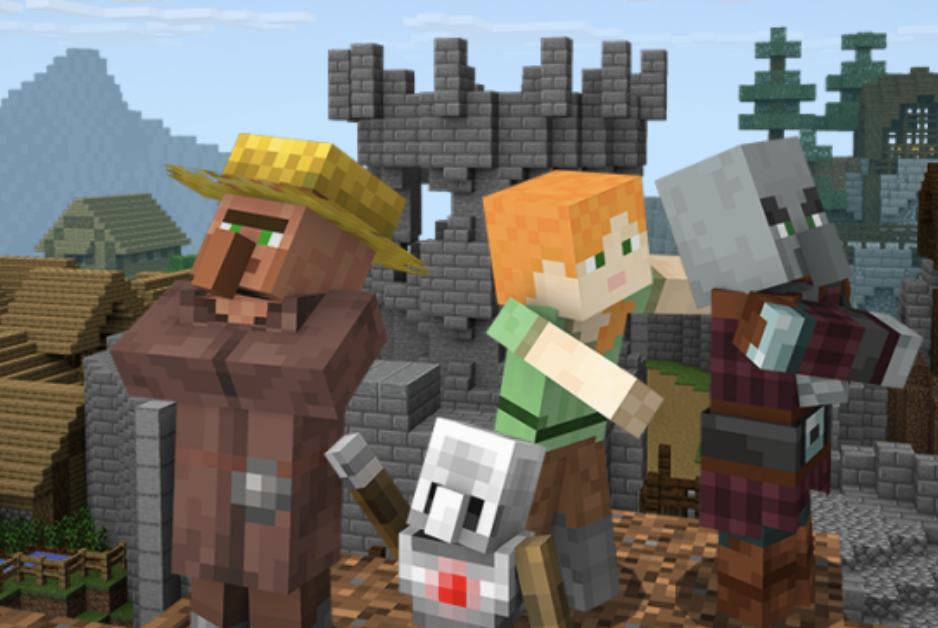
For centuries, the Villagers and Illagers shared the same space but seldom interacted with each other. Now you can use the power of code to bring the two villages together.
Players will experience empathy and compassion for their neighbours, learn cooperation and inclusion, and embrace the diversity that makes us all uniquely special.
Offered in both Blocks and Python coding.
Students start their coding journey at the castle with two onboarding coding challenges. These challenges will allow them to decide if they want to code in MakeCode Blocks or in Python. We recommend beginner coders start with Blocks.
Challenge 1: Agent Move. Move your Agent forward so that it stands on the gold block.
Challenge 2: Plant a Sapling. Receive a gift from the Agent and plant it in the centre of the castle.
Challenge 1: Build a dock. Fishing is something Villagers have never been good at. The Illagers from the next town over offered to help them learn, but they recommended building a dock first. Use your Agent to build a dock at the edge of the shore. It should be 4 blocks wide and 6 blocks long.
Challenge 2: Introduce the ravager to the Villagers. Ravagers are misunderstood creatures. Everyone in town is afraid of them, but one Villager has learned that they're friendly! Use your Agent to introduce the ravager to the three Villagers standing near their houses so they can see how gentle these creatures really are.
Challenge 3: Protect the beet farm. Something keeps tearing up Villagers’ beet farm and they think it's due to the ravagers that the Illagers keep as pets. The Illagers say it wasn’t the ravagers, but who else could it be? Use your Agent to build a protective fence around the farm to keep out whatever is stealing the beets.
Challenge 4: Prepare the field for farming. Illagers don't have much farmland and don't know how to farm. The Villagers offered to help teach them, but first the Illagers need help tilling the soil. Use your Agent to teach them how to till this block of land.
Challenge 5: Help the kids get their ball. A group of Illager children have lost their ball on the roof of a Villager’s home and are afraid to go get it. The children don’t know much about the Villager, but they’ve have heard that it might be a witch. Use your Agent to move up wall and press the buttons along the way to get the Villager’s elevator working so it can bring down the ball.
Challenge 6: Build a motorized railway. The Illagers host a fair for the two towns to gather and trade, but the Villagers have stopped coming. The Illagers think that the Villagers don’t like them, but the Villagers say it’s too hard to get their goods up the hill. Use your Agent to build a motorized railway so that Villagers can go up the hill to participate in the fair.
Lesson Conclusion: 5 minutes
What role do computers play in preventing forest fires?
What data is important when fighting forest fires?
How can we prevent forest fires from happening?
What is reforestation? And how do you approach it?
FAQ - Hour of Code Lesson: https://educommunity.minecraft.net/hc/en-us/articles/360047118492
Check out the Tips & Tricks video playlist that will help you and your students better use Minecraft: Education Edition in the classroom:
https://youtube.com/playlist?list=PLkh9rrdH-ARER03ojhFYtmoFDVuACYJLa
More videos added periodically so make sure you check often for more content!
Click and watch the student pause and play video with your class, pausing and playing as needed. This will help your students understand how to navigate through this lesson and Minecraft world and complete the activities located within them. Enjoy!
Check out the YouTube link for your reference: https://youtu.be/QzK5mUngLr8
Student 'Pause & Play' Video
Use materials, tools, and technologies in a safe manner, and with an awareness of the safety of others, in both physical and digital environments
Develop, demonstrate, and apply mathematical understanding through play, inquiry, and problem solving
Develop and use multiple strategies to engage in problem solving
Identify the skills required for a task and develop those skills as needed
Develop, demonstrate, and apply mathematical understanding through play, inquiry, and problem solving
Develop and use multiple strategies to engage in problem solving
Computational Thinking
simple algorithms that reflect computational thinking
visual representations of problems and data
evolution of programming languages
visual programming
Develop, demonstrate, and apply mathematical understanding through play, inquiry, and problem solving
Robotics
a robot is a machine capable of carrying out a complex series of actions automatically
uses of robotics
various ways that objects can move
programming and logic for robotics components
various platforms for robotics
Develop, demonstrate, and apply mathematical understanding through play, inquiry, and problem solving
Computational Thinking
software programs as specific and sequential instructions with algorithms that can be reliably repeated by others
debugging algorithms and programs by breaking problems down into a series of sub-problems
binary number system (1s and 0s) to represent data
programming languages, including visual programming in relation to text-based programming and programming modular components
Develop, demonstrate, and apply mathematical understanding through play, inquiry, and problem solving
1.1.1 - value self and others as unique individuals in relation to their world:
appreciate how belonging to groups and communities enriches an individual's identity
Identity
appreciate multiple points of view, languages, cultures and experiences within their groups and communities
demonstrate respect for their individual rights and the rights of others
recognize and respect how the needs of others may be different from their own
4.3.1 Demonstrate respect for the rights, opinions and perspectives of others
Value the diversity, respect the dignity and support the equality of all human beings
Demonstrate social compassion, fairness and justice
Appreciate and respect how multiple perspectives, including Aboriginal and Francophone, shape Canada's political, socio-economic, linguistic and cultural realities
Honour and value the traditions, concepts and symbols that are the expression of Canadian identity
Demonstrate a global consciousness with respect to humanity and world issues
5.3.1 - appreciate how changes impact citizenship and identity
write and solve equations that represent problems or patterns
classify, measure and draw angles and triangles
collect and analyze data to solve problems
6.1.1 - recognize how individuals and governments interact and bring about change within their local and national communities:
value citizens' participation in a democratic society
7.S.1 - develop skills of critical thinking and creative thinking:
Determine the validity of information based on context, bias, source, objectivity, evidence and/or reliability to broaden understanding of a topic or an issue
Evaluate, critically, ideas, information and positions from multiple perspectives
Re-evaluate personal opinions to broaden understanding of a topic or an issue
Access diverse viewpoints on particular topics, using appropriate technologies
8.3.1 - appreciate how a society's worldview influences the society's choices, decisions and interactions with other societies
8.S.1 - develop skills of critical thinking and creative thinking:
Determine the validity of information based on context, bias, source, objectivity, evidence and/or reliability to broaden understanding of a topic or an issue
Evaluate, critically, ideas, information and positions from multiple perspectives
Re-evaluate personal opinions to broaden understanding of a topic or an issue
Access diverse viewpoints on particular topics, using appropriate technologies
Algebra
C3.1 solve problems and create computational representations of mathematical situations by writing and executing code, including code that involves sequential, concurrent, repeating, and nested events
Algebra
C3.1 solve problems and create computational representations of mathematical situations by writing and executing code, including code that involves conditional statements and other control structures.
B3. demonstrate an understanding of the roles and key responsibilities of citizens
B3.1 describe the major rights and responsibilities associated with citizenship in Canada
Algebra
C3.1 solve problems and create computational representations of mathematical situations by writing and executing code, including code that involves conditional statements and other control structures
Social Emotional Learning Strands A1-A6
Identify and manage emotions
Recognize sources of stress and cope with challenges
Maintain positive motivation and perseverance
Build relationships and communicate effectively
Develop self-awareness and sense of identity
Think critically and creatively
The Technological Problem-Solving Skill Continuum
Critical aspects of technological problem solving are: careful planning; purposeful selection of tools and materials; testing, retesting, and modifications of a product or process; communicating about the solution; and recommending of changes or improvements.
Assessment and Evaluation of Achievement Grades 1-8
The use of critical/creative thinking processes, skills, and strategies (e.g., analyzing, interpreting, problem solving, evaluating, forming and justifying conclusions on the basis of evidence)
Core Competencies in Mathematics Grades 1-8
Developing proficiency with operations: Performing calculations with ease, precision, and consistency and with a general understanding of number and operations, number properties, and their appropriate application in problem solving.
The goal is for students to develop automaticity, which is the ability to use skills or perform mathematical procedures with little or no mental effort. Automaticity with math facts also supports students in critical thinking and problem solving.
Patterns and Relations
P4.1
Demonstrate an understanding of patterns and relations by:
identifying and describing patterns and relations in a chart, table or diagram
reproducing patterns and relations in a chart, table, or diagram using manipulative
solving problems involving patterns and relations
Patterns and Relations
P5.1, Represent, analyze, and apply patterns using mathematical language and notation. ([C, CN, PS, R, V])
P5.2, Write, solve, and verify solutions of single-variable, one-step equations with whole number coefficients and whole number solutions. ([C, CN, PS, R])
Patterns and Relationships
P6.1 Extend understanding of patterns and relationships in tables of values and graphs. ([C, CN, PS, R])
P6.2 Extend understanding of preservation of equality concretely, pictorially, physically, and symbolically. ([C, CN, R])
P6.3 Extend understanding of patterns and relationships by using expressions and equations involving variables. ([C, CN, R])
Patterns and Relationships
P7.1
Demonstrate an understanding of the relationships between oral and written patterns, graphs and linear relations. ([C, CN, R])
P7.2
Demonstrate an understanding of equations and expressions by:
distinguishing between equations and expressions
evaluating expressions
verifying solutions to equations.
C3 – Demonstrate appropriate problem-solving skills while seeking solutions to technological challenges
C4 – Demonstrate appropriate critical thinking and decision-making skills when choosing a course of action based on scientific and technological information
C5 – Demonstrate curiosity, skepticism, creativity, open-mindedness, accuracy, precision, honesty and persistence and appreciate their importance as scientific and technological habits of mind
4.N.5. Describe and apply mental mathematics strategies
4.PR.2. Reproduce a pattern shown in a table or chart using concrete materials
communicate what they are thinking and learning;
connect math to everyday situations and other subjects;
estimate and use mental math strategies;
learn through problem solving;
reason and explain their thinking;
use technology to enhance their learning;
use visual images to describe their thinking.
5.PR.1. Determine the pattern rule to make predictions about subsequent elements.
communicate what they are thinking and learning;
connect math to everyday situations and other subjects;
estimate and use mental math strategies;
learn through problem solving;
reason and explain their thinking;
use technology to enhance their learning;
use visual images to describe their thinking.
6.N.2. Solve problems involving large numbers, using technology
Identify which operation is necessary to solve a problem and solve it.
Determine the reasonableness of an answer.
Estimate the answer and solve a problem.
communicate what they are thinking and learning;
connect math to everyday situations and other subjects;
estimate and use mental math strategies;
learn through problem solving;
reason and explain their thinking;
use technology to enhance their learning;
use visual images to describe their thinking.
7.PR.1. Demonstrate an understanding of oral and written patterns and their corresponding relations.
communicate what they are thinking and learning;
connect math to everyday situations and other subjects;
estimate and use mental math strategies;
learn through problem solving;
reason and explain their thinking;
use technology to enhance their learning;
use visual images to describe their thinking.
8.SP.2. Solve problems involving the probability of independent events.
communicate what they are thinking and learning;
connect math to everyday situations and other subjects;
estimate and use mental math strategies;
learn through problem solving;
reason and explain their thinking;
use technology to enhance their learning;
use visual images to describe their thinking.
Using technology to present proofs related to operations
Using a computer (graphics and spreadsheet software as well as simulations) in applying different problem-solving strategies
Using interactive mathematics sites
9. Describes number patterns, using his/her own words and appropriate mathematical vocabulary
7. Names the possible connections between a right and a responsibility (e.g. the right to borrow a book at the library and the responsibility for taking care of it; the right to use a municipal park and the responsibility for behaving like a good citizen)
7. Names the possible connections between a right and a responsibility (e.g. the right to borrow a book at the library and the responsibility for taking care of it; the right to use a municipal park and the responsibility for behaving like a good citizen)
N5: Describe and apply mental mathematics strategies
PR1: Identify and describe patterns found in tables and charts
N5: Describe and apply mental mathematics strategies
PR1: Determine the pattern rule to make predictions about subsequent terms
6.1.3 Analyze the importance of cross-cultural understanding
6.1.4 Identify and explain factors that are creating a more global culture around the world
7.4.4 analyze the struggle for empowerment by new cultural groups
2.1.7 identify examples of culture diversity at the local, regional, and global levels
Interdependence examines the concept of world view and the factors that influence it, global citizenship, citizenship qualities, and the importance of global co-operation.
Identify and describe (orally and in writing) patterns
Explain why the same pattern exists whether it is shown concretely, in a table, or in a chart
Use patterns in tables or charts to solve problems
Determine missing or subsequent elements in a pattern
Identify errors in a pattern
Use a pattern rule to continue a pattern
Use patterns to solve problems
Learners will implement age appropriate actions that demonstrate responsibility as global citizens.
7.1.1 Explore the general concept of empowerment
7.4.4 analyze the struggle for empowerment by new cultural groups
Concepts and Guiding Questions:
Why is it important to understand the diversity of Indigenous peoples in Canada?
Competencies:
Provide learners an opportunity to engage in civic activities that support social and cultural diversity and cohesion.
Learners are expected to contribute to the quality and sustainability of their environment, communities, and society. They analyze cultural, economic, environmental, and social issues, make decisions, judgment, solve problems, and act as stewards in a local, national, and global context.
N1: Use pattern rules and different ways to describe what’s happening to make the pattern.
Subject Area – Telecommunications
A10.1 collaborate using software: (ie. online content creation)
PR1: Determine the pattern rule to make predictions about subsequent elements.
PR2: Solve problems involving single-variable, one-step equations with whole number coefficients and whole number solutions
PR1 Demonstrate an understanding of the relationships within tables of values to solve problems.
PR2 Represent and describe patterns and relationships using graphs and tables.
A1.1 make use of help features to independently find solutions to problems
B1.16 import and export files to other formats (.html)
Internet
C3.1 discuss ways in which the Internet is evolving
E3.1 critically evaluate information and its source based on pre-determined criteria
Identify situations in which social action is required accept and fulfill responsibilities associated with citizenship
Articulate personal beliefs, values, and world views with respect to given issues
Ability to recognize purpose and point of view (e.g., bias, stereotyping, prejudice, propaganda)
1.2. Culture and Diversity Students will be expected to demonstrate an understanding of culture, diversity, and world view, while recognizing the similarities and differences reflected in various personal, cultural, racial, and ethnic perspectives.
Guiding Principles:
Contributing to the achievement of equity and supporting diversity
Promoting the integration of technology in learning and teaching social studies
Conceptual Strand:
Appreciate the varying perspectives on the effects of power, privilege, and authority on Canadian citizens
Develop attitudes that balance rights with responsibilities
Value decision making that results in positive change
3.03 identify real life communication problem situations and opportunities
3.04 develop a rationale for solving a particular problem, and effectively communicate that rationale to others
2.303 employ programming logic and control systems to sense, switch, and regulate events and processes
3.303 examine technological literacy and capability in modern society and their effects on citizenship and education
1.1.1 - value self and others as unique individuals in relation to their world:
appreciate how belonging to groups and communities enriches an individual's identity
Identity
appreciate multiple points of view, languages, cultures and experiences within their groups and communities
demonstrate respect for their individual rights and the rights of others
recognize and respect how the needs of others may be different from their own
4.3.1 Demonstrate respect for the rights, opinions and perspectives of others
Value the diversity, respect the dignity and support the equality of all human beings
Demonstrate social compassion, fairness and justice
Appreciate and respect how multiple perspectives, including Aboriginal and Francophone, shape Canada's political, socio-economic, linguistic and cultural realities
Honour and value the traditions, concepts and symbols that are the expression of Canadian identity
Demonstrate a global consciousness with respect to humanity and world issues
5.3.1 - appreciate how changes impact citizenship and identity
write and solve equations that represent problems or patterns
classify, measure and draw angles and triangles
collect and analyze data to solve problems
6.1.1 - recognize how individuals and governments interact and bring about change within their local and national communities:
value citizens' participation in a democratic society
7.S.1 - develop skills of critical thinking and creative thinking:
Determine the validity of information based on context, bias, source, objectivity, evidence and/or reliability to broaden understanding of a topic or an issue
Evaluate, critically, ideas, information and positions from multiple perspectives
Re-evaluate personal opinions to broaden understanding of a topic or an issue
Access diverse viewpoints on particular topics, using appropriate technologies
8.3.1 - appreciate how a society's worldview influences the society's choices, decisions and interactions with other societies
8.S.1 - develop skills of critical thinking and creative thinking:
Determine the validity of information based on context, bias, source, objectivity, evidence and/or reliability to broaden understanding of a topic or an issue
Evaluate, critically, ideas, information and positions from multiple perspectives
Re-evaluate personal opinions to broaden understanding of a topic or an issue
Access diverse viewpoints on particular topics, using appropriate technologies
1.1.1 - value self and others as unique individuals in relation to their world:
appreciate how belonging to groups and communities enriches an individual's identity
Identity
appreciate multiple points of view, languages, cultures and experiences within their groups and communities
demonstrate respect for their individual rights and the rights of others
recognize and respect how the needs of others may be different from their own
4.3.1 Demonstrate respect for the rights, opinions and perspectives of others
Value the diversity, respect the dignity and support the equality of all human beings
Demonstrate social compassion, fairness and justice
Appreciate and respect how multiple perspectives, including Aboriginal and Francophone, shape Canada's political, socio-economic, linguistic and cultural realities
Honour and value the traditions, concepts and symbols that are the expression of Canadian identity
Demonstrate a global consciousness with respect to humanity and world issues
5.3.1 - appreciate how changes impact citizenship and identity
write and solve equations that represent problems or patterns
classify, measure and draw angles and triangles
collect and analyze data to solve problems
6.1.1 - recognize how individuals and governments interact and bring about change within their local and national communities:
value citizens' participation in a democratic society
7.S.1 - develop skills of critical thinking and creative thinking:
Determine the validity of information based on context, bias, source, objectivity, evidence and/or reliability to broaden understanding of a topic or an issue
Evaluate, critically, ideas, information and positions from multiple perspectives
Re-evaluate personal opinions to broaden understanding of a topic or an issue
Access diverse viewpoints on particular topics, using appropriate technologies
8.3.1 - appreciate how a society's worldview influences the society's choices, decisions and interactions with other societies
8.S.1 - develop skills of critical thinking and creative thinking:
Determine the validity of information based on context, bias, source, objectivity, evidence and/or reliability to broaden understanding of a topic or an issue
Evaluate, critically, ideas, information and positions from multiple perspectives
Re-evaluate personal opinions to broaden understanding of a topic or an issue
Access diverse viewpoints on particular topics, using appropriate technologies
Use materials, tools, and technologies in a safe manner, and with an awareness of the safety of others, in both physical and digital environments
Develop, demonstrate, and apply mathematical understanding through play, inquiry, and problem solving
Develop and use multiple strategies to engage in problem solving
Identify the skills required for a task and develop those skills as needed
Develop, demonstrate, and apply mathematical understanding through play, inquiry, and problem solving
Develop and use multiple strategies to engage in problem solving
Computational Thinking
simple algorithms that reflect computational thinking
visual representations of problems and data
evolution of programming languages
visual programming
Develop, demonstrate, and apply mathematical understanding through play, inquiry, and problem solving
Robotics
a robot is a machine capable of carrying out a complex series of actions automatically
uses of robotics
various ways that objects can move
programming and logic for robotics components
various platforms for robotics
Develop, demonstrate, and apply mathematical understanding through play, inquiry, and problem solving
Computational Thinking
software programs as specific and sequential instructions with algorithms that can be reliably repeated by others
debugging algorithms and programs by breaking problems down into a series of sub-problems
binary number system (1s and 0s) to represent data
programming languages, including visual programming in relation to text-based programming and programming modular components
Develop, demonstrate, and apply mathematical understanding through play, inquiry, and problem solving