
Loading…
Loading…
In this lesson, students will begin to identify arithmetic patterns, including patterns in the addition table or multiplication table, and explain them using properties of operations.
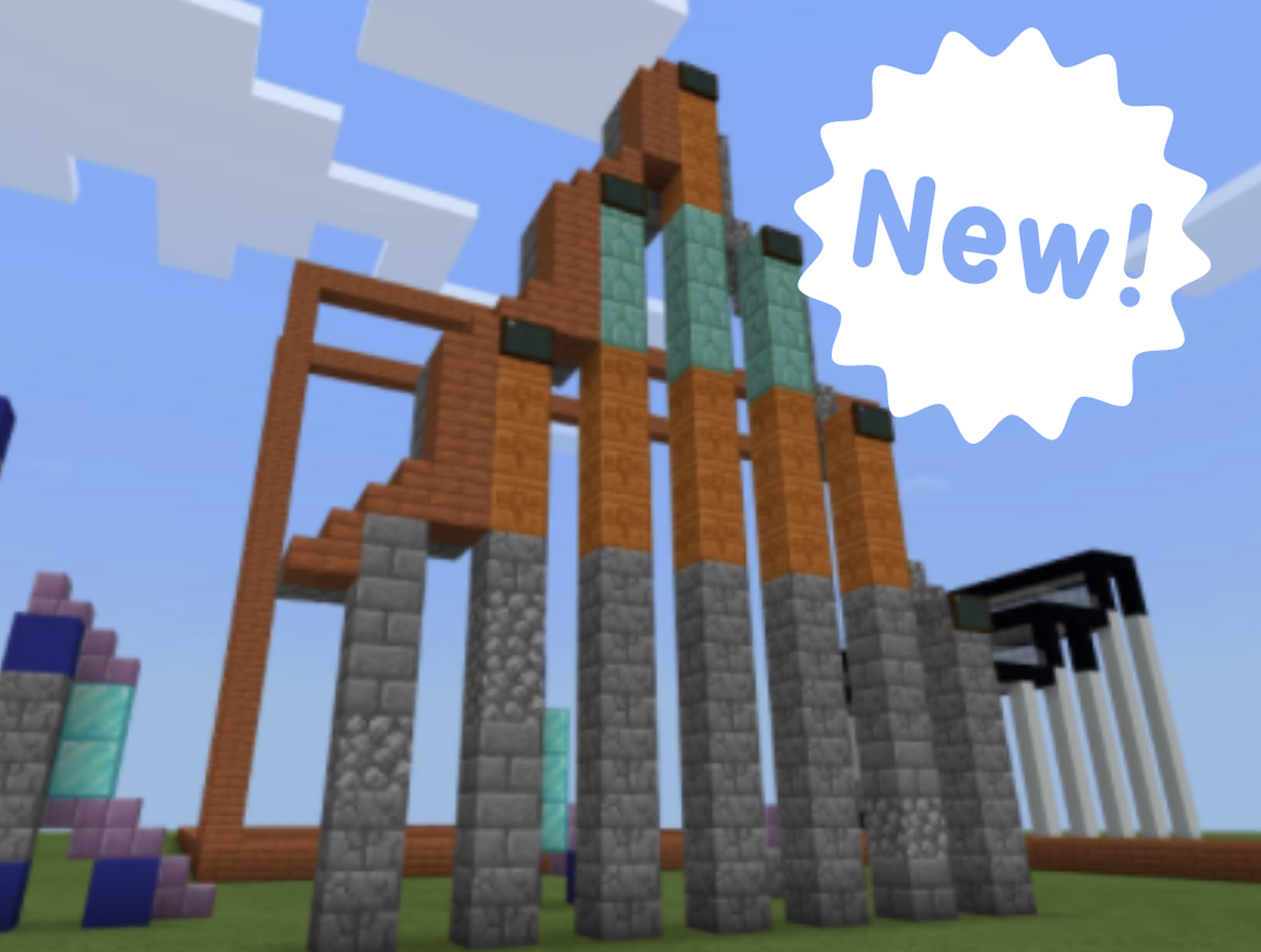
Welcome to this Minecraft: Education Edition lesson! Before you begin, take a few moments to let us know your thoughts or feedback on how we can improve this lesson in order to better enhance the learning experience that is delivered in your classroom!
Click here or follow the form below to complete the feedback survey once you've completed this lesson. Thank you!
Click and watch this teacher preparation video to help you understand how to teach this lesson. Here is a YouTube link of the teacher video for your reference: https://youtu.be/ds82Cx0ZZSM
Start Here: Teacher Preparation Video
Identify arithmetic patterns (including patterns in the addition table or multiplication table), and explain them using properties of operations.
Observe that 4 times a number is always even and explain why 4 times a number can be decomposed into two equal addends.
Creativity
Critical Thinking
Slideshow: Go through the slideshow (found in Supporting Files) and show the math models of the number pattern tower. When the student understands how they look like buildings, the students will enter the game world and ask how math is used in construction.
Students will explore the pre-made math models of number patterns and find the next set of numbers. Also, they will be given sets of numbers on slates and build a math model.
Students will then explore and study the architecture designs made from the number pattern math models and get ideas on what they want to build.
In the first building area, students will create and build a math model of a number pattern and push the clone button. The model will appear in the next build area where the students will finish the frame of their building. Push the clone button and the frame will appear in the third build area where the students will design and finish their structure.
Have students travel to their classmates’ worlds and ask:
1. What is their math pattern?
2. What can I learn from their design?
3. How can I improve their design?
Teacher facilitates a conversation about where we can find math in buildings.
The student was able to find and explain how number patterns grow.
The student was able to find the missing numbers in a number pattern.
The student was able to create their own number pattern tower.
The student was able to use the number pattern tower to create architecture.
The student was able to correctly complete and document all the number pattern problems in the Minecraft World.
The student was able to make connections with other number patterns in the tower; such as, they are all even or they are all the multiples of three.
The student was able to use a number pattern to build an architecture structure that is pleasing to the eye.
Check out the Tips & Tricks video playlist that will help you and your students better use Minecraft: Education Edition in the classroom:
https://youtube.com/playlist?list=PLkh9rrdH-ARER03ojhFYtmoFDVuACYJLa
More videos added periodically so make sure you check often for more content!
Click and watch the student pause and play video with your class, pausing and playing as needed. This will help your students understand how to navigate through this lesson and Minecraft world and complete the activities located within them. Enjoy!
Check out the YouTube link of this video for your reference: https://youtu.be/YvJL1R77pvU
Student 'Pause & Play' Video
PATTERNS AND RELATIONS (Patterns)
General Outcome : Use patterns to describe the world and to solve problems.
Specific Outcomes
Demonstrate an understanding of increasing and decreasing patterns by: • describing • extending • comparing • creating numerical (numbers to 1000) and non-numerical patterns using manipulatives, diagrams, sounds and actions.
PATTERNS AND RELATIONS (Variables and Equations)
General Outcome : Represent algebraic expressions in multiple ways.
Specific Outcomes
Solve one-step addition and subtraction equations involving a symbol to represent an unknown number.
PATTERNS AND RELATIONS (Variables and Equations)
General Outcome : Represent algebraic expressions in multiple ways.
Specific Outcomes
Express a given problem as an equation in which a symbol is used to represent an unknown number.
Solve one-step equations involving a symbol to represent an unknown number.
PATTERNS AND RELATIONS (Variables and Equations)
General Outcome : Represent algebraic expressions in multiple ways.
Specific Outcomes :
Express a given problem as an equation in which a letter variable is used to represent an unknown number (limited to whole numbers).
3. Solve problems involving single-variable, one-step equations with whole number coefficients and whole number solutions.
Identify needs and opportunities for designing, through exploration
Generate ideas from their experiences and interests
Add to others’ ideas
Choose an idea to pursue.
Making
Choose tools and materials
Make a product using known procedures or through modelling of others
Use trial and error to make changes, solve problems, or incorporate new ideas from self or others
Sharing
Decide on how and with whom to share their product
Demonstrate their product, tell the story of designing and making their product, and explain how their product contributes to the individual, family, community, and/or environment
Use personal preferences to evaluate the success of their design solutions
Reflect on their ability to work effectively both as individuals and collaboratively in a group
Use materials, tools, and technologies in a safe manner in both physical and digital environments
Develop their skills and add new ones through play and collaborative work
Explore the use of simple, available tools and technologies to extend their capabilities
Curricular Competencies
Develop mental math strategies and abilities to make sense of quantities
Use technology to explore mathematics
Understanding and solving
Develop, demonstrate, and apply mathematical understanding through play, inquiry, and problem solving
Content
Students are expected to know the following:
Regular increases and decreases in patterns: using words and numbers to describe increasing and decreasing patterns.
One-step equations: solving one-step equations with a variable;
Expressing a given problem as an equation, using symbols.
Identify needs and opportunities for designing, through exploration
Generate ideas from their experiences and interests
Add to others’ ideas
Choose an idea to pursue.
Making
Choose tools and materials
Make a product using known procedures or through modelling of others
Use trial and error to make changes, solve problems, or incorporate new ideas from self or others
Sharing
Decide on how and with whom to share their product
Demonstrate their product, tell the story of designing and making their product, and explain how their product contributes to the individual, family, community, and/or environment
Use personal preferences to evaluate the success of their design solutions
Reflect on their ability to work effectively both as individuals and collaboratively in a group
Use materials, tools, and technologies in a safe manner in both physical and digital environments
Develop their skills and add new ones through play and collaborative work
Explore the use of simple, available tools and technologies to extend their capabilities
Curricular Competencies
Develop mental math strategies and abilities to make sense of quantities
Use technology to explore mathematics
Understanding and solving
Develop, demonstrate, and apply mathematical understanding through play, inquiry, and problem solving
Content
Students are expected to know the following:
Regular increases and decreases in patterns: using words and numbers to describe increasing and decreasing patterns.
One-step equations: solving one-step equations with a variable;
Expressing a given problem as an equation, using symbols.
Patterns and Relations
Overall Expectation: C1. Patterns and Relationships identify, describe, extend, create, and make predictions about a variety of patterns, including those found in real-life contexts Specific expectations.
C1.1 Patterns identify and describe a variety of patterns involving geometric designs, including patterns found in real-life contexts.
C1.2 Patterns create and translate patterns using various representations, including shapes and numbers.
C1.3 Patterns determine pattern rules and use them to extend patterns, make and justify predictions, and identify missing elements in patterns represented with shapes and numbers.
Algebra
C3.1 solve problems and create computational representations of mathematical situations by writing and executing code, including code that involves sequential, concurrent, and repeating events
C3.2 read and alter existing code, including code that involves sequential, concurrent, and repeating events, and describe how changes to the code affect the outcomes
Patterns and Relations
C1.1 Patterns identify and describe repeating, growing, and shrinking patterns, including patterns found in real-life contexts.
C1.3 Patterns determine pattern rules and use them to extend patterns, make and justify predictions, and identify missing elements in repeating, growing, and shrinking patterns.
Algebra
C3.1 solve problems and create computational representations of mathematical situations by writing and executing code, including code that involves sequential, concurrent, and repeating events
C3.2 read and alter existing code, including code that involves sequential, concurrent, and repeating events, and describe how changes to the code affect the outcomes
Patterns and Relations
C1.2 Patterns create and translate repeating, growing, and shrinking patterns using various representations, including tables of values, graphs, and, for linear growing patterns, algebraic expressions and equations.
C1.3 Patterns determine pattern rules and use them to extend patterns, make and justify predictions, and identify missing elements in repeating, growing, and shrinking patterns, and use algebraic representations of the pattern rules to solve for unknown values in linear growing patterns.
Algebra
C3.1 solve problems and create computational representations of mathematical situations by writing and executing code, including code that involves sequential, concurrent, and repeating events
C3.2 read and alter existing code, including code that involves sequential, concurrent, and repeating events, and describe how changes to the code affect the outcomes.
Patterns and Relations
P3.1 Demonstrate understanding of increasing and decreasing patterns including: • observing and describing • extending • comparing • creating patterns using manipulatives, pictures, sounds, and actions.
P3.2 Demonstrate understanding of equality by solving one-step addition and subtraction equations involving symbols representing an unknown quantity.
Patterns and Relations
P4.1 Demonstrate an understanding of patterns and relations by: • identifying and describing patterns and relations in a chart, table or diagram • reproducing patterns and relations in a chart, table, or diagram using manipulatives • creating charts, tables, or diagrams to represent patterns and relations • solving problems involving patterns and relations
P4.2 Demonstrate an understanding of equations involving symbols to represent an unknown value by: • writing an equation to represent a problem • solving one step equations.
Patterns and Relations
P5.1 Represent, analyze, and apply patterns using mathematical language and notation.
P5.2 Write, solve, and verify solutions of single-variable, one-step equations with whole number coefficients and whole number solutions.
Patterns and Relations
P6.3 Extend understanding of patterns and relationships by using expressions and equations involving variables.
Patterns and Relations
3.PR.1 Demonstrate an understanding of increasing patterns by
· describing
· extending
· comparing
· creating patterns using manipulatives, diagrams, and numbers (to 1000).
Describe an increasing pattern by stating a pattern rule that includes the starting point and a description of how the pattern continues. Identify the pattern rule of an increasing pattern, and extend the pattern for the next three terms. Identify and explain errors in an increasing pattern. Identify and describe various increasing patterns found on a hundred chart, such as horizontal, vertical, and diagonal patterns. Compare numeric patterns of counting by 2s, 3s, 4s, 5s, 10s, 25s, and 100s. Create a concrete, pictorial, or symbolic representation of an increasing pattern for a pattern rule. Create a concrete, pictorial, or symbolic increasing pattern, and describe the pattern rule. Solve a problem using increasing patterns. Identify and describe increasing patterns in the environment. Identify and apply a pattern rule to determine missing elements for a pattern. Describe the strategy used to determine missing elements in an increasing pattern.
Patterns and Relations
4.PR.2 Reproduce a pattern shown in a table or chart using concrete materials.
Patterns and Relations
5.PR.1 Determine the pattern rule to make predictions about subsequent elements.
· Extend a pattern with or without concrete materials, and explain how each element differs from the preceding one. Describe, orally or in writing, a pattern using mathematical language, such as one more, one less, five more. Write a mathematical expression to represent a pattern, such as r + 1, r – 1, r + 5. Describe the relationship in a table or chart using a mathematical expression. Determine and explain why a number is or is not the next element in a pattern. Predict subsequent elements in a pattern. Solve a problem by using a pattern rule to determine subsequent elements. Represent a pattern visually to verify predictions.
Meaning of operations involving numbers
3. Uses objects, diagrams or equations to represent a situation and conversely, describes a situation represented by objects, diagrams or equations (use of different meanings of multiplication and division)
Natural Numbers
8. Determines the missing term in an equation
Patterns & Relations (PR): Use patterns to describe the world and solve problems
PR1: Demonstrate an understanding of increasing patterns by: • describing • extending • comparing • creating patterns using manipulatives, diagrams, sounds and actions (numbers to 1000).
PR2: Demonstrate an understanding of decreasing patterns by: • describing • extending • comparing • creating patterns using manipulatives, diagrams, sounds and actions (numbers to 1000).
PR3: Solve one-step addition and subtraction equations involving symbols representing an unknown number.
Patterns & Relations (PR): Use patterns to describe the world and solve problems
PR1: Identify and describe patterns found in tables and charts, including a multiplication chart.
PR2: Reproduce a pattern shown in a table or chart using concrete materials.
PR3: Represent and describe patterns and relationships using charts and tables to solve problems.
PR5: Express a given problem as an equation in which a symbol is used to represent an unknown number.
PR6: Solve one-step equations involving a symbol to represent an unknown number.
Patterns & Relations (PR): Use patterns to describe the world and solve problems
PR1: Determine the pattern rule to make predictions about subsequent terms (elements).
PR2: Solve problems involving single-variable, one-step equations with whole number coefficients and whole number solutions.
Patterns & Relations (PR): Use patterns to describe the world and solve problems
PR1: Demonstrate an understanding of the relationships within tables of values to solve problems.
PR2: Represent and describe patterns and relationships using graphs and tables.
PR3: Represent generalizations arising from number relationships using equations with letter variables.
PR4: Demonstrate and explain the meaning of preservation of equality concretely, pictorially and symbolically.
Patterns and Relations
PR01: Students will be expected to demonstrate an understanding of increasing patterns by describing, extending, comparing, and creating numerical (numbers to 1000) patterns and non-numerical patterns using manipulatives, diagrams, sounds, and actions.
PR01.01 identify and describe increasing patterns
PR01.02 describe a given increasing pattern by stating a pattern rule that includes the starting point and a description of how the pattern continues
PR01.03 extend a pattern, using the pattern rule, for the next three terms
PR01.05 identify and explain errors in a given increasing pattern
PR01.06 create a concrete, pictorial (both print and digital), or symbolic representation of an increasing pattern for a given pattern rule
PR01.07 create a concrete, pictorial (both print and digital), or symbolic increasing pattern and describe the pattern rule
PR01.09 identify and describe the strategy used to determine a missing term in a given increasing pattern
Patterns and Relations
PR01 Students will be expected to identify and describe patterns found in tables and charts, including a multiplication chart.
PR01.01 Identify and describe a variety of patterns in a multiplication chart.
PR01.02 Determine the missing element(s) in a given table or chart.
PR01.03 Identify the error(s) in a given table or chart.
PR01.04 Describe the pattern found in a given table or chart.
PR02 Students will be expected to translate among different representations of a pattern (a table, a chart, or concrete materials).
PR02.01 Create a table or chart from a given concrete representation of a pattern.
PR02.03 Translate between pictorial, contextual, and concrete representations of a pattern.
PR02.04 Explain why the same relationship exists between the pattern in a table and its concrete representation.
PR05 Students will be expected to express a given problem as an equation in which a symbol is used to represent an unknown number.
PR05.01 Explain the purpose of the symbol in a given addition, subtraction, multiplication, or division equation with one unknown (e.g., 36 ÷ � = 6).
PR05.02 Express a given pictorial or concrete representation of an equation in symbolic form.
PR05.03 Identify the unknown in a problem; represent the problem with an equation; and solve the problem concretely, pictorially, and/or symbolically.
Patterns and Relations
PR01: Students will be expected to determine the pattern rule to make predictions about subsequent terms.
PR01.02 describe, orally or in written form, a given pattern using mathematical language such as one more, one less, or five more
PR01.03 write a mathematical expression to represent a given pattern, such as r + 1, r – 1, r + 5
PR01.05 determine and explain why a given number is or is not the next term in a pattern
PR01.07 solve a given problem by using a pattern rule to determine subsequent terms
PR01.08 represent a given pattern visually to verify predictions
PR02: Students will be expected to solve problems involving single-variable, one-step equations with whole number coefficients and whole number solutions.
PR02.02 express a given pictorial or concrete representation of an equation in symbolic form.
PR02.03 express a given problem as an equation where the unknown is represented by a letter variable
Patterns & Relations
3PR1. Demonstrate an understanding of increasing patterns by: • describing • extending • comparing • creating patterns using manipulatives, diagrams, sounds and actions (numbers to 1000).
3PR2. Demonstrate an understanding of decreasing patterns by: • describing • extending • comparing • creating patterns using manipulatives, diagrams, sounds and actions (numbers to 1000).
Patterns & Relations
4PR2. Translate among different representations of a pattern, such as a table, a chart or concrete materials.
4PR3. Represent, describe and extend patterns and relationships, using charts and tables, to solve problems.
4PR4. Identify and explain mathematical relationships, using charts and diagrams, to solve problems.
4PR6 Solve one-step equations involving a symbol to represent an unknown number.
Patterns & Relations
5PR2 Solve Problems involving single-variable, one-step equations with whole number coefficients and whole number solutions.
Patterns & Relations
6PR4 Demonstrate and explain the meaning of preservation of equality, concretely and pictorially.
Patterns and Relations
PR1: Demonstrate an understanding of increasing patterns by: • describing • extending • comparing • creating patterns using manipulatives, diagrams, sounds and actions (numbers to 1000).
PR2: Demonstrate an understanding of decreasing patterns by: • describing • extending • comparing • creating patterns using manipulatives, diagrams, sounds and actions (numbers to 1000).
PR3: Solve one-step addition and subtraction equations involving symbols representing an unknown number.
Patterns and Relations
PR1: Identify and describe patterns found in tables and charts, including a multiplication chart.
PR2: Reproduce a pattern shown in a table or chart using concrete materials.
PR3: Represent and describe patterns and relationships using charts and tables to solve problems.
PR5: Express a given problem as an equation in which a symbol is used to represent an unknown number.
PR6: Solve one-step equations involving a symbol to represent an unknown number.
Patterns and Relations
PR1: Determine the pattern rule to make predictions about subsequent terms (elements).
PR2: Solve problems involving single-variable, one-step equations with whole number coefficients and whole number solutions.
Patterns and Relations
PR1: Demonstrate an understanding of the relationships within tables of values to solve problems.
PR2: Represent and describe patterns and relationships using graphs and tables.
PR3: Represent generalizations arising from number relationships using equations with letter variables.
PR4: Demonstrate and explain the meaning of preservation of equality concretely, pictorially and symbolically.