
Loading…
Loading…
In this lesson, students will use blocks and NPCs to solve increasingly difficult multiplication problems using arrays in a simple short project.
Welcome to this Minecraft: Education Edition lesson! Before you begin, take a few moments to let us know your thoughts or feedback on how we can improve this lesson in order to better enhance the learning experience that is delivered in your classroom!
Click here or follow the form below to complete the feedback survey once you've completed this lesson. Thank you!
Click and watch this teacher preparation video to help you understand how to teach this lesson. Check out the YouTube link as a reference: https://youtu.be/eUA2zRg3W5g
Start Here: Teacher Preparation Video
Use multiplication within 100 to solve word problems in situations involving arrays
Demonstrate an understanding of the Distributive Property of Multiplication.
Creativity
Critical Thinking
Some students struggle to learn how to multiply.
Using arrays makes it easier for the student to visualize the equation and how to easily arrive at the answer.
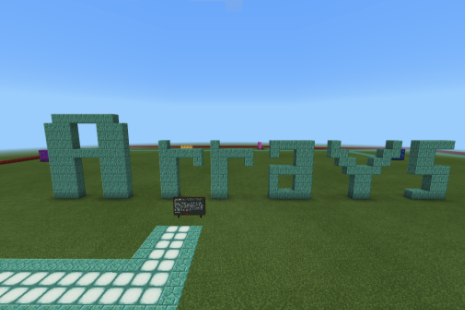
Using the efficient and colourful blocks in Minecraft to create arrays to help solve single digit and double digit multiplication problems.
NPCs guide the student through a simple map to solve increasingly difficult equations using arrays and the Distributive Property of multiplication.
To assist the student the NPCs provide a link to a helpful video which demonstrates the Distributive Property.
Students have to place a photo of their solution along with the typed equation and answer in their portfolio. The portfolio can be exported and sent to the teacher for review.
You will spawn before a sign with student directions. Their first stop is Janie and she gives the student a camera and portfolio and tells them what is expected. She also tells the student the name of the next NPC.
There are 10 NPCs altogether who have problems for the student to solve. Each time the student solves a problem, he/she will take a photo and under the photo in the portfolio type out the equation and answer.
After all 10 problems have been solved, the student can export their portfolio and send it to their teacher for review.
Extensions - Prodigy Learning Connections
Each student is expected to complete each problem and fill out their portfolio.
Along the way, as the problems get more difficult they are invited to watch a video explaining the Distributive Property of Multiplication.
As demonstrated in the video the array is divided into 2 groups to make solving simpler. When doing these problems the student is expected to use a fence of some variety to separate the 2 groups and show this in the work they put in their portfolio to demonstrate an understanding of the Distributive Property of Multiplication.
Check out the Tips & Tricks video playlist that will help you and your students better use Minecraft: Education Edition in the classroom:
https://youtube.com/playlist?list=PLkh9rrdH-ARER03ojhFYtmoFDVuACYJLa
More videos added periodically so make sure you check often for more content!
Click and watch the student pause and play video with your class, pausing and playing as needed. This will help your students understand how to navigate through this lesson and Minecraft world and complete the activities located within them. Enjoy!
Check out the YouTube link of this video for your reference: https://youtu.be/5ClpbYuCuH0
Student 'Pause & Play' Video
Multiply 2- or 3-digit numbers by 1-digit numbers
Understand and apply strategies for multiplication and related division facts to 9 x 9
Communicating and representing
Communicate mathematical thinking in many ways
Use mathematical vocabulary and language to contribute to mathematical discussions
Explain and justify mathematical ideas and decisions
Represent mathematical ideas in concrete, pictorial, and symbolic forms
Content
Multiplication and division of two- or three-digit numbers by one-digit numbers
Multiplication and division facts to 100 (introductory computational strategies)
Communicating and representing
Communicate mathematical thinking in many ways
Use mathematical vocabulary and language to contribute to mathematical discussions
Explain and justify mathematical ideas and decisions
Represent mathematical ideas in concrete, pictorial, and symbolic forms
Content
Multiplication and division of two- or three-digit numbers by one-digit numbers
Multiplication and division facts to 100 (introductory computational strategies)
Number
Key Concepts
The distributive property can be used to determine the product of two numbers. For example, to determine 8 × 7 one can rewrite 8 as 5 and 3 and find the sum of the products for 5 × 7 and 3 × 7 (i.e., 8 × 7 = (5 + 3) × 7 which equals (5 × 7) + (3 × 7), which is 35 + 21, or 56).
B2.1
Use the properties of operations, and the relationships between addition, subtraction, multiplication, and division, to solve problems involving whole numbers, including those requiring more than one operation, and check calculations.
B2.5
Represent and solve problems involving the multiplication of two- or three-digit whole numbers by one-digit whole numbers and by 10, 100, and 1000, using appropriate tools, including arrays.
N4.3
Demonstrate an understanding of multiplication of whole numbers (limited to numbers less than or equal to 10) by:
applying mental mathematics strategies
N4.4
Demonstrate an understanding of multiplication (2- or 3-digit by 1-digit) by:
using personal strategies for multiplication, with and without concrete materials
using arrays to represent multiplication
Understand and apply strategies for multiplication and related division facts to 9 x 9
Identify and apply different mental math strategies to determine a multiplication fact such as doubling, repeated doubling
Meaning of operations involving numbers
2. Counts collections (using objects or drawings)
c. counts a collection by grouping or regrouping
d. counts a pre-grouped collection
4. Represents natural numbers in different ways or associates a number with a set of objects or drawings emphasis on apparent, accessible groupings using objects, drawings or unstructured materials (e.g. tokens, nesting cubes, groups of ten objects placed inside a bag and ten of these bags placed inside another container.
5. Determines numerical equivalencies using relationships between:
Operations (the four operations), the commutative property of addition and multiplication, the associative property and the distributive property of multiplication over addition or subtraction
GCO: Number (N): Develop number sense
N5: Describe and apply mental mathematics strategies, such as:
skip counting from a known fact
using doubling or halving
using doubling or halving and adding or subtracting one more group
using patterns in the 9s facts to determine basic multiplication facts to 9 × 9 and related division facts
Choosing Instructional Strategies
Use the properties of multiplication in developing mental strategies: the associative property; e.g., (2 × 2) × 6 = 2 × (2 × 6); the commutative property: 3 × 4 is read 3 sets, or groups of 4; the product however, is the same if the factors are reversed (4 × 3); distributive property: 4 × 8 = (4 × 5) + (4 × 3) = 20 + 12 = 32
Number
multiply two- or three-digit whole numbers by one-digit numbers using concrete models, pictures, symbols, and personal strategies
Number
use mental mathematics strategies to make multiplication more efficient
continue to use personal strategies to multiply one-, two-, and three-digit numbers by a one-digit number
SCO 4N5
Describe and apply mental mathematics strategies, such as:
skip counting from a known fact
using doubling or halving
using doubling or halving and adding or subtracting one more group
using patterns in the 9s facts
using repeated doubling to determine basic multiplication facts to 9 X 9 and related division facts
SCO 5N4
Apply mental mathematics strategies for multiplication, such as:
annexing then adding zero
halving and doubling
using the distributive property
SCO 4N5
Describe and apply mental mathematics strategies, such as:
skip counting from a known fact
using doubling or halving
using doubling or halving and adding or subtracting one more group
using patterns in the 9s facts
using repeated doubling to determine basic multiplication facts to 9 X 9 and related division facts
SCO 5N4
Apply mental mathematics strategies for multiplication, such as:
annexing then adding zero
halving and doubling
using the distributive property