
Loading…
Loading…
In this lesson, students will design a bridge through a set of 6 build challenges.
Welcome to this Minecraft: Education Edition lesson! Before you begin, take a few moments to let us know your thoughts or feedback on how we can improve this lesson in order to better enhance the learning experience that is delivered in your classroom!
Click here or follow the form below to complete the feedback survey once you've completed this lesson. Thank you!
Click and watch this teacher preparation video to help you understand how to teach this lesson. Here is a YouTube link of the teacher video for your reference: https://youtu.be/yUXlcze9oak
Start Here: Teacher Preparation Video
Demonstrate understanding of the physical sciences involved in bridge building
Address various challenge requirements efficiently and effectively
Use recording tools of Minecraft to evidence progress, knowledge and understandings
Communication
Creativity
Critical thinking
What are the many different purposes of bridges?
What materials can bridges be made from?
Are some bridge designs stronger than others?
Are the aesthetics of bridges important or is it more about functionality?
How are Minecraft bridges similar and different to those in the ‘real world’?
Are different types of bridges more suited to traversing different types of terrain?
In the Minecraft world the children will work their way through a series of bridge build challenges with levels of increasing difficulty. Along the way there are things to discover and prizes to find. This lesson was the Minecraft component of a science/physics unit on bridge building during which different types of bridges were explored and constructed with material such as straws, newspaper, LEGO etc, having their strength and durability tested. The Minecraft challenges allow the students to demonstrate their understandings of the science/physics both in the world build, listening to peer conversations and through the teacher questioning students while building. Students can also evidence their learning and progress using tools in Minecraft. They can capture build images for each completed challenge (using the camera in the inventory) to create a portfolio of images. These images can then readily be captioned and included in a Minecraft book with either reflection and/or explanations of the physical sciences demonstrated in each build and any challenges they faced. These can then be exported to a classroom collection area or student class portfolio.
Challenge 1
Find your way out of the room and go to the first sign that details your first bridge build
Challenge 2
Build a bridge across the water to get to your friend’s house
Challenge 3
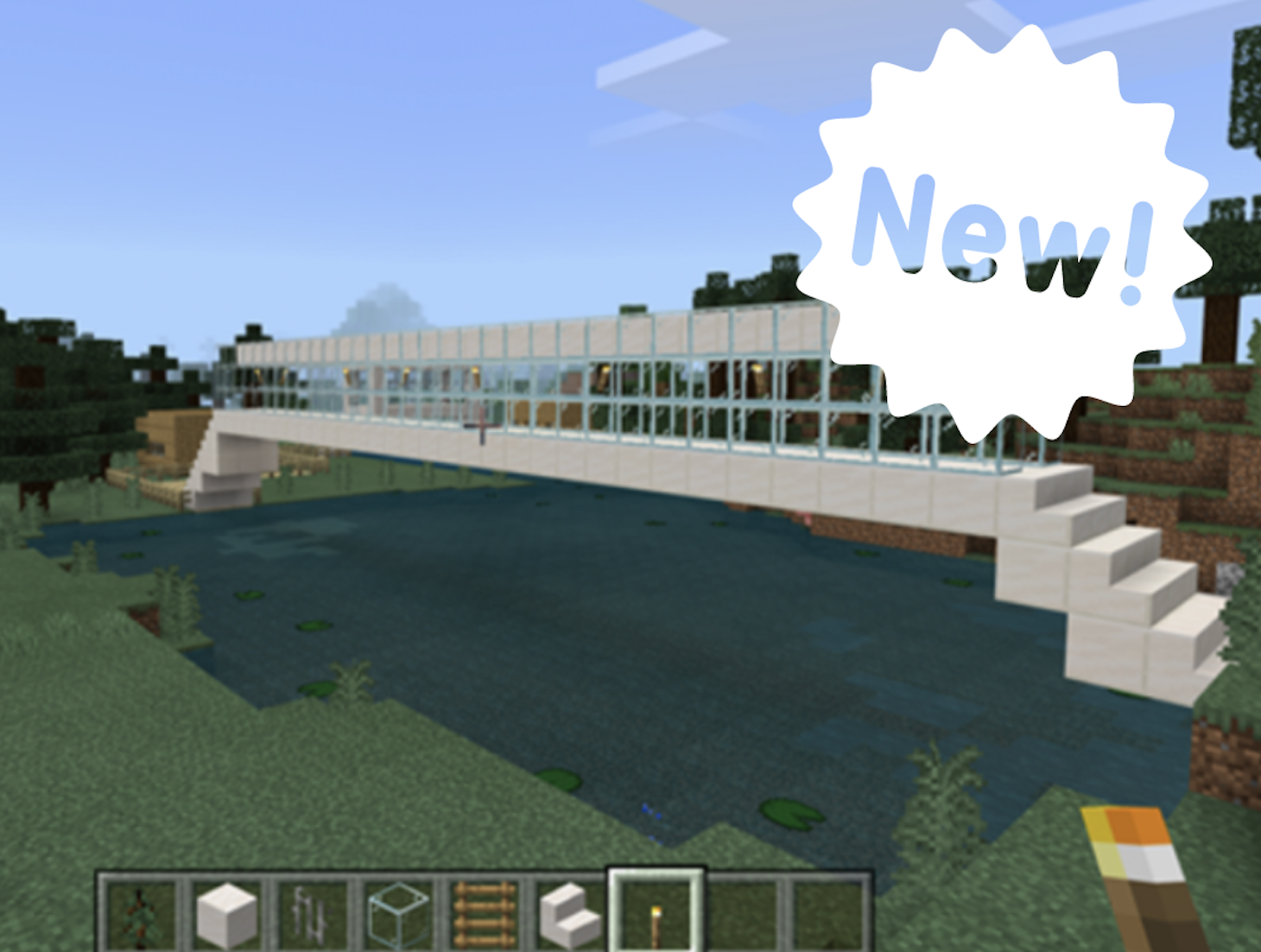
Build a bridge to the shops that will protect you from the weather and that is lit so that you can go to the shops at night
Challenge 4
Find the giant tree near the lava pit and go to the sheep paddock.
Build an arch bridge across the water that gets the sheep safely across to the larger paddock (it may need rails so the sheep don’t fall off into the water).
It also needs to be high enough to allow the person rowing the boat to fit under it.
Challenge 5
Go to where the tree-houses are … this is a school of the air but the classrooms aren’t connected
Build a ladder to get up to the rooms and connect all of the classrooms by building air bridges
Made a bridge from the last room back down to the stone path
Challenge 6
Build a 3m wide bridge the traverses the huge chasm to get to the village.
Explore the village when you get there to discover some hidden ‘surprises’
The gamified progress in the Bridge Building Challenge can be tracked in a physical class chart on a wall in the class to share progress along the 6 challenges. The Bridge Building Challenge could be a fitting assessment task on the end of the physical sciences unit if students develop a book to evidence their work and science understandings on each challenge.
Check out the Tips & Tricks video playlist that will help you and your students better use Minecraft: Education Edition in the classroom:
https://youtube.com/playlist?list=PLkh9rrdH-ARER03ojhFYtmoFDVuACYJLa
More videos added periodically so make sure you check often for more content!
Click and watch the student pause and play video with your class, pausing and playing as needed. This will help your students understand how to navigate through this lesson and Minecraft world and complete the activities located within them. Enjoy!
Check out the YouTube link for your reference: https://youtu.be/s2dlBC2rR0g
Student 'Pause & Play' Video
Identify the intended purpose and use of structures to be built and explain how knowing the intended purpose and use helps guide decisions regarding materials and design.
Recognize that functional structures must be sufficiently strong and stable and that unstable or weak structures are often unsafe to use.
Identify needs and opportunities for designing, through exploration
Generate ideas from their experiences and interests
Add to others’ ideas
Choose an idea to pursue.
Making
Choose tools and materials
Make a product using known procedures or through modelling of others
Use trial and error to make changes, solve problems, or incorporate new ideas from self or others
Sharing
Decide on how and with whom to share their product
Demonstrate their product, tell the story of designing and making their product, and explain how their product contributes to the individual, family, community, and/or environment
Use personal preferences to evaluate the success of their design solutions
Reflect on their ability to work effectively both as individuals and collaboratively in a group
Use materials, tools, and technologies in a safe manner in both physical and digital environments
Develop their skills and add new ones through play and collaborative work
Explore the use of simple, available tools and technologies to extend their capabilities
Curricular Competencies
Develop mental math strategies and abilities to make sense of quantities
Use technology to explore mathematics
Understanding and solving
Develop, demonstrate, and apply mathematical understanding through play, inquiry, and problem solving
Content
Students are expected to know the following:
The use of emotional and logical appeals to persuade
Use appropriate vocabulary related to their investigations of forces and structures.
Recognize that internal and external forces apply stress to structures and describe examples in which this stress has led to structural fatigue or structural failure.
Consider and choose writing forms that match both the writing purpose (to define, report, persuade, compare) and the reader for whom the text is intended (understand why language choice, organization, and voice used in an essay differ from that used in a media advertisement)
interview an engineer to explain how soil properties are important in building large structures such as bridges. (310-3)
Through their own writing, demonstrates a growing understanding that persuasive writing convinces the reader to another’s point of view (i.e. persuasive essay, commercial, print advertisement)
Design and manufacture of instruments, tools, machines, structures (e.g. bridges, towers), devices (e.g. water filtration device), models (e.g. glider) and simple circuits
Create and present a variety of representations that communicate ideas and information to inform or persuade and to entertain an audience, including illustrations, diagrams, posters, displays, and cartoons.
analyze personal, social, economic, and environmental factors that need to be considered in designing and building structures and devices
design and construct a variety of structures, and investigate the relationship between the design and function of these structures and the forces that act on them
demonstrate an understanding of the relationship between structural forms and the forces that act on and within them.
Buildings, highways, and bridges are examples of structures that require rocks and minerals.