
Loading…
Loading…
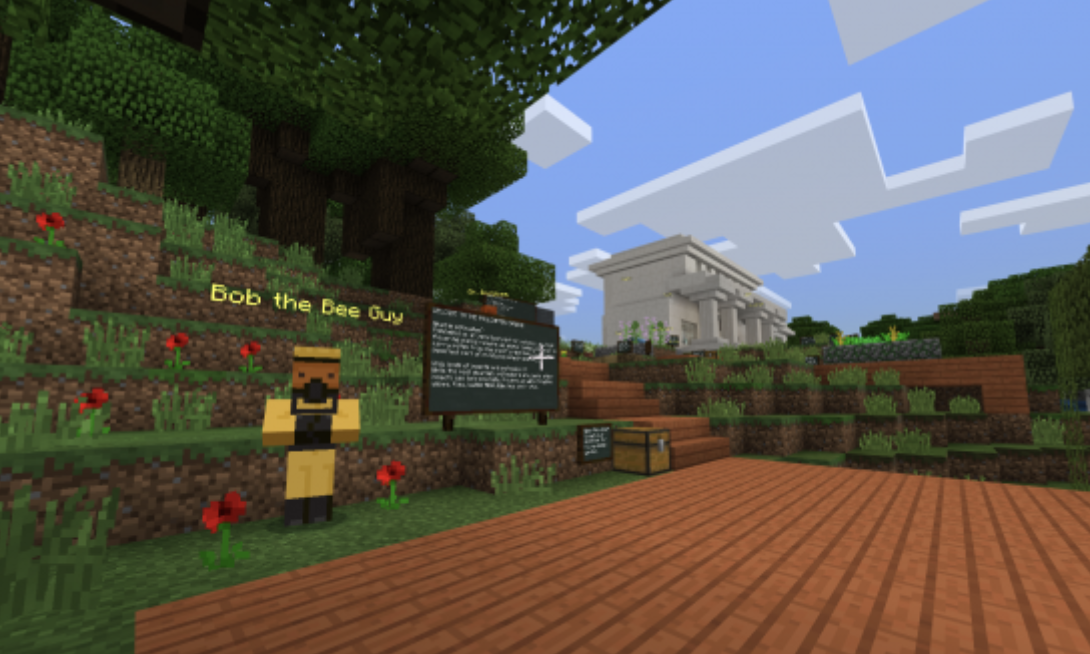
In this lesson, students will be able to explore the Pollinator Garden world to learn about bees and butterflies. They will then tour the museum and grounds, and gather supplies to create their very own garden.
Welcome to this Minecraft: Education Edition lesson! Before you begin, take a few moments to let us know your thoughts or feedback on how we can improve this lesson in order to better enhance the learning experience that is delivered in your classroom!
Click here or follow the form below to complete the feedback survey once you've completed this lesson. Thank you!
Click and watch this teacher preparation video to help you understand how to teach this lesson.
Here is a YouTube link of the teacher video for your reference: https://youtu.be/AL5aN24TXIA
Start Here: Teacher Preparation Video
To learn the importance of pollinators
To learn different ways to attract pollinators to a garden
To understand the value of creating pollinator gardens to protect threatened and endangered species
Collaboration
Communication
Creativity
1. Students should understand the importance of pollinators, reasons that pollinators are at risk, and what the world would be like if we no longer had bees. Prepare the students by sharing one or both of the recommended videos.
• “A World without bees”
https://www.youtube.com/watch?v=7X1xIIyZw3M
• “What would happen if bees went extinct?” a BBC Production
http://www.bbc.com/future/story/20140502-what-if-bees-went-extinct
2. From the videos, students should be able to understand that one in every three bites of food we eat relies on bees for pollination. And without bees, our sources of food and ability to feed the world’s population would become a great challenge.
3. Before students create their Minecraft pollinator garden, discuss the following questions with the students:
•What is a pollinator?
•Why are pollinators important?
•What types of plants are dependent on pollinators?
•What are ways we can help protect pollinators?
•How might a pollinator garden help to protect pollinators?
•What are some items we might consider putting in our garden?
4. You can find more information on region specific plants for attracting pollinators at http://pollinator.org/guides
1. Provide students with the colour-coded information charts.
a. Pink chart – Common pollinators. Are all pollinators bees? Discuss the many different types of pollinators. What ways are they different?Are there certain pollinators you would like to attract to your garden?
b. Yellow chart – Minecraft plants. These are various plants available in Minecraft that may be attractive to different pollinators. Note that most bees do not see red, and most flowers that they are attractive to are white, yellow, blue, or purple. However, hummingbirds and butterflies might be more attracted to red flowers.
c. Blue chart – Items available in Minecraft that will be useful in developing a pollinator garden. Discuss with the students why it is important to have different substrates (wood, dirt, sand) available.
2. Have students plan out their gardens on the provided graph paper. There is also available software (https://mcdesign.michd.me) if students would rather design their garden online. There are four plots available in the pollinator garden world, each of which is 40 x 20 blocks. Plots are directly behind the pollinator garden museum, where they can gather materials in order to build. They should have an idea of the flowers and materials available in Minecraft using the colour-coded informational charts. All of these items will be available either in the museum or in the chests next to the gardens. Have them draw out walking paths, raised beds, edible landscaping, flower gardens, water sources, informational signs, and other materials. Consider having them work in groups, either by working together to design the plots, delegating different tasks, or by having them select the best design in the group.
3. Have students explore the provided pollinator garden world, and construct their very own pollinator gardens within Minecraft Education. Students will find all materials they need (those described in the blue and yellow charts)in the museum, walking path, or chests. Students should take photos of their completed pollinator gardens. They should also have photos of signs throughout the gardens that provide educational information on pollinators.
• Students should be able to discuss the components of their pollinator gardens, why they chose certain flowers or materials, and how the gardens can help protect threatened and endangered pollinators.
• Have student groups present their findings as a group in a report or presentation. Have them follow the standard format below:
o Introduction: They should include basic information on the importance of pollinators and pollinator gardens
o Methods: How did they go about planning and constructing their gardens? What plants did they select? What other materials did they use?
o Results: What did the final pollinator garden look like? Utilize screenshots and photos to show their final garden.
o Discussion: If this was a real garden, what types of pollinators would they anticipate using this?
Check out the Tips & Tricks video playlist that will help you and your students better use Minecraft: Education Edition in the classroom:
https://youtube.com/playlist?list=PLkh9rrdH-ARER03ojhFYtmoFDVuACYJLa
More videos added periodically so make sure you check often for more content!
Click and watch the student pause and play video with your class, pausing and playing as needed. This will help your students understand how to navigate through this lesson and Minecraft world and complete the activities located within them. Enjoy!
Check out the YouTube link for your reference: https://youtu.be/5HUFN1V7VkQ
Building a Pollinator Garden Student Video
208-5 state a prediction and a hypothesis based on background information or an observed pattern of events
208-2 identify questions to investigate arising from practical problems and issues
209-1 carry out procedures controlling the major variables
211-2 communicate questions, ideas, intentions, plans, and results, using lists, notes in point form, sentences, data tables, graphs, drawings, oral language, and other means
211-5 defend a given position on an issue or problem on the basis of their findings