
Loading…
Loading…
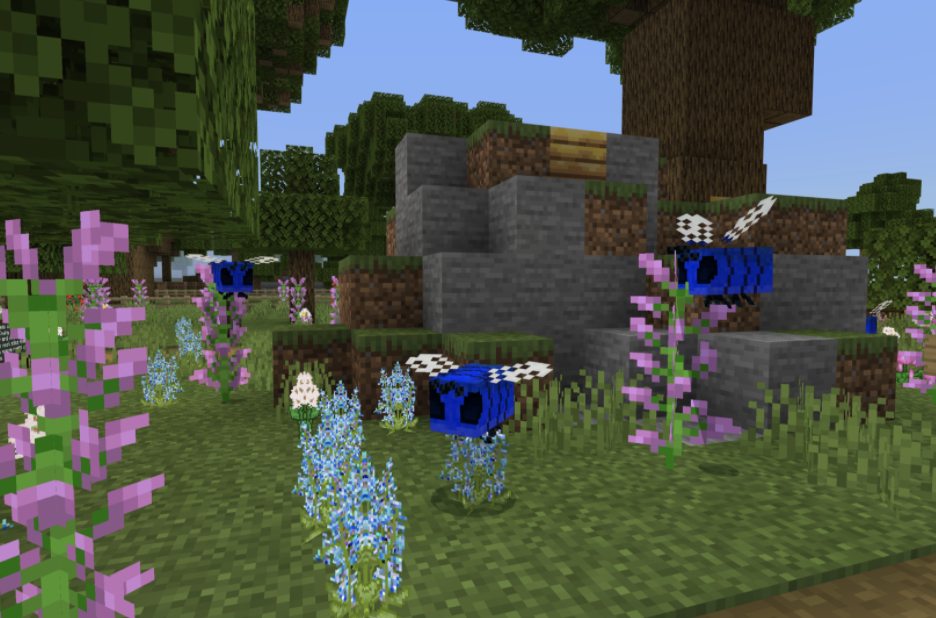
In this lesson, students will apply their knowledge of bees’ lifelong needs to build Minecraft “beetopias” to support and grow their very own bee colonies.
Welcome to this Minecraft: Education Edition lesson! Before you begin, take a few moments to let us know your thoughts or feedback on how we can improve this lesson in order to better enhance the learning experience that is delivered in your classroom!
Click here or follow the form below to complete the feedback survey once you've completed this lesson. Thank you!
Click and watch this teacher preparation video to help you understand how to teach this lesson.
Here is a YouTube link of the teacher video for your reference: https://youtu.be/p3TRYZE09xk
Start Here: Teacher Preparation Video
Students will list the four stages of a bee’s life
Students will describe what a bee needs in order to survive
Students will identify common threats to bees’ survival
Creativity
Critical thinking
Project Based Learning
What do all living things need in order to survive?
What can threaten a bee’s survival?
Explain to students that in this lesson, they will build “beetopias” to serve as healthy, happy homes for their own Minecraft bee colonies. But before they can build the perfect habitat for bees, they have to learn what bees need! As a class, read the Bumblebee Conservation Trust’s page on the Bumblebee Lifecycle, which illustrates how a bee relies on many different habitat components throughout the year. Use the questions above to highlight bees’ habitat requirements, and invite students to brainstorm some threats to bees’ survival.
Direct students to load the Kids and Bees Minecraft world and travel to the Beetopia area. Ask them to talk to the NPC Bee Girl who will introduce Beekeeper Sarah. Sarah will teach the students about what a bee colony needs to survive (habitat) and about the challenges bees face.
Then ask the students to meet Carl at the “Sweat Bee Garden” and explore here and in the “Bumble Bee Garden” (also visited in Beetopia Lesson “Bumble Buzz”). Invite students to put a camera, quill, and pen from the chest into their inventory to record what they learn along the way.
After students have had time to explore the “Sweat Bee Garden” and the “Bumble Bee Garden”, ask them to turn their attention away from the game and toward the classroom. Discuss with the students what they discovered while walking in the gardens, highlighting bees’ life cycle stages, their habitat requirements, and threats to their survival.
Next, direct students to return to the game, where they will walk to the empty field next to the “Sweat Bee Garden” or the “Bumble Bee Garden.” There, they will use the inventory they have collected from the bee garden chests to build their own bee-friendly gardens, based on what they have learned about bees’ needs.
Students can dig holes with the shovels to make nests in the ground, plant flowers, and create ponds; this can be done individually or in collaboration mode with a small group of other players. After they have built their gardens, they can add bees, and watch as the bees pollinate nearby flowers and return to the nest, covered in pollen!
Split the students up into small groups, and hand out one Building Beetopia worksheet to each small group. If students were collaborating on a garden, direct them to be in different small groups than they were in the game. Ask students to discuss in their new small groups what choices they made when building their “beetopia”, using the topics on the worksheet as a guide; direct students to choose a scribe in each small group to fill in the worksheet as the group talks.
Gather the whole class back together. Invite a representative from each group to share with the class one of the ways in which bee colonies are like human families.
Optional Creative Writing Exercise in the Teachers Guide
Total time - 55-75 minutes + optional 15-30 minute activity
This lesson will enable students to:
List the four stages of a bee’s life
Describe what a bee needs in order to survive
Identify common threats to bees’ survival
Life cycle of a Bumblebee (click here to open link)
This resource from the Bumblebee Conservation Trust describes the seasonal life cycle of bumble bees with text and images.
Bicolored Metallic Green Sweat Bee (click here to open link)
This is one of 14 known species of Agapostemon in the United States and Canada.
Check out the Tips & Tricks video playlist that will help you and your students better use Minecraft: Education Edition in the classroom:
https://youtube.com/playlist?list=PLkh9rrdH-ARER03ojhFYtmoFDVuACYJLa
More videos added periodically so make sure you check often for more content!
Click and watch the student pause and play video with your class, pausing and playing as needed. This will help your students understand how to navigate through this lesson and Minecraft world and complete the activities located within them. Enjoy!
Check out the YouTube link for your reference: https://youtu.be/EyNnlMfmCSQ
Student Pause & Play Video
Big Idea
Living things are diverse, can be grouped, and interact in their ecosystems
Sample questions to support inquiry with students:
What is biodiversity?
Why is biodiversity important in an ecosystem?
Interconnectedness means that all things are related to and interact with each other in the environment. How does local First Peoples knowledge of living things demonstrate interconnectedness
Content - Biodiversity
biodiversity: the variety of different types of living things in an ecosystem
characteristics of local plants, animals and fungi
energy is needed for life
producers (plants), consumers (animals), and decomposers (bacteria and fungi) respond to their environment in energy pyramids (flow of energy in the community from the sun)
food chains: the flow of food energy from one organism to another (e.g., grass to rabbit to lynx)
food webs: interconnecting food chains (e.g., a rabbit may be eaten by a lynx or a wolf)
observable changes in the local environment caused by erosion and deposition by wind, water, and ice
Big Ideas
All living things sense and respond to their environment
Sample questions to support inquiry with students:
How do living things sense, respond, and adapt to stimuli in their environment?
How is sensing and responding related to interdependence within ecosystems?
Content
all organisms need space, food, water, and access to resources in order to survive
Topic A: Waste and Our World
1. Identify plant and animal wastes, and describe how they are recycled in nature. For example, plant leaves serve as a source of food for soil insects, worms and other creatures. The wastes of these animals may then be further broken down by molds, fungi and bacteria
Topic E: Plant Growth and Changes
1. Describe the importance of plants to humans and their importance to the natural environment. Students who meet this expectation should be able to give examples of plants being used as a source of food or shelter, and be aware of the role plants play in the environment; e.g., preventing erosion, maintaining oxygen
4. Recognize that a variety of plant communities can be found within the local area and that differences in plant communities are related to variations in the amount of light, water and other conditions.
Outcomes for Science, Technology and Society (STS) and Knowledge Students will:
1. Investigate and describe relationships between humans and their environments, and identify related issues and scientific questions
• illustrate how life-supporting environments meet the needs of living things for nutrients, energy sources, moisture, suitable habitat, and exchange of gases
describe examples of interaction and interdependency within an ecosystem (e.g., identify examples of dependency between species, and describe adaptations involved; identify changing relationships between humans and their environments, over time and in different cultures—as, for example, in aboriginal cultures)
Overall
2. investigate the interdependence of plants and animals within specific habitats and communities;
3. demonstrate an understanding of habitats and communities and the relationships among the plants and animals that live in them.
Specific
2.5 use appropriate science and technology vocabulary, including habitat, population, community, adaptation, and food chain, in oral and written communication
2.6 use a variety of forms (e.g., oral, written, graphic, multimedia) to communicate with different audiences and for a variety of purposes
3.1 demonstrate an understanding of habitats as areas that provide plants and animals with the necessities of life (e.g., food, water, air, space, and light
3.2 demonstrate an understanding of food chains as systems in which energy from the sun is transferred to producers (plants) and then to consumers (animals
3.3 identify factors (e.g., availability of water or food, amount of light, type of weather) that affect the ability of plants and animals to survive in a specific habitat
3.4 demonstrate an understanding of a community as a group of interacting species sharing a common habitat (e.g., the life in a meadow or in a patch of forest)
Overall
2. investigate the characteristics of living things, and classify diverse organisms according to specific characteristics;
3. demonstrate an understanding of biodiversity, its contributions to the stability of natural systems, and its benefits to humans
2.4 use appropriate science and technology vocabulary, including classification, biodiversity, natural community, interrelationships, vertebrate, invertebrate, stability, characteristics, and organism, in oral and written communication
3.2 demonstrate an understanding of biodiversity as the variety of life on earth, including variety within each species of plant and animal, among species of plants and animals in communities, and among communities and the physical landscapes that support them
3.3 describe ways in which biodiversity within species is important for maintaining the resilience of those species (e.g., because of genetic differences, not all squirrels are affected equally by infectious diseases such as mange; some species of bacteria have become resistant to antibiotics because resistant individuals have survived and reproduced)
3.4 describe ways in which biodiversity within and among communities is important for maintaining the resilience of these communities (e.g., having a variety of species of wheat allows for some part of the crop to survive adverse conditions)
3.5 describe interrelationships within species
Overall
3. demonstrate an understanding of interactions between and among biotic and abiotic elements in the environment
Specific
2.2 design and construct a model ecosystem
2.4 use appropriate science and technology vocabulary,
2.5 use a variety of forms (e.g., oral, written, graphic, multimedia)
3.1 demonstrate an understanding of an ecosystem (e.g., a log, a pond, a forest) as a system of interactions between living organisms and their environment 3.2 identify biotic and abiotic elements in an ecosystem, and describe the interactions between them (e.g., between hours of sunlight and the growth of plants in a pond; between a termite colony and a decaying log; between the soil, plants, and animals in a forest) 3.3 describe the roles and interactions of producers, consumers, and decomposers within an ecosystem
3.4 describe the transfer of energy in a food chain and explain the effects of the elimination of any part of the chain
3.5 describe how matter is cycled within the environment and explain how it promotes sustainability
Life Science – Habitats and Communities
(HC) HC4.1 Investigate the interdependence of plants and animals, including humans, within habitats and communities.
HC4.3 Assess the effects of natural and human activities on habitats and communities, and propose actions to maintain or restore habitats.
a. Identify the plants and animals which can be found in the communities (e.g., house, village, farm, reserve, and city) in which students live.
b. Differentiate between populations, communities, and habitats using local and regional examples.
c. Predict and research the populations of plants and animals that exist in various habitats (e.g., desert, farmland, meadow, tree, forest, rain puddle, seashore, lake, river, tropical forest, tundra, river delta, and mountains)
f. Classify plants and animals, including humans, according to their role(s) (e.g., producer, consumer, herbivore, omnivore, carnivore, predator, prey, scavenger, and decomposer) in food chains and food webs
g. Construct a visual representation of a specific food chain that exists within a habitat or community
k. Predict how the removal of a specific plant or animal population may affect a community in the short- and long-term
b. Recognize that each plant and animal depends on a specific habitat to meet its needs. c. Identify factors (e.g., availability of food, water, and shelter, weather conditions, and available living space) that influence the ability of plants and animals to meet their needs within a specific habitat.
Life Science: Diversity of Living Things (DL)
b. Observe and document the diversity of living things in their local habitat through journaling, a nature walk, sketching, drawing, photographing, video recording, or other means
d. Document the diversity of living things in different terrestrial and aquatic habitats (e.g., grasslands, forests, tundra, deserts, rivers, ponds, and oceans) using print, video, and/or online resources
IE7.2 Observe, illustrate, and analyze living organisms within local ecosystems as part of interconnected food webs, populations, and communities.
a. Illustrate the ecological organization of life within the biosphere, using specific examples of species, populations, communities, ecosystems, and biomes. b. Provide examples of ecosystems of varying sizes and locations, including their biotic and abiotic components
j. Interpret interdependence within natural systems by constructing food chains and food webs to illustrate the interactions among producers, consumers, and decomposers in a particular ecosystem
Cluster 1
4-1-01 Use appropriate vocabulary related to their investigations of habitats and communities. Include: habitat, physical adaptation, behavioural adaptation, traditional knowledge, technological development, population, community, food chain, food web, organism, producer, consumer, herbivore, omnivore, carnivore, predator, prey, scavenger, endangerment, extinction, conservation. GLO: C6, D
4-1-02 Recognize that each plant and animal depends on a specific habitat to meet its needs. GLO: D2
4-1-03 Identify the components of an animal habitat. Include: food, water, living space, cover/shelter. GLO: D2, E2
4-1-09 Recognize that plant and animal populations interact within a community. GLO: D2
4-1-10 Recognize that the food chain is a system in which some of the energy from the Sun is transferred eventually to animals. GLO: D2, D4, E2 4-1-11 Construct food chains and food webs, and classify organisms according to their roles. Include: producer, consumer, herbivore, omnivore, carnivore, predator, prey, scavenger. GLO: D2, E2
4-1-12 Use the design process to construct a model of a local or regional habitat and its associated populations of plants and animals GLO: C3, D4
4-1-13 Predict, based on their investigations, how the removal of a plant or animal population may affect the rest of the community. Examples: if the wolves were removed from a community, the deer population may increase rapidly... GLO: D2, E2, E3
Grade 7 Cluster 1 Interactions with Eco Systems
7-1-07 Propose a course of action to protect the habitat of a particular organism within an ecosystem. Examples: protect the nesting habitat of a given bird in a local wetland... GLO: B5, C3, D2, E2
7-1-09 Analyze food webs, using ecological pyramids, to show energy gained or lost at various consumer levels.
7-1-12 Provide examples of scavengers and decomposers, and describe their role in cycling matter in an ecosystem.
Science and Technology: Living Things
c. Identifies habitats and the animal and plant populations found in them
d. Describes how animals meet their basic needs within their habitat
e. Describes relationships between living things (parasitism, predation) Explains how animals and plants adapt to increase their chances of survival
1. Ecology
a. Habitat Names the characteristics that define a habitat (e.g. geographic location, climate, flora, fauna, proximity of man-made constructions)
i. ii. Describes the habitat of certain species
b. Ecological niche Names the characteristics that define an ecological niche (e.g. habitat, diet, daily rhythms)
i. ii. Describes the ecological niche of an animal species
c. Species Names the characteristics that define a species (common physical characteristics; natural, viable and fertile reproduction)
302-1 identify a variety of local and regional habitats and their associated populations of plants and animals
302-2 describe how various animals are able to meet their basic needs in their habitat
301-1 predict how the removal of a plant or animal population affects the rest of the community
Outcomes: students will be expected to use the terms habitat, population, and community in appropriate contexts (104-6)
- distinguish between the following scientific terms: - consumer - decomposer - producer - ecosystem - habitat - photosynthesis (109-12)
- demonstrate the importance of choosing words that are scientifically appropriate by using these words in context: - niche - habitat - population - community - ecosystem (109-13)
Life Science: Habitats
• identify questions to investigate the types of plants and/or animals at a local habitat using the terms habitat, population, and community (104-6, 204-1)
• examine and investigate, using various methods and questions, local habitats and their associated populations of plants and animals (204-6, 302-1)
Collecting Scientific Information Using Models of Natural Habitats • construct and/or maintain a model of a natural habitat and, through observations, suggest improvements to make it more habitable for organisms (205-5, 205-10, 206-6)
Food Chains
• classify organisms and draw diagrams to illustrate their role in a food chain (206-1, 302-3)
• predict how the removal of a plant or animal population affects the rest of the community and relate habitat loss to the endangerment or extinction of plants and animals (301-1, 301-2)
- Learners will analyze the inter-connectiveness of living things and the environment, in relation to the concept of Netukulimk. Learners will explore the following concepts: ecosystems, inter-connectiveness, biotic and abiotic, energy input and matter recycling, food webs, Netukulimk, human impact.
- Analyze the interactions of various organisms within an ecosystem (CZ/CT/COM)
STSE
104-6 demonstrate that specific terminology is used in science and technology contexts
Knowledge
302-1 identify a variety of local and regional habitats and their associated populations of plants and animals
302-2 describe how a variety of animals are able to meet their basic needs in their habitat
302-3 classify organisms according to their role in a food chain
301-1 predict how the removal of a plant or animal population affects the rest of the community
301-2 relate habitat loss to the endangerment or extinction of plants and animals
LS1 Explain how different parts of an ecosystem interact
Identify and describe examples of local ecosystems
Identify and explain the roles of producers consumers and decomposers in an ecosystem and how they interact with each other
Unit 4 Habitat and Communities
GCO 1 STSE
25.0 demonstrate that specific terminology is used in science and technology contexts
GCO 3 Knowledge
63.0 identify a variety of local and regional habitats and their associated populations of plants and animals
64.0 investigate and describe how a variety of local animals are able to meet their basic needs in their habitat
68.0 classify organisms according to their role in a food chain
69.0 predict how reduction or removal of a plant or animal population affects the rest of the community
70.0 relate habitat loss to the endangerment or extinction of plants and animals
304-2 identify the roles of producers, consumers, and decomposers in a local ecosystem, and describe both their diversity and their interactions
306-1 describe how energy is supplied to, and how it flows through, a food web
306-2 describe how matter is recycled in an ecosystem through interactions among plants, animals, fungi and microorganisms
306-3 describe interactions between biotic and abiotic factors in an ecosystem
Topic A: Waste and Our World
1. Identify plant and animal wastes, and describe how they are recycled in nature. For example, plant leaves serve as a source of food for soil insects, worms and other creatures. The wastes of these animals may then be further broken down by molds, fungi and bacteria
Topic E: Plant Growth and Changes
1. Describe the importance of plants to humans and their importance to the natural environment. Students who meet this expectation should be able to give examples of plants being used as a source of food or shelter, and be aware of the role plants play in the environment; e.g., preventing erosion, maintaining oxygen
4. Recognize that a variety of plant communities can be found within the local area and that differences in plant communities are related to variations in the amount of light, water and other conditions.
Outcomes for Science, Technology and Society (STS) and Knowledge Students will:
1. Investigate and describe relationships between humans and their environments, and identify related issues and scientific questions
• illustrate how life-supporting environments meet the needs of living things for nutrients, energy sources, moisture, suitable habitat, and exchange of gases
describe examples of interaction and interdependency within an ecosystem (e.g., identify examples of dependency between species, and describe adaptations involved; identify changing relationships between humans and their environments, over time and in different cultures—as, for example, in aboriginal cultures)
Topic A: Waste and Our World
1. Identify plant and animal wastes, and describe how they are recycled in nature. For example, plant leaves serve as a source of food for soil insects, worms and other creatures. The wastes of these animals may then be further broken down by molds, fungi and bacteria
Topic E: Plant Growth and Changes
1. Describe the importance of plants to humans and their importance to the natural environment. Students who meet this expectation should be able to give examples of plants being used as a source of food or shelter, and be aware of the role plants play in the environment; e.g., preventing erosion, maintaining oxygen
4. Recognize that a variety of plant communities can be found within the local area and that differences in plant communities are related to variations in the amount of light, water and other conditions.
Outcomes for Science, Technology and Society (STS) and Knowledge Students will:
1. Investigate and describe relationships between humans and their environments, and identify related issues and scientific questions
• illustrate how life-supporting environments meet the needs of living things for nutrients, energy sources, moisture, suitable habitat, and exchange of gases
describe examples of interaction and interdependency within an ecosystem (e.g., identify examples of dependency between species, and describe adaptations involved; identify changing relationships between humans and their environments, over time and in different cultures—as, for example, in aboriginal cultures)
Big Idea
Living things are diverse, can be grouped, and interact in their ecosystems
Sample questions to support inquiry with students:
What is biodiversity?
Why is biodiversity important in an ecosystem?
Interconnectedness means that all things are related to and interact with each other in the environment. How does local First Peoples knowledge of living things demonstrate interconnectedness
Content - Biodiversity
biodiversity: the variety of different types of living things in an ecosystem
characteristics of local plants, animals and fungi
energy is needed for life
producers (plants), consumers (animals), and decomposers (bacteria and fungi) respond to their environment in energy pyramids (flow of energy in the community from the sun)
food chains: the flow of food energy from one organism to another (e.g., grass to rabbit to lynx)
food webs: interconnecting food chains (e.g., a rabbit may be eaten by a lynx or a wolf)
observable changes in the local environment caused by erosion and deposition by wind, water, and ice
Big Ideas
All living things sense and respond to their environment
Sample questions to support inquiry with students:
How do living things sense, respond, and adapt to stimuli in their environment?
How is sensing and responding related to interdependence within ecosystems?
Content
all organisms need space, food, water, and access to resources in order to survive