
Loading…
Loading…
In this lesson, students will use multiplication and division within 100 to solve word problems in situations involving equal groups, arrays, and measurement quantities by using drawings and equations with a symbol for the unknown number to represent the problem.
Welcome to this Minecraft: Education Edition lesson! Before you begin, take a few moments to let us know your thoughts or feedback on how we can improve this lesson in order to better enhance the learning experience that is delivered in your classroom!
Click here or follow the form below to complete the feedback survey once you've completed this lesson. Thank you!
Click and watch this teacher preparation video to help you understand how to teach this lesson. Here is a YouTube link of the teacher video for your reference: https://youtu.be/VYR8uCvNQ2Q
Start Here: Teacher Preparation Video
Use multiplication and division within 100 to solve word problems in situations involving equal groups, arrays, and measurement quantities by using drawings and equations with a symbol for the unknown number to represent the problem.
Creativity
Critical Thinking
Hand out the Word Problem Design Sheet Packet (see Supporting Files) and walk your students through the word problem Mad Lib on page 1.
Next unveil the Big Idea: Multiplication Can Be Used to Solve Problems.
Unveil the Challenge.
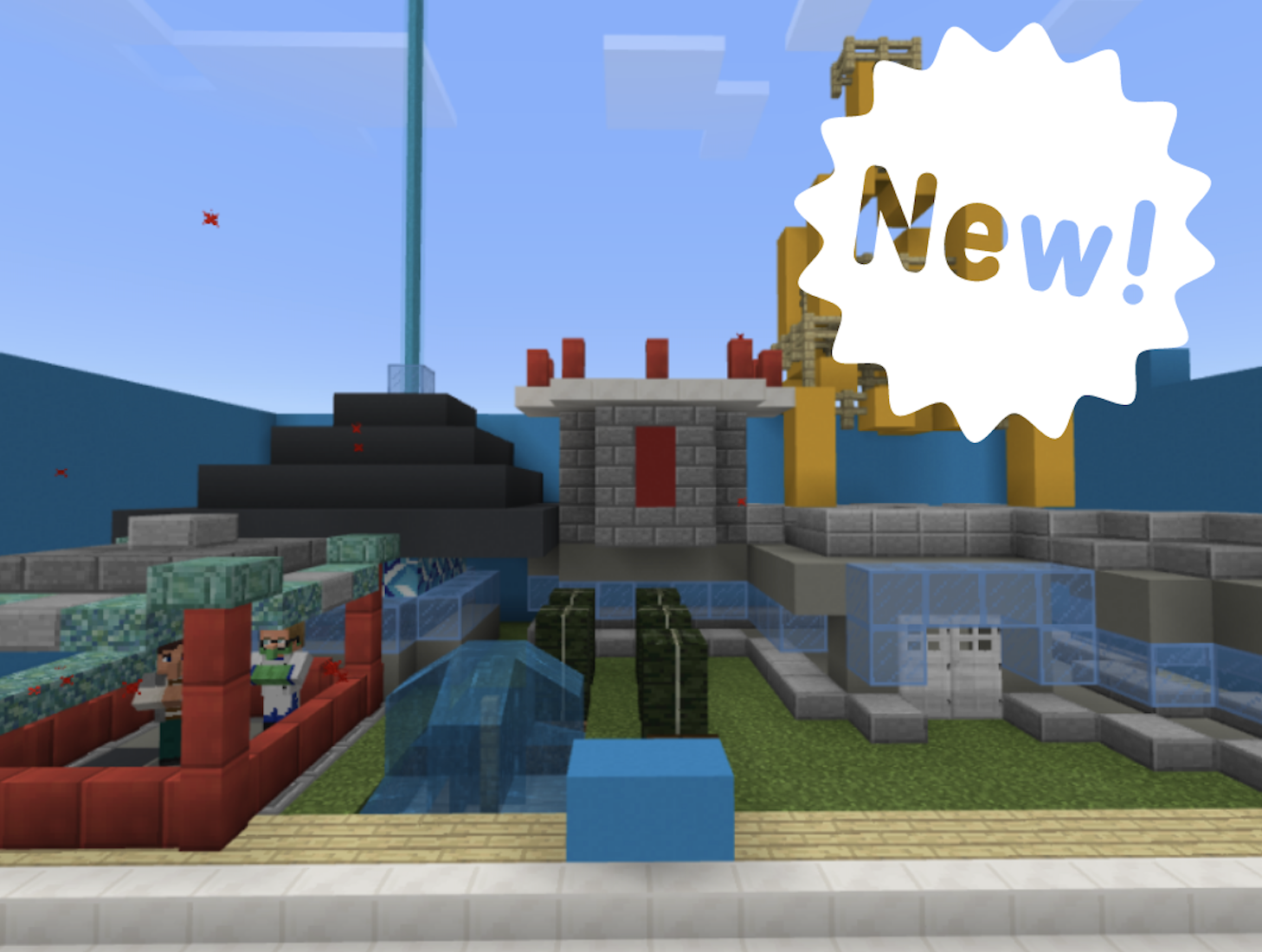
Students load the "Build Word Problems" Minecraft world. There are 8 practice problems to solve as well as a stage to build their world problem.
Go to page 2 of the packet and have your students choose only one of the four problems. There are two multiplication and two division word problems on the sheet. After they solve and check their problem with a peer who did the same problem, they will become building partners and plan their build together by:
Changing the characters and the numbers (if they want)
Changing the setting (if they want)
Drawing the set with a math model
Once the last pair of students finish, start the 20 minute timer. Partners work together and build the word problem that has:
The problem written on a slate
A math model of the problem
The equation on a slate
A setting
NPCs as characters (if they finish their builds with time to spare, make the NPCs talk)
If students finish before the time is up, encourage them to add more details.
Once time has been called, each group will check out another group’s word problem.
Is the math correct and how do I know?
Is the math model correct?
Does the story make sense?
What ideas can I think of to improve this set?
What ideas did I learn from looking at this set?
Best Practices: Things like set building ideas, math, and story are all things that can be learned or taught so lead the students to these topics if they are having trouble thinking of ideas to add.
The teacher will facilitate a discussion of what the students learned.
The student did all seven of the following:
1. The student was able to identify what problems can be solved with multiplication and/or division. For example, in multiplication, we are looking for the whole number in a number family and in division problems we are looking for the number of groups or the amount in each group.
2. The student was able to deconstruct a word problem by identifying the characters, the setting, the problem, the number family, and the variables.
3. The student was able to independently read and solve a division and multiplication word problem.
4. The student was able to complete the four-question worksheet for homework.
5. The student provided valuable feedback during peer review.
6. The student was able to build a word problem story set in Minecraft. The story sets must include:
a. A set that showed the character and setting of the word problems
b. Use of NPCs as characters to have a conversation about the problem
c. At least one Minecraft math model per set that represented the math of the word problem
7. The student exhibited higher level thinking skills such as:
a. Was able to explain the inverse relationship between multiplication and division
b. Created a unique math model
c. Wrote their own word problem
d. Made an unexpected connection during peer review
Check out the Tips & Tricks video playlist that will help you and your students better use Minecraft: Education Edition in the classroom:
https://youtube.com/playlist?list=PLkh9rrdH-ARER03ojhFYtmoFDVuACYJLa
More videos added periodically so make sure you check often for more content!
Click and watch the student pause and play video with your class, pausing and playing as needed. This will help your students understand how to navigate through this lesson and Minecraft world and complete the activities located within them. Enjoy!
Check out the YouTube link of this video for your reference: https://youtu.be/eYWwdaPU-XU
Student 'Pause & Play' Video
NUMBERS: Develop number sense
- 6. Demonstrate an understanding of multiplication (2- or 3-digit by 1-digit) to solve problems by:
using personal strategies for multiplication with and without concrete materials
using arrays to represent multiplication
connecting concrete representations to symbolic representations
estimating products
applying the distributive property
7. Demonstrate an understanding of division (1-digit divisor and up to 2-digit dividend) to solve problems by:
using personal strategies for dividing with and without concrete materials
estimating quotients
relating division to multiplication
- 5. Demonstrate, with and without concrete materials, an understanding of multiplication (2-digit by 2-digit) to solve problems.
- 6. Demonstrate, with and without concrete materials, an understanding of division (3-digit by 1-digit), and interpret remainders to solve problems.
Identify needs and opportunities for designing, through exploration
Generate ideas from their experiences and interests
Add to others’ ideas
Choose an idea to pursue.
Making
Choose tools and materials
Make a product using known procedures or through modelling of others
Use trial and error to make changes, solve problems, or incorporate new ideas from self or others
Sharing
Decide on how and with whom to share their product
Demonstrate their product, tell the story of designing and making their product, and explain how their product contributes to the individual, family, community, and/or environment
Use personal preferences to evaluate the success of their design solutions
Reflect on their ability to work effectively both as individuals and collaboratively in a group
Use materials, tools, and technologies in a safe manner in both physical and digital environments
Develop their skills and add new ones through play and collaborative work
Explore the use of simple, available tools and technologies to extend their capabilities
Curricular Competencies
Develop mental math strategies and abilities to make sense of quantities
Use technology to explore mathematics
Understanding and solving
Develop, demonstrate, and apply mathematical understanding through play, inquiry, and problem solving
Students are expected to know the following:
Multiplication and Division
understanding concepts of multiplication (e.g., groups of, arrays, repeated addition)
understanding concepts of division (e.g., sharing, grouping, repeated subtraction)
Multiplication and division are related.
Provide opportunities for concrete and pictorial representations of multiplication.
Use games to develop opportunities for authentic practice of multiplication computations.
Identify needs and opportunities for designing, through exploration
Generate ideas from their experiences and interests
Add to others’ ideas
Choose an idea to pursue.
Making
Choose tools and materials
Make a product using known procedures or through modelling of others
Use trial and error to make changes, solve problems, or incorporate new ideas from self or others
Sharing
Decide on how and with whom to share their product
Demonstrate their product, tell the story of designing and making their product, and explain how their product contributes to the individual, family, community, and/or environment
Use personal preferences to evaluate the success of their design solutions
Reflect on their ability to work effectively both as individuals and collaboratively in a group
Use materials, tools, and technologies in a safe manner in both physical and digital environments
Develop their skills and add new ones through play and collaborative work
Explore the use of simple, available tools and technologies to extend their capabilities
Curricular Competencies
Develop mental math strategies and abilities to make sense of quantities
Use technology to explore mathematics
Understanding and solving
Develop, demonstrate, and apply mathematical understanding through play, inquiry, and problem solving
Students are expected to know the following:
Multiplication and Division
understanding concepts of multiplication (e.g., groups of, arrays, repeated addition)
understanding concepts of division (e.g., sharing, grouping, repeated subtraction)
Multiplication and division are related.
Provide opportunities for concrete and pictorial representations of multiplication.
Use games to develop opportunities for authentic practice of multiplication computations.
B2. operation
Use knowledge of numbers and operations to solve mathematical problems encountered in everyday life.
B2.1 Use the properties of operations, and the relationships between multiplication and division, to solve problems and check calculations.
B2.6 represent multiplication of numbers up to 10 × 10 and division up to 100 ÷ 10, using a variety of tools and drawings, including arrays.
B2.7 represent and solve problems involving multiplication and division, including problems that involve groups of one half, one fourth, and one third, using tools and drawings.
Algebra
C3.1 solve problems and create computational representations of mathematical situations by writing and executing code, including code that involves sequential, concurrent, and repeating events
C3.2 read and alter existing code, including code that involves sequential, concurrent, and repeating events, and describe how changes to the code affect the outcomes.
B2.1 use the properties of operations, and the relationships between addition, subtraction, multiplication, and division, to solve problems involving whole numbers, including those requiring more than one operation, and check calculations.
B2.5 represent and solve problems involving the multiplication of two- or three-digit whole numbers by one-digit whole numbers and by 10, 100, and 1000, using appropriate tools, including arrays
Algebra
C3.1 solve problems and create computational representations of mathematical situations by writing and executing code, including code that involves sequential, concurrent, and repeating events
C3.2 read and alter existing code, including code that involves sequential, concurrent, and repeating events, and describe how changes to the code affect the outcomes
B2.1 use the properties of operations, and the relationships between operations, to solve problems involving whole numbers and decimal numbers, including those requiring more than one operation, and check calculations
Algebra
C3.1 solve problems and create computational representations of mathematical situations by writing and executing code, including code that involves sequential, concurrent, and repeating events
C3.2 read and alter existing code, including code that involves sequential, concurrent, and repeating events, and describe how changes to the code affect the outcomes
Number Sense, Logical Thinking, Mathematical Attitude
N4.3 Demonstrate an understanding of multiplication of whole numbers (limited to numbers less than or equal to 10) by:
applying mental mathematics strategies
explaining the results of multiplying
using personal strategies for multiplication, with and without concrete materials
using arrays to represent multiplication
connecting concrete representations to symbolic representations
estimating products
solving problems.
N4.5 Demonstrate an understanding of division (1-digit divisor and up to 2-digit dividend) to solve problems by:
using personal strategies for dividing with and without concrete materials
estimating quotients
explaining the results of dividing by 1
solving problems involving division of whole numbers
relating division to multiplication.
N5.2 Analyze models of, develop strategies for, and carry out multiplication of whole numbers.
N5.2 Demonstrate, with and without concrete materials, an understanding of division (3-digit by 1-digit) and interpret remainders to solve problems.
N6.2 Demonstrate understanding of factors and multiples (concretely, pictorially, and symbolically) including:
determining factors and multiples of numbers less than 100
relating factors and multiples to multiplication and division
determining and relating prime and composite numbers.
Number: General Learning Outcome Develop number sense
4.N.5. Describe and apply mental mathematics strategies, such as skip-counting from a known fact using doubling, halving using doubling and adding one more group using patterns in the 9s facts using repeated doubling to develop an understanding of basic multiplication facts to 9 x 9 and related division facts.
4.N.6. Demonstrate an understanding of multiplication (2- or 3-digit numerals by 1-digit numerals) to solve problems by using personal strategies for multiplication with and without concrete materials using arrays to represent multiplication connecting concrete representations to symbolic representations estimating products.
4.N.7. Demonstrate an understanding of division (1-digit divisor and up to 2-digit dividend) to solve problems by using personal strategies for dividing with and without concrete materials estimating quotients relating division to multiplication.
5.N.2. Apply estimation strategies, including front-end rounding compensation compatible numbers in problem-solving contexts.
5.N.4. Apply mental mathematics strategies for multiplication, such as annexing then adding zeros halving and doubling using the distributive property.
5.N.5. Demonstrate an understanding of multiplication (1- and 2-digit multipliers and up to 4-digit multiplicands), concretely, pictorially, and symbolically, by using personal strategies using the standard algorithm estimating products to solve problems.
5.N.6. Demonstrate an understanding of division (1- and 2-digit divisors and up to 4-digit dividends), concretely, pictorially, and symbolically, and interpret remainders by using personal strategies using the standard algorithm estimating quotients to solve problems.
Meaning of operations involving numbers
Uses objects, diagrams or equations to represent a situation and conversely, describes a situation represented by objects, diagrams or equations (use of different meanings of multiplication and division)
Natural Numbers
Operation sense: multiplication (e.g. repeated addition, Cartesian product), product, factor, multiples of a natural number, division (repeated subtraction, sharing, number of times x goes into y), quotient, remainder, dividend, divisor, set of divisors of a natural number, properties of divisibility
Choice of operation: multiplication, division
Patterns & Relations (PR): Use patterns to describe the world and solve problems
N10 Apply mental mathematics strategies and number properties to determine answers for basic addition facts and related subtraction facts (to 18).
N11 Demonstrate an understanding of multiplication to 5 × 5
N4 Explain the properties of 0 and 1 for multiplication and the property of 1 for division.
N5 Describe and apply mental mathematics strategies, such as:
skip counting from a known fact
using doubling or halving
using doubling or halving and adding or subtracting one more group
using patterns in the 9s facts
using repeated doubling to determine basic multiplication facts to 9 × 9 and related division facts.
N3 Apply mental mathematics strategies and number properties, such as: skip counting from a known fact; using doubling or halving; using patterns in the 9s facts; using repeated doubling or halving; to determine answers for basic multiplication facts to 81 and related division facts.
Outcome N08: Students will be expected to apply estimation strategies to predict sums and differences of one-, two-, and three-digit numerals in a problem-solving context.
Outcome N11: Students will be expected to demonstrate an understanding of multiplication to 5 × 5 by:
representing and explaining multiplication using equal grouping and arrays
creating and solving problems in context that involves multiplication
modelling multiplication using concrete and visual representations and recording the process symbolically
relating multiplication to repeated addition
relating multiplication to division
Outcome N12: Students will be expected to demonstrate an understanding of division by:
representing and explaining division using equal sharing and equal grouping
creating and solving problems in context that involve equal sharing and equal grouping
modelling equal sharing and equal grouping using concrete and visual representations, and recording the process symbolically
relating division to repeated subtraction
relating division to multiplication (Limited to division related to multiplication facts up to 5 × 5.)
Outcome N04: Students will be expected to apply and explain the properties of 0 and 1 for multiplication and the property of 1 for division.
Outcome N05: Students will be expected to describe and apply mental mathematics strategies, to recall basic multiplication facts to 9 × 9, and to determine related division facts.
Outcome N07: Students will be expected to demonstrate an understanding of division (one-digit divisor and up to two-digit dividend) to solve problems by:
using personal strategies for dividing, with and without concrete materials
estimating quotients
relating division to multiplication
Outcome N04: Students will be expected to apply mental mathematics strategies for multiplication, including:
multiplying by multiples of 10, 100, and 1000
halving and doubling
using the distributive property.
Outcome N06: Students will be expected to demonstrate, with and without concrete materials, an understanding of division (three-digit by one-digit), and interpret remainders to solve problems.
3PR3 Solve one-step addition and subtraction equations involving a symbol to represent an unknown number
4PR6 Solve one-step equations involving a symbol to represent an unknown number.
5PR2 Solve Problems involving single-variable, one-step equations with whole number coefficients and whole number solutions.
Patterns & Relations (PR): Use patterns to describe the world and solve problems
N10 Apply mental mathematics strategies and number properties to determine answers for basic addition facts and related subtraction facts (to 18).
N11 Demonstrate an understanding of multiplication to 5 × 5
N4 Explain the properties of 0 and 1 for multiplication and the property of 1 for division.
N5 Describe and apply mental mathematics strategies, such as:
skip counting from a known fact
using doubling or halving
using doubling or halving and adding or subtracting one more group
using patterns in the 9s facts
using repeated doubling to determine basic multiplication facts to 9 × 9 and related division facts.
N3 Apply mental mathematics strategies and number properties, such as: skip counting from a known fact; using doubling or halving; using patterns in the 9s facts; using repeated doubling or halving; to determine answers for basic multiplication facts to 81 and related division facts.