
Loading…
Loading…
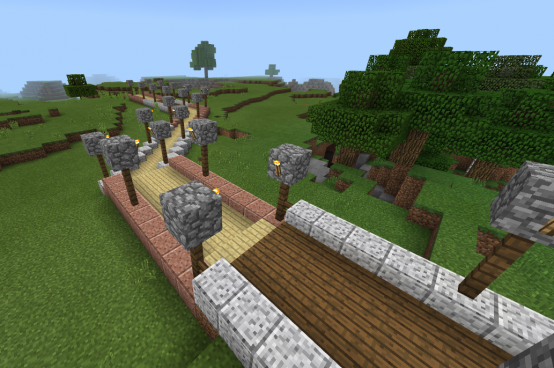
In this lesson, students will build roads that are 0.2 kilometers long and write equations to figure out how many blocks they will need.
Welcome to this Minecraft: Education Edition lesson! Before you begin, take a few moments to let us know your thoughts or feedback on how we can improve this lesson in order to better enhance the learning experience that is delivered in your classroom!
Click here or follow the form below to complete the feedback survey once you've completed this lesson. Thank you!
Click and watch this teacher preparation video to help you understand how to teach this lesson. Check out the YouTube link as a reference: https://youtu.be/TVdI6OLZ-sU
Start Here: Teacher Preparation Video
Use parentheses, brackets, or braces in numerical expressions, and evaluate expressions with these symbols.
Write simple expressions that record calculations with numbers, and interpret numerical expressions without evaluating them.
Convert among different-sized standard measurement units within a given measurement system and use these conversions in solving multi-step, real world problems.
Generate two numerical patterns using two given rules. Identify apparent relationships between corresponding terms. Form ordered pairs consisting of corresponding terms from the two patterns, and graph the ordered pairs on a coordinate plane.
Creativity
Critical Thinking
Start by exploring these questions with your class:
How can we find out how many meters are in a kilometre?
How can we find out how many blocks we would have to gather to build a road that is 0.2 kilometres long?
What do decimals mean in measurement?
How can algebra help us build a road?
Begin by loading the attached Minecraft world for Survival City Roads. It is recommended that students work in small groups of 3-5 people.
Open the world and have students explore the world and figure out where they would like their road to go. This should not take long and students can also talk about what kind of biomes and land structures they see.
Hand out the worksheet and work with students on how to write equations for each step. Begin with the problem of how many blocks we need to collect to build a road that is 0.2 kilometres long.
1 meter of the road will be made out of 2 whole blocks and 3 slabs. 1 whole block can be crafted into 2 slabs so slabs are a ½ a block.
Blocks could equal 2 times meters.
Slabs could be equal to the product of 3 times meters divided by 2
At the end of the worksheet the students must compare their equation to a fictional characters equation. The characters equation is correct so you can use that to help you understand how to write the equation for a road. (m=200 meter)
R= (2xM) + (3xM)/2
Now that the equation have been written and solved, your students will now know they need to gather at least 700 blocks to build a road that is 0.2 meters. Students will get into groups of four and chose to be a lumberjack, a miner, or a sandman. Click the buttons on the NPC named Jude Washington and get your gear.
Lumberjacks collect lots of: wood, flowers dye and dirt
Miners collect lots of: stone or all kinds, Ores and Gravel
Concrete Workers collect lots of: Sand, Gravel, Sandstone, Dirt, Flowers
All teams will be called to their village and groups will begin to make their 0.2 kilometre roads. The jobs are Block Placers, Slab Pavers, Land Levellers.
Land Levellers: Make the land in front of the road flat
a) Use shovel to dig out bumps in the land that get into way or the road.
b) Make sure the land is always flat at least 5 blocks wide, so the road will fit on it.
c) Fill in the land with dirt if there is a whole or dip in the land.
Block Placers: Will place the outer curb blocks always leaving a space of exactly 3 between blocks so the slabs can be filled in.
Slab Pavers: Will fill in 3 slabs between the curbs.
The student was able to work in groups and build a 0.2 kilometre road.
The student was able to convert measurements between meters and kilometres.
The student was able to write algebraic equations to help them find out how many blocks they will need to gather for the road.
Check out the Tips & Tricks video playlist that will help you and your students better use Minecraft: Education Edition in the classroom:
https://youtube.com/playlist?list=PLkh9rrdH-ARER03ojhFYtmoFDVuACYJLa
More videos added periodically so make sure you check often for more content!
Click and watch the student pause and play video with your class, pausing and playing as needed. This will help your students understand how to navigate through this lesson and Minecraft world and complete the activities located within them. Enjoy!
Check out the YouTube link of this video for your reference: https://youtu.be/k7GBBh0_Sq8
Student 'Pause & Play' Video
Use estimation strategies in problem-solving contexts. [C, CN, ME, PS, R, V]
Demonstrate an understanding of addition and subtraction of decimals (limited to thousandths). [C, CN, PS, R, V]
Express a given problem as an equation in which a letter variable is used to represent an unknown number (limited to whole numbers).
Explain and apply the order of operations, excluding exponents, with and without technology (limited to whole numbers).
Demonstrate an understanding of the relationships within tables of values to solve problems
Represent generalizations arising from number relationships, using equations with letter variables. [C, CN, PS, R, V]
Demonstrate an understanding of the addition, subtraction, multiplication and division of decimals to solve problems (for more than 1-digit divisors or 2-digit multipliers, the use of technology is expected).
Model and solve, concretely, pictorially and symbolically, problems that can be represented by one-step linear equations of the form x + a = b, where a and b are integers.
Solve problems that involve rates, ratios and proportional reasoning.
Model and solve problems concretely, pictorially and symbolically, using linear equations of the form: x + a = b, where a and b are integers.
• Develop, demonstrate, and apply mathematical understanding through play, inquiry, and problem solving
• Visualize to explore mathematical concepts
• Develop and use multiple strategies to engage in problem solving
Explain and justify mathematical ideas and decisions rules for increasing and decreasing patterns with words, numbers, symbols, and variables one-step equations with variables
• One-step equations with whole-number coefficients and solutions
• Develop, demonstrate, and apply mathematical understanding through play, inquiry, and problem solving
• Visualize to explore mathematical concepts
• Order of operations with whole numbers
• Develop, demonstrate, and apply mathematical understanding through play, inquiry, and problem solving • Visualize to explore mathematical concepts
• operations with integers (addition, subtraction, multiplication, division, and order of operations)
• Develop, demonstrate, and apply mathematical understanding through play, inquiry, and problem solving • Visualize to explore mathematical concepts
• Operations with fractions (addition, subtraction, multiplication, division, and order of operations)
C1.1 Patterns identify and describe repeating, growing, and shrinking patterns, including patterns found in real-life contexts
C1.3 Patterns determine pattern rules and use them to extend patterns, make and justify predictions, and identify missing elements in repeating, growing, and shrinking patterns
C1.4 Patterns create and describe patterns to illustrate relationships among whole numbers and decimal tenths and hundredths
C2.1 Variables and Expressions translate among words, algebraic expressions, and visual representations that describe equivalent relationships
B2.1 Properties and Relationships use the properties of operations, and the relationships between operations, to solve problems involving whole numbers, decimal numbers, fractions, ratios, rates, and whole number percents, including those requiring multiple steps or multiple operations
B2.9 Multiplication and Division multiply whole numbers by proper fractions, using appropriate tools and strategies
C1.1 Patterns and Relationships identify, describe, extend, create, and make predictions about a variety of patterns, including those found in real-life contexts
C2.2 Variables and Expressions evaluate algebraic expressions that involve whole numbers and decimal tenths
B1.5 Fractions, Decimals, and Percents generate fractions and decimal numbers between any two quantities
B2. Operations use knowledge of numbers and operations to solve mathematical problems encountered in everyday life
B2.1 Properties and Relationships
B2.9 Multiplication and Division multiply and divide decimal numbers by decimal numbers, in various contexts
C1.1 Patterns identify and compare a variety of repeating, growing, and shrinking patterns, including patterns found in real-life contexts, and compare linear growing patterns on the basis of their constant rates and initial values
E2.2 The Metric System solve problems involving perimeter, area, and volume that require converting from one metric unit of measurement to another
C1.3 Patterns determine pattern rules and use them to extend patterns, make and justify predictions, and identify missing elements in growing and shrinking patterns involving rational numbers, and use algebraic representations of the pattern rules to solve for unknown values in linear growing and shrinking patterns
C2.1 Variables and Expressions add and subtract monomials with a degree of 1, and add binomials with a degree of 1 that involve integers, using tools
Developing and understanding algebraic representations and manipulations as an extension of numbers.
Looking for patterns and ways to describe those patterns numerically and algebraically.
Recognize and generate equivalent forms (decimal or fraction) of fractions and decimals found in situations relevant to one’s life, family, or community.
Use and explain personal strategies for writing fractions with a denominator of 10, 100, or 1000 as a decimal.
Developing and understanding algebraic representations and manipulations as an extension of numbers.
An algebraic statement that shows a relationship between quantities and/or variables without involving equality or inequality.
A concrete approximation of a quantity or unit of measurement.
Explain by using examples why it is important to follow a specific order of operations when calculating with decimals and/or whole numbers.
Solve a problem that involves operations on decimals (limited to thousandths) taking into consideration the order of operations.
Explain: a. what a variable is and how it is used in an expression. b. Provide an example of an expression and an equation, and explain how they are similar and different.
Demonstrate an understanding of equations and expressions by: distinguishing between equations and expressions, evaluating expressions, verifying solutions to equations.
6.N.9. Explain and apply the order of operations, excluding exponents (limited to whole numbers). [CN, ME, PS, T]
6.PR.3. Represent generalizations arising from number relationships using equations with letter variables. [C, CN, PS, R, V]
7.N.2. Demonstrate an understanding of the addition, subtraction, multiplication, and division of decimals to solve problems (for more than 1-digit divisors or 2-digit multipliers, technology could be used).
7.PR.5. Evaluate an expression given the value of the variable(s). [CN, R]
8.N.6. Demonstrate an understanding of multiplying and dividing positive fractions and mixed numbers, concretely, pictorially, and symbolically. [C, CN, ME, PS]
8.N.7. Demonstrate an understanding of multiplication and division of integers, concretely, pictorially, and symbolically. [C, CN, PS, R, V]
Operations (the four operations), the commutative property of addition and multiplication and the associative property
Determines the missing term in an equation (relationships between operations): a × b = □, a × □ = c, □ × b = c, a ÷ b = □, a ÷ □ = c, □ ÷ b = c
Estimates and measures the dimensions of an object using conventional units
Operations (the four operations), the commutative property of addition and multiplication and the associative property
Determines the missing term in an equation (relationships between operations): a × b = □, a × □ = c, □ × b = c, a ÷ b = □, a ÷ □ = c, □ ÷ b = c
Estimates and measures the dimensions of an object using conventional units
Operations (the four operations), the commutative property of addition and multiplication, the associative property and the distributive property of multiplication over addition or subtraction
Translates a situation into a series of operations in accordance with the order of operations
Estimates and measures the dimensions of an object using conventional units
Establishes relationships between units of measure for length
Operations (the four operations), the commutative property of addition and multiplication, the associative property and the distributive property of multiplication over addition or subtraction
Translates a situation into a series of operations in accordance with the order of operations
Estimates and measures the dimensions of an object using conventional units
Establishes relationships between units of measure for length
SS2 Demonstrate an understanding of measuring length (mm and km)
PR1 Determine the pattern rule to make predictions about subsequent terms (elements).
PR1 Demonstrate an understanding of the relationship within tables of values to solve problems. PR2 Represent and describe patterns and relations
PR3 Represent generalizations arising from number relationships using equations with letter variables.
PR5 Evaluate an expression given the value of the variable(s).
PR2 Create a table of values from a linear relation, graph the table of values, and analyze the graph to draw conclusions and solve problems.
N7 Demonstrate an understanding of multiplication and division of integers, concretely, pictorially and symbolically.
N4 Demonstrate an understanding of ratio and rate. N5 Solve problems that involve rates, ratios and proportional reasoning.
solve and create multiplication and division story problems that involve whole numbers
extend an increasing or decreasing pattern and describe how the terms in the pattern change from one step to the next
create and solve addition, subtraction, multiplication, and division problems involving whole numbers, and addition and subtraction of decimal numbers
solve simple equations that have a missing number or that use a letter to represent the missing number(s)
add, subtract, multiply and divide decimals to solve problems (for more than one-digit divisors or more than two-digit multipliers, the use of technology is expected).
create a table of values from a linear relation, graph the table of values, and analyze the graph to draw conclusions and solve problems.
solve problems that involve rates, ratios, and proportional reasoning.
multiply and divide integers, concretely, pictorially, and symbolically.
5N8 – Describe and represent decimals
5SS2 Demonstrate an understanding of measuring length (mm & km) by: • selecting and justifying referents for the unit mm • modelling and describing the relationship between mm and cm units, and between mm and m units • selecting and justifying referents for the unit km • modelling and describing the relationship between m and km units. [C,CN,ME,PS,R,V]
5PR1 Determine the pattern rule to make predictions about subsequent elements. [C, CN, PS, R, V]
5PR2 Solve problems involving single-variable, one-step equations with whole number coefficients and whole number solutions. [C, CN, PS, R]
5PR2 – Solve problems involving single variable, one-step equations with whole number coeffecients and whole number solutions.
6N2 Solve problems involving whole numbers and decimal numbers
6PR1 Demonstrate an understanding of the relationships within tables of values to solve problems
7PR5 Evaluate an expression, given the value of the variable(s). [CN, R]
7N2 Demonstrate an understanding of the addition, subtraction, multiplication and division of decimals to solve problems (for more than 1-digit divisors or 2-digit multipliers, the use of technology is expected). [ME, PS, T]
8N5 Solve problems that involve rates, ratios and proportional reasoning. [C, CN, PS, R]
8N7 Demonstrate an understanding of multiplication and division of integers, concretely, pictorially and symbolically. [C, CN, PS, R, V]
N9 Relate decimals to fractions and fractions to decimals (to thousandths).
N10 Compare and order decimals (to thousandths), by using: • benchmarks • place value • equivalent decimals.
PR2 Solve problems involving single-variable, one-step equations with whole number coefficients and whole number solutions.
PR3 Represent generalizations arising from number relationships using equations with letter variables.
N8 Demonstrate an understanding of multiplication and division of decimals.
PR5 – Evaluate an expression given the value of the variable(s).
N2 – Demonstrate an understanding of the addition, subtraction, multiplication and division of decimals (for more than 1-digit divisors or 2-digit multipliers, the use of technology is expected) to solve problems.
N6 (K L) · decide when to multiply fractions and when to divide fractions in solving problems · apply the order of operations to solve problems involving fractions.
PR6 Model and solve problems that can be represented by one-step linear equations of the form.