
Loading…
Loading…
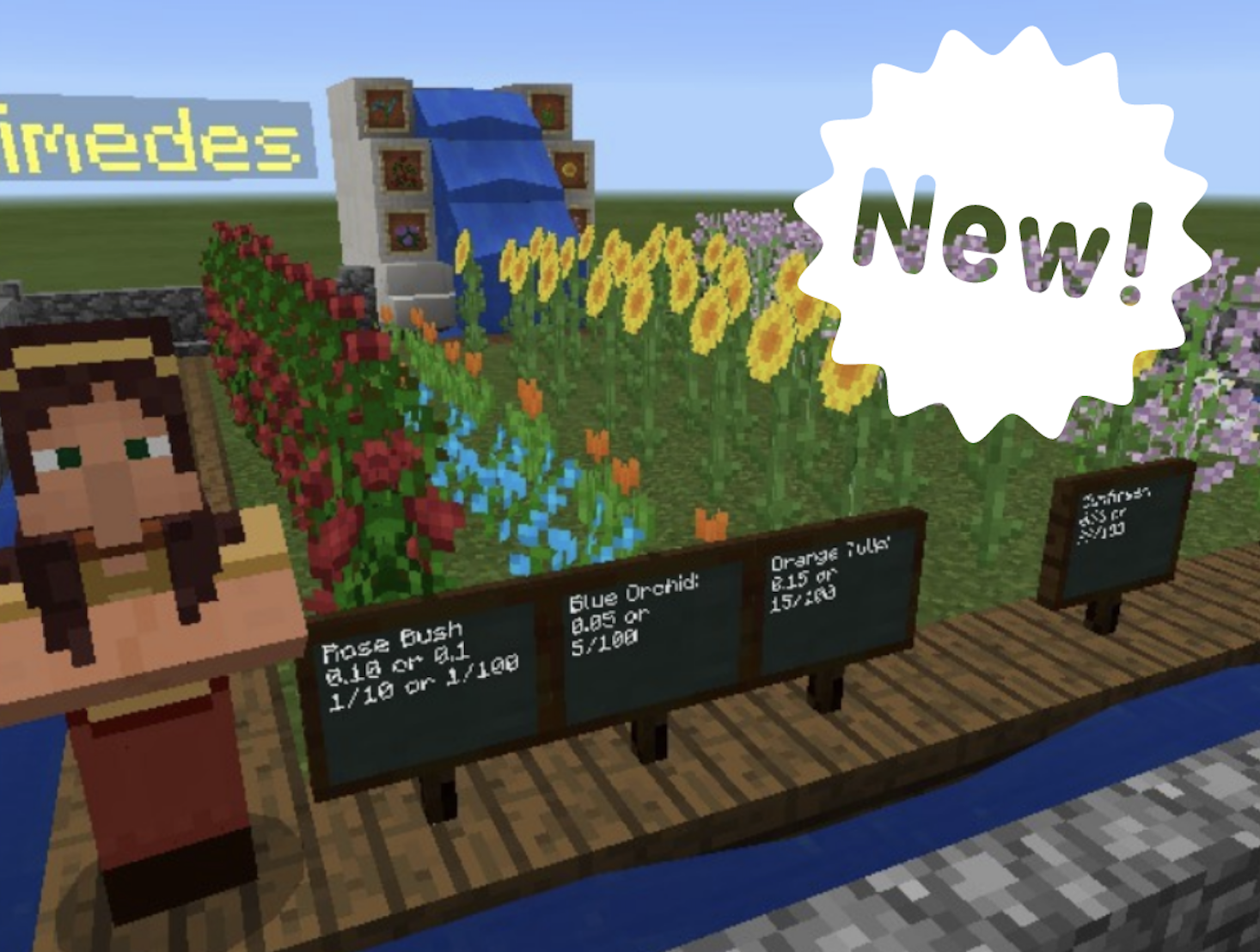
In this lesson, students will demonstrate understanding a fractional and decimal relationships using a 10 x 10 garden.
Welcome to this Minecraft: Education Edition lesson! Before you begin, take a few moments to let us know your thoughts or feedback on how we can improve this lesson in order to better enhance the learning experience that is delivered in your classroom!
Click here or follow the form below to complete the feedback survey once you've completed this lesson. Thank you!
Click and watch this teacher preparation video to help you understand how to teach this lesson. Here is a YouTube link of the teacher video for your reference: https://youtu.be/9pApddAQ9yY
Decimal Fraction Garden Teacher Video
Students will be able to relate fractions and decimals using base ten.
Students will be able to construct a 10 x 10 grid.
Students will be able to creatively design a "garden" and label their work.
Students will be able to present their work to their peers.
Creativity
Critical Thinking
Communication
1) How can we visualize fractions and decimals in the real world?
2) How do we relate fractions and decimals?
3) How can we represent parts of a whole?
Students should have a basic understanding of the relationship between fractions and decimals in base ten and base 100. However, the NPC has a link to a YouTube video that demonstrates this. Therefore, this activity may be used as an introductory or review activity.
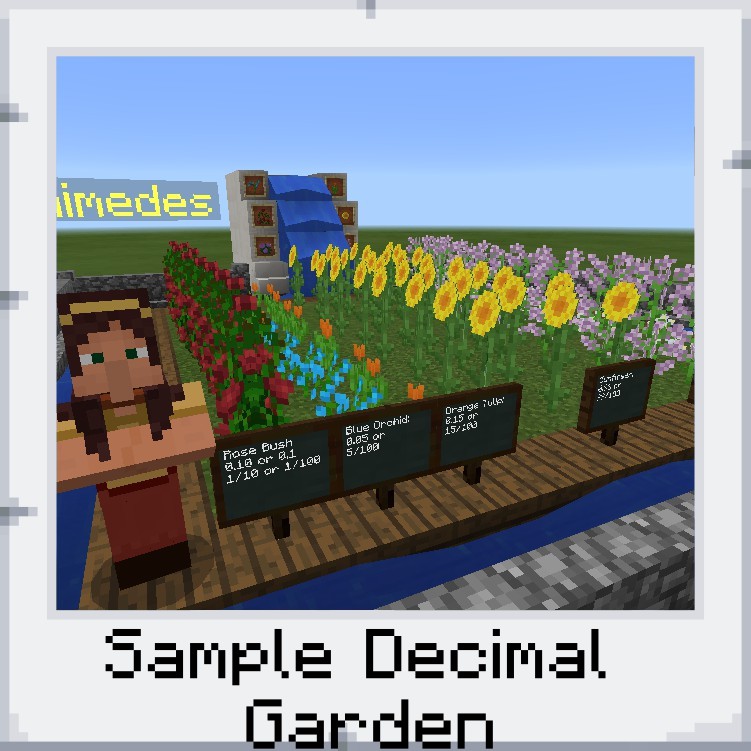
Students may view the sample world, Decimal_Garden. Students will then use graph paper to plan out a basic 10 x 10 grid and colour with crayons, markers, etc. Students will then go into Minecraft and build their decimal gardens. Students may choose to plant flowers, vegetables, ores, or other blocks.
Students will label their work using signs or slates. Students should use the camera and portfolio to document their work. If using the Decimal_Garden world, these are already set in the fixed inventory slots.
If time permits, students may decorate and embellish their gardens.
If students are more advanced, challenge them to find additional decimal or fractional equivalents.
Students will present their work at the end of the lesson.
Students will be able to relate decimals and fractions when using a base ten, or base one-hundred system.
Students will be able to demonstrate that decimals and fractions represent a part of a whole.
Students will be able to label and document their work.
Check out the Tips & Tricks video playlist that will help you and your students better use Minecraft: Education Edition in the classroom:
https://youtube.com/playlist?list=PLkh9rrdH-ARER03ojhFYtmoFDVuACYJLa
More videos added periodically so make sure you check often for more content!
Click and watch the student pause and play video with your class, pausing and playing as needed. This will help your students understand how to navigate through this lesson and Minecraft world and complete the activities located within them. Enjoy!
Check out the YouTube link of this video for your reference: https://youtu.be/82KIWn7tcuE
Student 'Pause & Play' Video
Specific Outcome 13: Demonstrate an understanding of fractions by:
explaining that a fraction represents a part of a whole
describing situations in which fractions are used
Specific Outcome 8: Demonstrate an understanding of fractions less than or equal to one by using concrete, pictorial and symbolic representations to:
name and record fractions for the parts of a whole or a set
model and explain that for different wholes, two identical fractions may not represent the same quantity
provide examples of where fractions are used.
Specific Outcome 9: Represent and describe decimals (tenths and hundredths), concretely, pictorially and symbolically
Specific Outcome 7: Demonstrate an understanding of fractions by using concrete, pictorial and symbolic representations to:
compare fractions with like and unlike denominators
Specific Outcome 8: Describe and represent decimals (tenths, hundredths, thousandths), concretely, pictorially and symbolically.
Specific Outcome 9: Relate decimals to fractions and fractions to decimals (to thousandths)
Specific Outcome 2: Solve problems involving whole numbers and decimal numbers
Identify needs and opportunities for designing, through exploration
Generate ideas from their experiences and interests
Add to others’ ideas
Choose an idea to pursue.
Making
Choose tools and materials
Make a product using known procedures or through modelling of others
Use trial and error to make changes, solve problems, or incorporate new ideas from self or others
Sharing
Decide on how and with whom to share their product
Demonstrate their product, tell the story of designing and making their product, and explain how their product contributes to the individual, family, community, and/or environment
Use personal preferences to evaluate the success of their design solutions
Reflect on their ability to work effectively both as individuals and collaboratively in a group
Use materials, tools, and technologies in a safe manner in both physical and digital environments
Develop their skills and add new ones through play and collaborative work
Explore the use of simple, available tools and technologies to extend their capabilities
Curricular Competencies
Develop mental math strategies and abilities to make sense of quantities
Use technology to explore mathematics
Understanding and solving
Develop, demonstrate, and apply mathematical understanding through play, inquiry, and problem solving
Content
Students are expected to know the following:
Fraction concepts: Fractions can represent parts of a region, set, or linear model.
Ordering and comparing fractions: Using concrete and visual models.
Decimals to hundredths:
Fractions and decimals are numbers that represent an amount or quantity.
Fractions and decimals can represent parts of a region, set, or linear model.
Fractional parts and decimals are equal shares or equal-sized portions of a whole or unit.
Understanding the relationship between fractions and decimals
Fractions: Two equivalent fractions are two ways to represent the same amount. Comparing and ordering of fractions and decimals. Equal partitioning.
Decimals to hundredths:
Using visual models such as base 10 blocks, place-value mats, grid paper, and number lines
Whole-class number talks
Improper fractions
Using benchmarks, number line, and common denominators to compare and order, including whole numbers.
Using pattern blocks, Cuisenaire Rods, fraction strips, fraction circles, grids
Identify needs and opportunities for designing, through exploration
Generate ideas from their experiences and interests
Add to others’ ideas
Choose an idea to pursue.
Making
Choose tools and materials
Make a product using known procedures or through modelling of others
Use trial and error to make changes, solve problems, or incorporate new ideas from self or others
Sharing
Decide on how and with whom to share their product
Demonstrate their product, tell the story of designing and making their product, and explain how their product contributes to the individual, family, community, and/or environment
Use personal preferences to evaluate the success of their design solutions
Reflect on their ability to work effectively both as individuals and collaboratively in a group
Use materials, tools, and technologies in a safe manner in both physical and digital environments
Develop their skills and add new ones through play and collaborative work
Explore the use of simple, available tools and technologies to extend their capabilities
Curricular Competencies
Develop mental math strategies and abilities to make sense of quantities
Use technology to explore mathematics
Understanding and solving
Develop, demonstrate, and apply mathematical understanding through play, inquiry, and problem solving
Content
Students are expected to know the following:
Fraction concepts: Fractions can represent parts of a region, set, or linear model.
Ordering and comparing fractions: Using concrete and visual models.
Decimals to hundredths:
Fractions and decimals are numbers that represent an amount or quantity.
Fractions and decimals can represent parts of a region, set, or linear model.
Fractional parts and decimals are equal shares or equal-sized portions of a whole or unit.
Understanding the relationship between fractions and decimals
Fractions: Two equivalent fractions are two ways to represent the same amount. Comparing and ordering of fractions and decimals. Equal partitioning.
Decimals to hundredths:
Using visual models such as base 10 blocks, place-value mats, grid paper, and number lines
Whole-class number talks
Improper fractions
Using benchmarks, number line, and common denominators to compare and order, including whole numbers.
Using pattern blocks, Cuisenaire Rods, fraction strips, fraction circles, grids
Numbers
B1.6 Fractions use drawings to represent, solve, and compare the results of fair-share problems that involve sharing up to 20 items among 2, 3, 4, 5, 6, 8, and 10 sharers, including problems that result in whole numbers, mixed numbers, and fractional amounts.
Algebra
C3.1 solve problems and create computational representations of mathematical situations by writing and executing code, including code that involves sequential, concurrent, and repeating events
C3.2 read and alter existing code, including code that involves sequential, concurrent, and repeating events, and describe how changes to the code affect the outcomes
Numbers
B1.4 Represent fractions from halves to tenths using drawings, tools, and standard fractional notation, and explain the meanings of the denominator and the numerator.
B1.5 Fractions and Decimals use drawings and models to represent, compare, and order fractions representing the individual portions that result from two different fair-share scenarios involving any combination of 2, 3, 4, 5, 6, 8, and 10 sharers.
B1.7 Fractions and Decimals read, represent, compare, and order decimal tenths, in various contexts
B1.9 Fractions and Decimals describe relationships and show equivalences among fractions and decimal tenths, in various contexts
Algebra
C3.1 solve problems and create computational representations of mathematical situations by writing and executing code, including code that involves sequential, concurrent, and repeating events
C3.2 read and alter existing code, including code that involves sequential, concurrent, and repeating events, and describe how changes to the code affect the outcomes
Numbers
B1.3 Fractions, Decimals, and Percents represent equivalent fractions from halves to twelfths, including improper fractions and mixed numbers, using appropriate tools, in various contexts.
B1.5 Fractions, Decimals, and Percents read, represent, compare, and order decimal numbers up to hundredths, in various contexts
B1.7 Describe relationships and show equivalences among fractions, decimal numbers up to hundredths, and whole number percents, using appropriate tools and drawings, in various contexts.
Algebra
C3.1 solve problems and create computational representations of mathematical situations by writing and executing code, including code that involves sequential, concurrent, and repeating events
C3.2 read and alter existing code, including code that involves sequential, concurrent, and repeating events, and describe how changes to the code affect the outcomes
Numbers
B1.3 Rational Numbers compare and order integers, decimal numbers, and fractions, separately and in combination, in various contexts.
B1.4 Fractions, Decimals, and Percents read, represent, compare, and order decimal numbers up to thousandths, in various contexts.
B1.6 Fractions, Decimals, and Percents describe relationships and show equivalences among fractions and decimal numbers up to thousandths, using appropriate tools and drawings, in various contexts.
Algebra
C3.1 solve problems and create computational representations of mathematical situations by writing and executing code, including code that involves sequential, concurrent, and repeating events
C3.2 read and alter existing code, including code that involves sequential, concurrent, and repeating events, and describe how changes to the code affect the outcomes
N3.4 Demonstrate understanding of fractions concretely, pictorially, physically, and orally including: • representing • observing and describing situations • comparing • relating to quantity.
N4.6 Demonstrate an understanding of fractions less than or equal to one by using concrete and pictorial representations to: • name and record fractions for the parts of a whole or a set • compare and order fractions • model and explain that for different wholes, two identical fractions may not represent the same quantity • provide examples of where fractions are used.
N4.7 Demonstrate an understanding of decimal numbers in tenths and hundredths (pictorially, orally, in writing, and symbolically) by: • describing • representing • relating to fractions.
N5.5 Demonstrate an understanding of fractions by using concrete and pictorial representations to: • create sets of equivalent fractions • compare fractions with like and unlike denominators.
N5.6 Demonstrate understanding of decimals to thousandths by: • describing and representing • relating to fractions • comparing and ordering.
N6.7 Extend understanding of fractions to improper fractions and mixed numbers.
3.N.13. Demonstrate an understanding of fractions by n explaining that a fraction represents a portion of a whole divided into equal parts in describing situations in which fractions are used n comparing fractions of the same whole with like denominators [C, CN, ME, R, V]
· Identify common characteristics of a set of fractions.
· Describe everyday situations where fractions are used.
· Represent a fraction concretely or pictorially.
4.N.8. Demonstrate an understanding of fractions less than or equal to one by using concrete and pictorial representations to n name and record fractions for the parts of a whole or a set n compare and order fractions n model and explain that for different wholes, two identical fractions may not represent the same quantity n provide examples of where fractions are used [C, CN, PS, R, V]
· Represent a fraction using concrete materials.
· Identify a fraction from its concrete representation.
· Name and record the shaded and non-shaded parts of a set.
· Name and record the shaded and non-shaded parts of a whole.
· Represent a fraction pictorially by shading parts of a whole.
· Name fractions between two benchmarks on a number line (horizontal or vertical).
· Order a set of fractions by placing them on a number line (horizontal or vertical) with benchmarks.
4.N.9. Describe and represent decimals (tenths and hundredths) concretely, pictorially, and symbolically. [C, CN, R, V]
4.N.10. Relate decimals to fractions (to hundredths).
4.N.11. Demonstrate an understanding of addition and subtraction of decimals (limited to hundredths) by:
· using compatible numbers
· estimating sums and differences
· using mental math strategies to solve problems
5.N.7. Demonstrate an understanding of fractions by using concrete and pictorial representations to n create sets of equivalent fractions n compare fractions with like and unlike denominators [C, CN, PS, R, V]
· Create a set of equivalent fractions and explain why there are many equivalent fractions for any fraction using concrete materials.
· Formulate and verify a rule for developing a set of equivalent fractions.
· Identify equivalent fractions for a fraction.
5.N.8. Describe and represent decimals (tenths, hundredths, and thousandths), concretely, pictorially, and symbolically. [C, CN, R, V]
5.N.9. Relate decimals to fractions (tenths, hundredths, thousandths)
Fractions:
· Represents a fraction in a variety of ways, based on a whole or a collection of objects.
· Uses objects, diagrams or equations to represent a situation and conversely, describes a situation represented by objects, diagrams or equations (use of different meanings of addition, subtraction and multiplication by a natural number)
· Generates a set of equivalent fractions
· Reduces a fraction to its simplest form (lowest terms)
· Matches a decimal or percentage to a fraction
· Represents decimals in a variety of ways (using objects or drawings)
· Identifies equivalent representations (using objects or drawings)
· Matches a fraction to its decimal
N13: Demonstrate an understanding of fractions by: • explaining that a fraction represents a part of a whole; • describing situations in which fractions are used; • comparing fractions of the same whole with like denominators.
N8: Demonstrate an understanding of fractions less than or equal to one by using concrete and pictorial representations to: name and record fractions for the parts of a whole or a set; compare and order fractions; model and explain that for different wholes, two identical fractions may not represent the same quantity; provide examples of where fractions are used.
N9: Describe and represent decimals (tenths and hundredths) concretely, pictorially and symbolically.
N10: Relate decimals to fractions (to hundredths).
N7: Demonstrate an understanding of fractions by using concrete and pictorial representations to: create sets of equivalent fractions; compare fractions with like and unlike denominators.
N8: Describe and represent decimals (tenths, hundredths, thousandths) concretely, pictorially and symbolically.
N9: Relate decimals to fractions (to thousandths).
N10: Compare and order decimals (to thousandths) by using: • benchmarks • place value • equivalent decimals.
N4: Relate improper fractions to mixed numbers.
N13: Students will be expected to demonstrate an understanding of fractions by · explaining that a fraction represents a part of a whole · describing situations in which fractions are used · comparing fractions of the same whole with like denominators.
N08: Students will be expected to demonstrate an understanding of fractions less than or equal to 1 by using concrete, pictorial, and symbolic representations to name and record fractions for the parts of one whole or a set compare and order fractions model and explain that for different wholes, two identical fractions may not represent the same quantity provide examples of where fractions are used
N09: Students will be expected to describe and represent decimals (tenths and hundredths) concretely, pictorially, and symbolically.
N10: Students will be expected to relate decimals to fractions and fractions to decimals (to hundredths).
N07: Students will be expected to demonstrate an understanding of fractions by using concrete, pictorial, and symbolic representations to create sets of equivalent fractions compare and order fractions with like and unlike denominators.
N08: Students will be expected to describe and represent decimals (tenths, hundredths, and thousandths) concretely, pictorially, and symbolically.
N09: Students will be expected to relate decimals to fractions and fractions to decimals (to thousandths).
N04: Students will be expected to relate improper fractions to mixed numbers and mixed numbers to improper fractions.
3N13 Demonstrate an understanding of fractions by: • explaining that a fraction represents a part of a whole • describing situations in which fractions are used • comparing fractions of the same whole that have like denominators.
4N8 Demonstrate an understanding of fractions less than or equal to one by using concrete, pictorial and symbolic representations to: • name and record fractions for the parts of a whole or a set • compare and order fractions • model and explain that for different wholes, two identical fractions may not represent the same quantity • provide examples of where fractions are used.
4N9 Represent and describe decimals (tenths and hundredths), concretely, pictorially and symbolically. [C, CN, R, V]
4N10 Relate decimals to fractions and fractions to decimals (to hundredths).
5N7 Demonstrate an understanding of fractions by using concrete, pictorial and symbolic representations to: • create sets of equivalent fractions • compare fractions with like and unlike denominators.
5N8 Describe and represent decimals (tenths, hundredths, thousandths), concretely, pictorially and symbolically.
5N9 Relate decimals to fractions and fractions to decimals (to thousandths).
N13 Demonstrate an understanding of fractions by: • explaining that a fraction represents a part of a whole; • describing situations in which fractions are used; • comparing fractions of the same whole with like denominators.
N8 Demonstrate an understanding of fractions less than or equal to one by using concrete and pictorial representations to: name and record fractions for the parts of a whole or a set; compare and order fractions; model and explain that for different wholes, two identical fractions may not represent the same quantity; provide examples of where fractions are used.
N9: Describe and represent decimals (tenths and hundredths) concretely, pictorially and symbolically.
N10: Relate decimals to fractions (to hundredths).
N7 Demonstrate an understanding of fractions by using concrete and pictorial representations to: create sets of equivalent fractions; compare fractions with like and unlike denominators.
N8: Describe and represent decimals (tenths, hundredths, thousandths) concretely, pictorially and symbolically.
N9: Relate decimals to fractions (to thousandths).
N10: Compare and order decimals (to thousandths) by using: • benchmarks • place value • equivalent decimals.
N4 Relate improper fractions to mixed numbers.