
Loading…
Loading…
In this lesson, students will demonstrate understanding that substances are made from different types of atoms, which combine with one another in various ways.
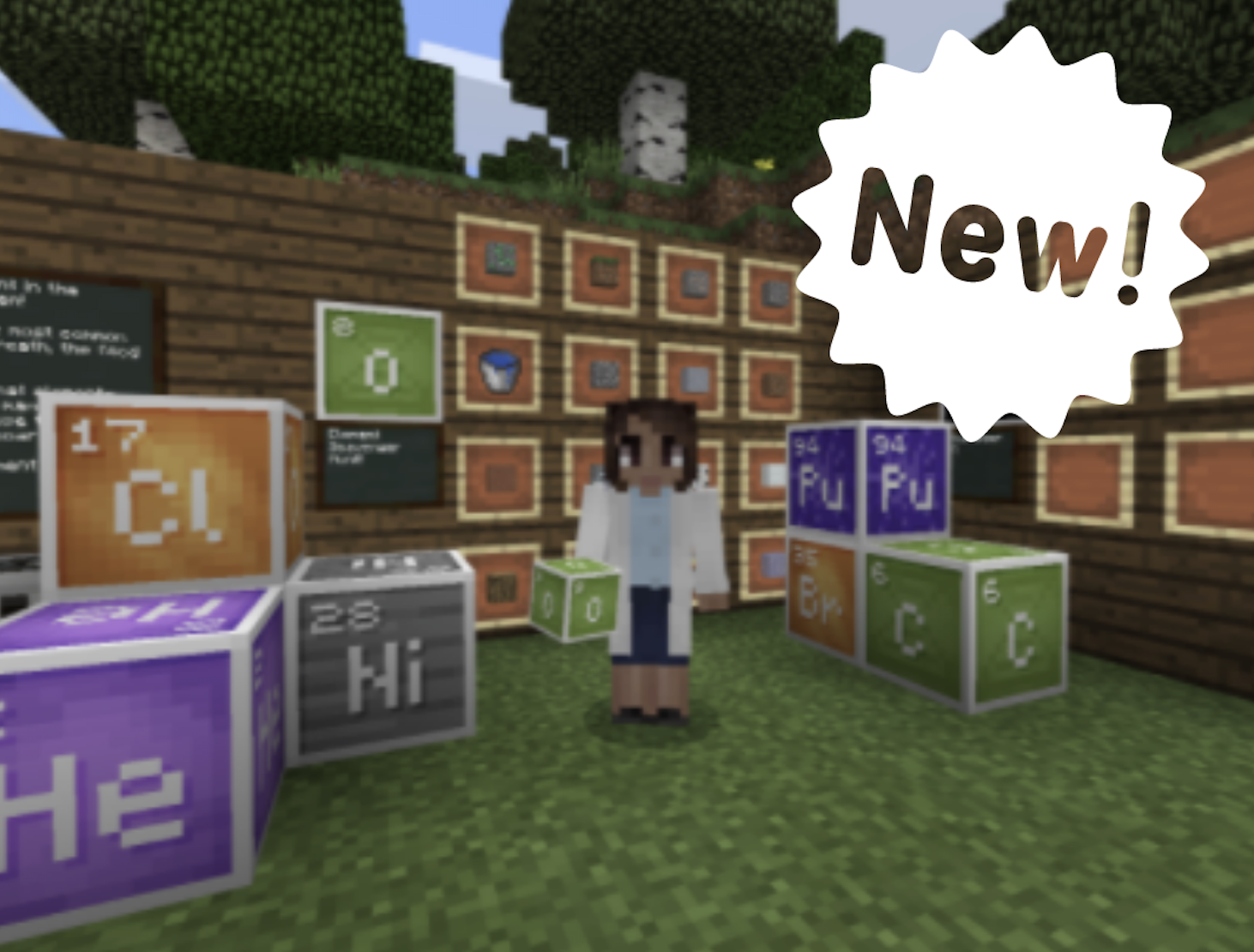
Welcome to this Minecraft: Education Edition lesson! Before you begin, take a few moments to let us know your thoughts or feedback on how we can improve this lesson in order to better enhance the learning experience that is delivered in your classroom!
Click here or follow the form below to complete the feedback survey once you've completed this lesson. Thank you!
Click and watch this teacher preparation video to help you understand how to teach this lesson. Here is a YouTube link of the teacher video for your reference: https://youtu.be/5Lc7uEXduAA
Start Here: Teacher Preparation Video
Use the material reducer to explore the structure and properties of matter.
Understand that substances are made from different types of atoms, which combine with one another in various ways.
Critical thinking
Project Based Learning
Matter is made of smaller parts called atoms.
All natural and synthetic materials are composed of elements (individual atoms), molecules, or compounds.
Many materials have similar elemental compositions but different properties. For example most stone-like materials are composed of silicon and oxygen. Whilst living things are largely carbon, oxygen, nitrogen and hydrogen.
In Minecraft, the material reducer can be used to see what elements form common materials. This is similar to real word instruments used to measure the elemental composition of materials.
Building on the concept that matter is composed of smaller parts. Explain that the most common element on Earth’s surface is oxygen. Have student load the supplied Minecraft world file.
In this scavenger hunt world, students will use the material reducer to find as many materials as you can that contain oxygen. Once they have confirmed that the Minecraft block contain oxygen, they should add the block to one of the picture frames.
Have a competition to see who can fill all their frames the fastest.
Once they have finished, you could extend by having assigning students to find a different element.
After completing the activity, discuss techniques scientists use to determine the elemental composition of materials in the real world (ex: CHNS Analysis, Mass Spectrometry).
To further demonstrate the concept that oxygen atoms exist as part of certain types of matter, conduct an experiment such as making “Elephant Toothpaste” or mixing vinegar and baking soda to demonstrate the presence of oxygen.
Students demonstrate understanding that substances are made from different types of atoms, which combine with one another in various ways.
Check out the Tips & Tricks video playlist that will help you and your students better use Minecraft: Education Edition in the classroom:
https://youtube.com/playlist?list=PLkh9rrdH-ARER03ojhFYtmoFDVuACYJLa
More videos added periodically so make sure you check often for more content!
Click and watch the student pause and play video with your class, pausing and playing as needed. This will help your students understand how to navigate through this lesson and Minecraft world and complete the activities located within them. Enjoy!
Check out the YouTube link for your reference: https://youtu.be/uOfWZn1wJk0
Student 'Pause & Play' Video
Use materials, tools, and technologies in a safe manner, and with an awareness of the safety of others, in both physical and digital environments
Content: The effect of Temperature
Solids, liquids, and gases change with heating (e.g., boiling point, melting point [melting chocolate]) and cooling (e.g., freezing point [making ice cream]), and these physical changes are reversible
Identify the skills required for a task and develop those skills as needed
Content: Properties of solutions: concentration, pH, etc.
Computational Thinking
simple algorithms that reflect computational thinking
visual representations of problems and data
evolution of programming languages
visual programming
Content: Heterogeneous mixtures - suspensions, emulsions, colloids
Robotics
a robot is a machine capable of carrying out a complex series of actions automatically
uses of robotics
various ways that objects can move
programming and logic for robotics components
various platforms for robotics
Big Ideas: Elements consist of one type of atom, and compounds consist of atoms of different elements chemically combined.
Content: Elements - a pure substance consisting of a single type of atom, as distinguished by its atomic number (e.g., iron, copper)
Computational Thinking
software programs as specific and sequential instructions with algorithms that can be reliably repeated by others
debugging algorithms and programs by breaking problems down into a series of sub-problems
binary number system (1s and 0s) to represent data
programming languages, including visual programming in relation to text-based programming and programming modular components
Content: Protons, Neutrons, and Quarks - Protons and neutrons (made of quarks) are held together in the nucleus by a strong nuclear force.
4–1 - Investigate the nature of things, demonstrating purposeful action that leads to inferences supported by observations.
4–4 - Demonstrate positive attitudes for the study of science and for the application of science in responsible ways.
Specific Learner Expectations
Students will show growth in acquiring and applying the following traits:
• curiosity
• confidence in personal ability to explore materials and learn by direct study
• inventiveness and willingness to consider new ideas
• perseverance in the search for understandings and for solutions to problems
• a willingness to base their conclusions and actions on the evidence of their own experiences
• a willingness to work with others in shared activities and in sharing of experiences
• appreciation of the benefits gained from shared effort and cooperation
• a sense of responsibility for personal and group actions
• respect for living things and environments, and commitment for their care.
5–4 Demonstrate positive attitudes for the study of science and for the application of science in responsible ways.
Specific Learner Expectations
Students will show growth in acquiring and applying the following traits:
• curiosity
• confidence in personal ability to learn and develop problem-solving skills
• inventiveness and open-mindedness
• perseverance in the search for understandings and for solutions to problems
• flexibility in considering new ideas
• critical-mindedness in examining evidence and determining what the evidence means
• a willingness to use evidence as the basis for their conclusions and actions
• a willingness to work with others in shared activities and in sharing of experiences
• appreciation of the benefits gained from shared effort and cooperation
• a sense of personal and shared responsibility for actions taken
• respect for living things and environments, and commitment for their care.
6–4 Demonstrate positive attitudes for the study of science and for the application of science in responsible ways.
Specific Learner Expectations
Students will show growth in acquiring and applying the following traits:
• curiosity
• confidence in personal ability to learn and develop problem-solving skills
• inventiveness and open-mindedness
• perseverance in the search for understandings and for solutions to problems
• flexibility in considering new ideas
• critical-mindedness in examining evidence and determining what the evidence means
• a willingness to use evidence as the basis for their conclusions and actions
• a willingness to work with others in shared activities and in sharing of experiences
• appreciation of the benefits gained from shared effort and cooperation
• a sense of personal and shared responsibility for actions taken
• respect for living things and environments, and commitment for their care.
Scientific Inquiry:
Seek and apply evidence when evaluating alternative approaches to investigations, problems and issues
Collaboration:
Work collaboratively in carrying out investigations and in generating and evaluating ideas
Mix and Flow of Matter:
Investigate and describe the composition of fluids, and interpret the behaviour of materials in solution. Distinguish among pure substances, mixtures and solutions, using common examples (e.g., identify examples found in households)
1. Relating Science and Technology to Society and the Environment
1.2 analyze the impact on society and the environment of extracting and refining rocks and minerals for human use, taking different perspectives into account
1. Relating Science and Technology to Society and the Environment
2.3 use scientific inquiry/research skills to investigate how structures are built to withstand forces. Sample guiding questions: What different materials and construction techniques are used to build structures
UNDERSTANDING MATTER AND ENERGY: The properties of materials determine their use and may have an effect on society and the environment. (Overall expectation 1)
1. Relating Science and Technology to Society and the Environment
1.2 assess the benefits that human societies derive from biodiversity (e.g., thousands of products such as food, clothing, medicine, and building materials come from plants and animals)
3. Understanding Basic Concepts
3.3 Describe the roles and interactions of producers, consumers, and decomposers within an ecosystem (e.g., Plants are producers in ponds. They take energy from the sun and produce food, oxygen,
3.8 identify common sources of greenhouse gases
Fundamental Concepts: Systems and Interactions - Big Ideas: Ecosystems are made up of biotic (living) and abiotic (non-living) elements, which depend on each other to survive. (Overall expectations 2 and 3)
1. Relating Science and Technology to Society and the Environment
1.2 assess the potential that our understanding of cells and cell processes has for both beneficial and harmful effects on human health and the environment, taking different perspectives into account (e.g., the perspectives of farmers, pesticide manufacturers, people with life-threatening illnesses)
2.6 use a variety of forms (e.g., oral, written, graphic, multimedia) to communicate with different audiences and for a variety of purposes
Earth and Space Science: Rocks, Minerals, and Erosion
RM4.1: Investigate physical properties of rocks and minerals, including those found in the local environment.
Physical Science: Properties and Changes of Materials
MC5.1: Investigate the characteristics and physical properties of materials in solid, liquid, and gaseous states of matter.
Earth and Space Science: Rocks, Minerals, and Erosion
RM4.1: Investigate physical properties of rocks and minerals, including those found in the local environment.
RM4.2: Assess how human uses of rocks and minerals impact self, society, and the environment.
Earth and Space Science: Earth's Crust and Resources
EC7.3: Investigate the characteristics and formation of the surface geology of Saskatchewan, including soil, and identify correlations between surface geology and past, present, and possible future land uses.
Physical Science: Mixtures and Solutions
MS7.1: Distinguish between pure substances and mixtures (mechanical mixtures and solutions) using the particle model of matter
Physical Science: Forces, Fluids, and Density
FD8.1: Investigate and represent the density of solids, liquids, and gases based on the particle theory of matter.
Cluster 0:
4-0-2a. Access information using a variety of sources. Examples: school libraries, videos, traditional knowledge, CD-ROMs, Internet... (ELA 3.2.2, 3.2.4, TFS 2.1.1)
7b. Identify new questions that arise from what was learned. (ELA 3.3.4) GLO: A1, C2, C3
Cluster 0:
5-0-1b Identify various methods for finding the answer to a specific question and, with guidance, select one to implement. Examples: generating experimental data; accessing information from a variety of sources… GLO: C2 (ELA Grade 5, 3.2.2; Math: SP-II.1.5)
5-0-5c Select and use tools and instruments to observe, measure, and construct. Include: balance, thermometer, spring scale, weather instruments. GLO: C2, C3, C5
5-0-5f Record and organize observations in a variety of ways. Examples: point-form notes, sentences, labelled diagrams, charts, ordered lists of data, frequency diagrams, spread sheets…
Cluster 2:
5-2-03 Investigate to determine how characteristics and properties of substances may change when they interact with one other. Examples: baking soda in vinegar produces a gas; adding flour to water produces a sticky paste... GLO: C2, D3, E3
Cluster 0:
6-0-1b Identify various methods for finding the answer to a specific question and select one to implement. Examples: generating experimental data; accessing information from a variety of sources
6-0-5a Make observations that are relevant to a specific question. GLO: A1, A2, C2
6-0-7a Draw a conclusion that explains investigation results.
Cluster 0:
7-0-2a Access information using a variety of sources.
7-0-1b Select and justify a method to be used in finding the answer to a specific question. GLO: C2
7-0-8d Describe examples of how technologies have evolved over time in response to changing needs and scientific advances.
7-0-9c Demonstrate confidence in their ability to carry out investigations.
Cluster 0:
8-0-1a Formulate specific questions that lead to investigations. Include: rephrase questions to a testable form; focus research questions.
8-0-9b Express interest in a broad scope of science and technology related fields and issues.
Terminology related to an understanding of the material world a. Appropriately uses terminology related to the material world
Earth and Space
Matter: Compares the properties of different types of soil (e.g. composition)
Terminology related to an understanding of the material world a. Appropriately uses terminology related to the material world
Material World
Matter: Recognizes the materials of which an object is made
Earth and Space
Matter: Classifies rocks (presence of strata, size of the crystals) and minerals (colour, texture, lustre, hardness) according to their properties
Material World
Matter: Recognizes the materials of which an object is made
Earth and Space
Matter: Classifies rocks (presence of strata, size of the crystals) and minerals (colour, texture, lustre, hardness) according to their properties
Core Competencies
Discover that science and technology as well as the different branches of science (biology, chemistry, physics, Earth science and space science) complement one another
The Earth and Space
Cycle 1: General characteristics of the Earth
Core Competencies
Discover that science and technology as well as the different branches of science (biology, chemistry, physics, Earth science and space science) complement one another
The Earth and Space
Cycle 1: General characteristics of the Earth
SCO 1.2 Students will collect data by observing and measuring, using tools and methods appropriate for the task. Students will analyze and interpret patterns in data to construct explanations based on evidence from investigations.
GCO 1: Students will develop the skills required for scientific and technological inquiries, for solving problems, for communicating scientific ideas and results, for working collaboratively, and for making informed decisions (scientific literacy).
SCO 1.4: Students will communicate valid conclusions supported by data in writing, by drawing pictures, and through verbal discussion.
SCO 1.1 Students will plan investigations by asking questions, making inferences, and selecting and using equipment or technology needed to solve a specific problem in the natural world.
SCO 1.2 Students will collect data by observing and measuring, using tools and methods appropriate for the task.
GCO 1 Students will develop the skills required for scientific and technological inquiries, for solving problems, for communicating scientific ideas and results, for working collaboratively, and for making informed decisions (scientific literacy).
SCO 1.2 Students will collect data by observing and measuring, using tools and methods appropriate for the task
SCO 1.1 Students will ask questions about relationships between and among observable variables to plan investigations (scientific inquiry and technological problem-solving) to address those questions.
SCO 1.2 Students will collect and represent data using tools and methods appropriate for the task.
SCO 1.4 Students will work collaboratively on investigations to communicate conclusions supported by data.
The Nature of Science
GCO 1 Students will use scientific inquiry and technological design skills to solve practical problems, communicate scientific ideas and results, and make informed decisions while working collaboratively
The Nature of Science
SCO 1.4 Students will work collaboratively on investigations to communicate conclusions supported by data.
SCO 1.2 Students will collect and represent data using tools and methods appropriate for the task.
Earth and Space Science: Rocks and Minerals
Investigate properties of rocks and minerals in the local environment (CZ, COM, CT)
Classify local rocks and minerals (COM, CI, CT)
Physical Science: Chemical and Physical Properties
Investigate physical and chemical properties of matter (COM, CT, TF)
Life Science: Diversity of Life
Investigate the characteristics of living things (COM, CT)
Life Science: Interactions Within Ecosystems
Components of an Ecosystem • identify questions, investigate, classify, and record data collected on the components of an ecosystem using materials effectively
Physical Science: Initiating and Planning
208-2 identify questions to investigate arising from practical problems and issues
Properties of Rocks and Minerals
Classify their rocks and minerals according to several properties and create a chart or diagram that show the method of classifying (206-1, 207-2)
Compare their classification schemes of the rocks/minerals to those of others and recognize that results may vary (104-4)
Physical Science: Properties and Changes in Materials
Identify properties that allow materials to be distinguished from one another (104-7, 300-10)
Classify materials as solids, liquids, or gases, and illustrate this classification in a chart that shows their properties (206-1, 300-9)
The Role of a Common Classification Scheme for Living Things
104-5 Describe how classifications may vary and suggest possible explanations for variations
204-1 propose questions to investigate and practical problems to solve
7SCIA
PS3 Design and conduct experiments to explore methods of separating mixtures and solutions, and extend the impact of those methods on society and the environment.
7SCIA
ESS1 Identify the characteristics and relationships between rocks and minerals.
8SCIA
PS2 Compare the density of various substances qualitatively and quantitatively.
Collaborate to design an experiment, and identify major variables, in order to investigate floating, sinking, and density.
Describe practical applications that have developed over time that are based on differing densities (e.g., hot-air balloons, wooden boats, Galileo thermometer, oil/water separators).
GCO 3 - Rocks, Minerals, and Erosion
Compare rocks and minerals - Describe rocks and minerals
41.0 Explore how science and technology have been used to solve problems in the home and at school [GCO 1]
7.0 Identify appropriate tools, instruments, and materials to complete investigations [GCO 2]
18.0 compile and display data [GCO 2]
21.0 draw a conclusion that answers an initial question [GCO 2]
GCO 1: STSE
Demonstrate that science and technology use specific processes to investigate the natural and constructed world or to seek solutions to practical problems
38.0 describe examples of improvements to the tools and techniques of scientific investigation that have led to new discoveries [GCO 1]
GCO 3: Earth’s Crust
Classify rocks and minerals
SCO
1.4 express a point of view and support it with personal examples and evidence from various sources
1.5 use active listening skills to interpret main ideas and the relevancy of supporting details
4–1 - Investigate the nature of things, demonstrating purposeful action that leads to inferences supported by observations.
4–4 - Demonstrate positive attitudes for the study of science and for the application of science in responsible ways.
Specific Learner Expectations
Students will show growth in acquiring and applying the following traits:
• curiosity
• confidence in personal ability to explore materials and learn by direct study
• inventiveness and willingness to consider new ideas
• perseverance in the search for understandings and for solutions to problems
• a willingness to base their conclusions and actions on the evidence of their own experiences
• a willingness to work with others in shared activities and in sharing of experiences
• appreciation of the benefits gained from shared effort and cooperation
• a sense of responsibility for personal and group actions
• respect for living things and environments, and commitment for their care.
5–4 Demonstrate positive attitudes for the study of science and for the application of science in responsible ways.
Specific Learner Expectations
Students will show growth in acquiring and applying the following traits:
• curiosity
• confidence in personal ability to learn and develop problem-solving skills
• inventiveness and open-mindedness
• perseverance in the search for understandings and for solutions to problems
• flexibility in considering new ideas
• critical-mindedness in examining evidence and determining what the evidence means
• a willingness to use evidence as the basis for their conclusions and actions
• a willingness to work with others in shared activities and in sharing of experiences
• appreciation of the benefits gained from shared effort and cooperation
• a sense of personal and shared responsibility for actions taken
• respect for living things and environments, and commitment for their care.
6–4 Demonstrate positive attitudes for the study of science and for the application of science in responsible ways.
Specific Learner Expectations
Students will show growth in acquiring and applying the following traits:
• curiosity
• confidence in personal ability to learn and develop problem-solving skills
• inventiveness and open-mindedness
• perseverance in the search for understandings and for solutions to problems
• flexibility in considering new ideas
• critical-mindedness in examining evidence and determining what the evidence means
• a willingness to use evidence as the basis for their conclusions and actions
• a willingness to work with others in shared activities and in sharing of experiences
• appreciation of the benefits gained from shared effort and cooperation
• a sense of personal and shared responsibility for actions taken
• respect for living things and environments, and commitment for their care.
Scientific Inquiry:
Seek and apply evidence when evaluating alternative approaches to investigations, problems and issues
Collaboration:
Work collaboratively in carrying out investigations and in generating and evaluating ideas
Mix and Flow of Matter:
Investigate and describe the composition of fluids, and interpret the behaviour of materials in solution. Distinguish among pure substances, mixtures and solutions, using common examples (e.g., identify examples found in households)
4–1 - Investigate the nature of things, demonstrating purposeful action that leads to inferences supported by observations.
4–4 - Demonstrate positive attitudes for the study of science and for the application of science in responsible ways.
Specific Learner Expectations
Students will show growth in acquiring and applying the following traits:
• curiosity
• confidence in personal ability to explore materials and learn by direct study
• inventiveness and willingness to consider new ideas
• perseverance in the search for understandings and for solutions to problems
• a willingness to base their conclusions and actions on the evidence of their own experiences
• a willingness to work with others in shared activities and in sharing of experiences
• appreciation of the benefits gained from shared effort and cooperation
• a sense of responsibility for personal and group actions
• respect for living things and environments, and commitment for their care.
5–4 Demonstrate positive attitudes for the study of science and for the application of science in responsible ways.
Specific Learner Expectations
Students will show growth in acquiring and applying the following traits:
• curiosity
• confidence in personal ability to learn and develop problem-solving skills
• inventiveness and open-mindedness
• perseverance in the search for understandings and for solutions to problems
• flexibility in considering new ideas
• critical-mindedness in examining evidence and determining what the evidence means
• a willingness to use evidence as the basis for their conclusions and actions
• a willingness to work with others in shared activities and in sharing of experiences
• appreciation of the benefits gained from shared effort and cooperation
• a sense of personal and shared responsibility for actions taken
• respect for living things and environments, and commitment for their care.
6–4 Demonstrate positive attitudes for the study of science and for the application of science in responsible ways.
Specific Learner Expectations
Students will show growth in acquiring and applying the following traits:
• curiosity
• confidence in personal ability to learn and develop problem-solving skills
• inventiveness and open-mindedness
• perseverance in the search for understandings and for solutions to problems
• flexibility in considering new ideas
• critical-mindedness in examining evidence and determining what the evidence means
• a willingness to use evidence as the basis for their conclusions and actions
• a willingness to work with others in shared activities and in sharing of experiences
• appreciation of the benefits gained from shared effort and cooperation
• a sense of personal and shared responsibility for actions taken
• respect for living things and environments, and commitment for their care.
Scientific Inquiry:
Seek and apply evidence when evaluating alternative approaches to investigations, problems and issues
Collaboration:
Work collaboratively in carrying out investigations and in generating and evaluating ideas
Mix and Flow of Matter:
Investigate and describe the composition of fluids, and interpret the behaviour of materials in solution. Distinguish among pure substances, mixtures and solutions, using common examples (e.g., identify examples found in households)
Use materials, tools, and technologies in a safe manner, and with an awareness of the safety of others, in both physical and digital environments
Content: The effect of Temperature
Solids, liquids, and gases change with heating (e.g., boiling point, melting point [melting chocolate]) and cooling (e.g., freezing point [making ice cream]), and these physical changes are reversible
Identify the skills required for a task and develop those skills as needed
Content: Properties of solutions: concentration, pH, etc.
Computational Thinking
simple algorithms that reflect computational thinking
visual representations of problems and data
evolution of programming languages
visual programming
Content: Heterogeneous mixtures - suspensions, emulsions, colloids
Robotics
a robot is a machine capable of carrying out a complex series of actions automatically
uses of robotics
various ways that objects can move
programming and logic for robotics components
various platforms for robotics
Big Ideas: Elements consist of one type of atom, and compounds consist of atoms of different elements chemically combined.
Content: Elements - a pure substance consisting of a single type of atom, as distinguished by its atomic number (e.g., iron, copper)
Computational Thinking
software programs as specific and sequential instructions with algorithms that can be reliably repeated by others
debugging algorithms and programs by breaking problems down into a series of sub-problems
binary number system (1s and 0s) to represent data
programming languages, including visual programming in relation to text-based programming and programming modular components
Content: Protons, Neutrons, and Quarks - Protons and neutrons (made of quarks) are held together in the nucleus by a strong nuclear force.