
Loading…
Loading…
In this lesson, students will get a chance to travel to ancient Egypt and play an escape room inside a pyramid.
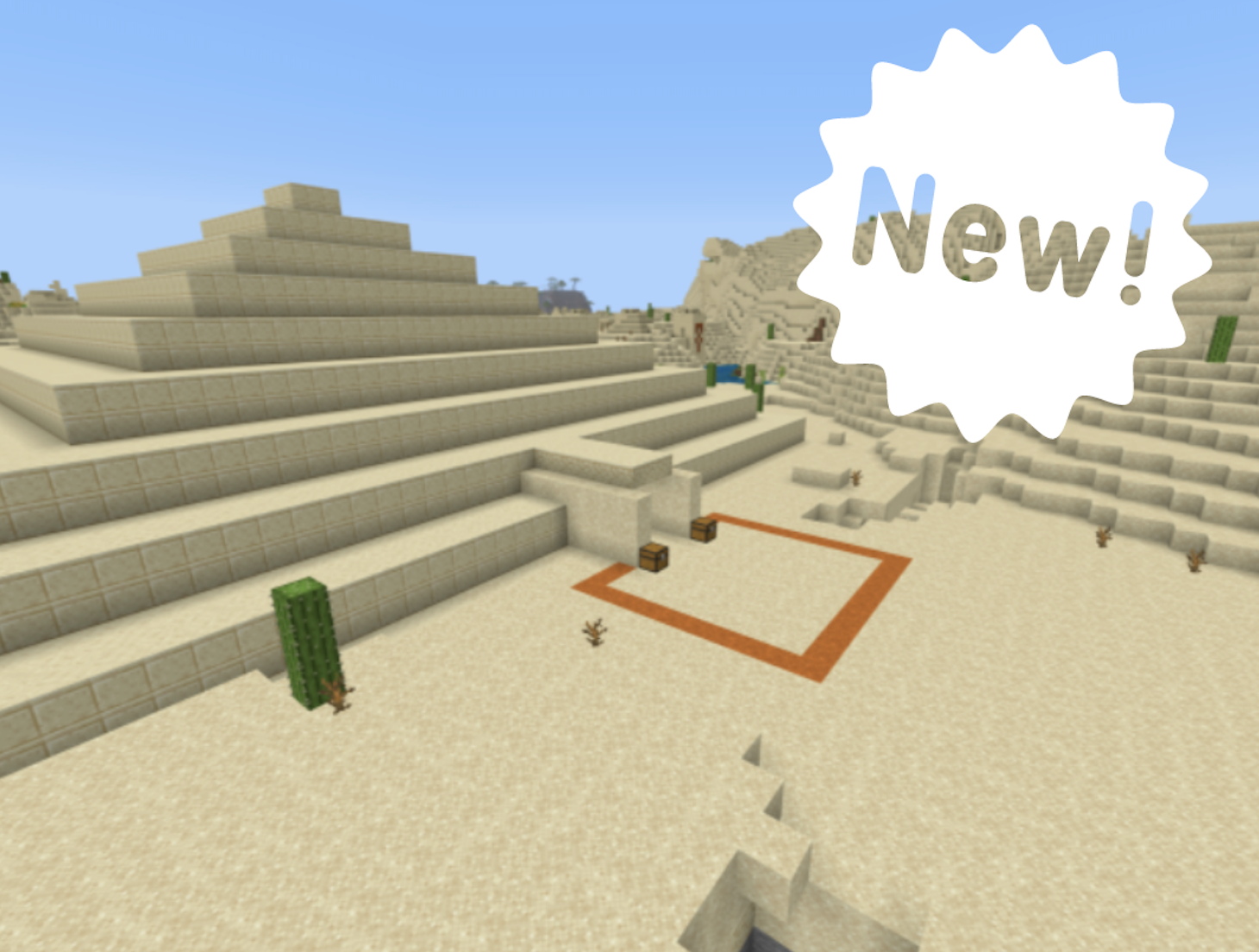
Welcome to this Minecraft: Education Edition lesson! Before you begin, take a few moments to let us know your thoughts or feedback on how we can improve this lesson in order to better enhance the learning experience that is delivered in your classroom!
Click here or follow the form below to complete the feedback survey once you've completed this lesson. Thank you!
Click and watch this teacher preparation video to help you understand how to teach this lesson. Here is a YouTube link of the teacher video for your reference: https://youtu.be/tuz70PuFtC8
Start Here: Teacher Preparation Video
Learn how to solve problems creatively
Learn about ancient Egypt and pharaohs
Learn how to move and interact in Minecraft
Creativity
Communication
Critical Thinking
The students can play in groups of three-four members in the same world or individually.
Inside the world there is no written instructions. As a teacher you can place a NPC or a board to introduce the adventure to the students.
In the pyramid they will have to look around and try to find the clues to solve the different challenges and get to the next room (you can download the file with all the solutions to the adventure)
At the end, the students will be able to exit the pyramid and explore the desert, in case you want to continue teaching about Egypt or climate.
The students will face different challenge. In each one of them, they will have to look around, at colours and patterns, trying to find the correct solution to the challenge. If they fail they won’t be able to continue the adventure, but they can try again as many times as they need. There is no punishment when they make a mistake, the only thing they are going to lose is time.
To encourage and motivate the students, the teacher can set a timer to measure the time each student or group need to complete the pyramid.
For each room you can ask the students to take a screenshot with their camera and create an adventure diary explaining each challenge.
Students won’t be able to skip the challenges so the teacher can see how they are doing in the world just by looking at their screen and the room the students are in.
All the mechanics in the pyramid are quite basic, they are powered by redstone (no command blocks or anything more advanced) so at the end we can ask the students to play in creative mode and world builder status, to learn how it works and try to recreate one of the rooms.
Check out the Tips & Tricks video playlist that will help you and your students better use Minecraft: Education Edition in the classroom:
https://youtube.com/playlist?list=PLkh9rrdH-ARER03ojhFYtmoFDVuACYJLa
More videos added periodically so make sure you check often for more content!
Click and watch the student pause and play video with your class, pausing and playing as needed. This will help your students understand how to navigate through this lesson and Minecraft world and complete the activities located within them. Enjoy!
Check out the YouTube link for your reference: https://youtu.be/hIxVNRv-E10
Student 'Pause & Play' Video
Identify needs and opportunities for designing, through exploration
Generate ideas from their experiences and interests
Add to others’ ideas
Choose an idea to pursue.
Making
Choose tools and materials
Make a product using known procedures or through modelling of others
Use trial and error to make changes, solve problems, or incorporate new ideas from self or others
Sharing
Decide on how and with whom to share their product
Demonstrate their product, tell the story of designing and making their product, and explain how their product contributes to the individual, family, community, and/or environment
Use personal preferences to evaluate the success of their design solutions
Reflect on their ability to work effectively both as individuals and collaboratively in a group
Use materials, tools, and technologies in a safe manner in both physical and digital environments
Develop their skills and add new ones through play and collaborative work
Explore the use of simple, available tools and technologies to extend their capabilities
Curricular Competencies
Develop mental math strategies and abilities to make sense of quantities
Use technology to explore mathematics
Understanding and solving
Develop, demonstrate, and apply mathematical understanding through play, inquiry, and problem solving
Content
Students are expected to know the following:
Curricular Competencies
Use Social Studies inquiry processes and skills to ask questions; gather, interpret, and analyze ideas; and communicate findings and decisions
Assess the significance of people, places, events, or developments, and compare varying perspectives on their historical significance at particular times and places, and from group to group (significance)
Assess the justification for competing historical accounts after investigating points of contention, reliability of sources, and adequacy of evidence (evidence)
Compare and contrast continuities and changes for different groups at the same time period (continuity and change)
Assess how prevailing conditions and the actions of individuals or groups affect events, decisions, or developments (cause and consequence)
Explain and infer different perspectives on past or present people, places, issues, or events by considering prevailing norms, values, world views, and beliefs (perspective)
Recognize implicit and explicit ethical judgments in a variety of sources (ethical judgment)
Make reasoned ethical judgments about actions in the past and present, and determine appropriate ways to remember and respond (ethical judgment)
Canada: Origins, Histories & Movement Of Peoples
Overview
Grade 7 students will explore the origins, histories and movement of peoples who forged the foundations of Canadian Confederation. They will examine how the political, demographic, economic and social changes that have occurred since Confederation have influenced ways in which contemporary Canada has evolved.
A2. use the historical inquiry process to investigate perspectives of different groups and communities, including First Nations, Métis, and/or Inuit communities, on some significant events, developments, and/or issues related to the shift in power in colonial Canada from France to Britain
A3. describe various significant people, events, and developments, including treaties, in Canada between 1713 and 1800, and explain their impact
B2. use the historical inquiry process to investigate perspectives of different groups and communities, including First Nations, Métis, and/or Inuit communities, on some significant events, developments, and/or issues that affected Canada and/or people in Canada between 1800 and 1850
B3. describe various significant people, events, and developments, including treaties between Indigenous nations and imperial powers, in Canada between 1800 and 1850, and explain their impact
DR9.1
Examine the challenges involved in obtaining information about societies of the past.
Indicators for this outcome
(a)Analyze the advantages and disadvantages of oral accounts as sources of information about historical events.
(b)Describe the role of archaeology in obtaining information about societies of the past.
(c)Explain various technologies used in archaeology (e.g., shovels, brushes, carbon dating, GPS cartography, satellite imagery).
(d)Present results obtained and techniques used in ongoing archaeological digs (e.g., Wanuskewin, Eagle Creek; Point-à Callières, Montréal; Pompéi, Italy; Dufferine Terrace, Québec City; Fort Temiscaming, Québec; Ahu o rongo, Easter Island).
(e)Investigate the role of literature, visual arts, music, newspapers, photographs, and other artifacts in obtaining information about past societies.
(f)Recognize the dynamic nature of historical knowledge by identifying examples of changes occurring in the interpretation of history as a result of new information uncovered or acknowledged.
Cluster 1 - World History: Societies of the Past Understanding Societies Past and Present
8.1.1 What Is a World View?
KI-005 Explain the concept of world view.
KI-006 Describe influences that create differences in world views. Examples: culture, time, place, cross-cultural interactions, media, governance...
VI-004 Be willing to consider differing world views.
8.1.2 Origins of Human Societies
KI-010 Relate various stories and theories of the origin and development of human life.
KI-011 Identify the characteristics, advantages, and disadvantages of a hunter-gatherer way of life.
KI-012 Describe the development of agrarian societies and explain how they differed from hunter-gatherer societies. Examples: food surplus, movement from nomadic to sedentary, division of labour, growth of villages and cities...
8.1.3 Societies and Civilizations
KI-007 Compare and contrast the concepts of society and civilization.
KI-008 Give reasons why societies may stay the same or change over time. Examples: culture, education, trade, power, war...
KI-009 Describe ways in which societies organize, maintain, and perpetuate themselves. Examples: physical survival, education, culture...
KL-022 Give examples of the influence of the natural environment on the development of societies.
VL-008 Appreciate the importance of sustaining the natural environment for future societies
8.1.4 Knowing the Past
KH-027 Identify various sources of historical evidence and information and explain how each enhances understanding of the past. Include: archeology, artifacts, literature, art, music, biographies, journals, photographs, oral histories.
KH-028 Explain the importance of knowing the past and understanding history
CANADIAN SOCIETY AROUND 1820
Influence of people and events on social and territorial organization
Overall Outcomes
Time, Continuity and Change
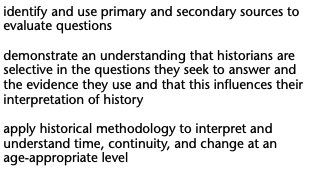
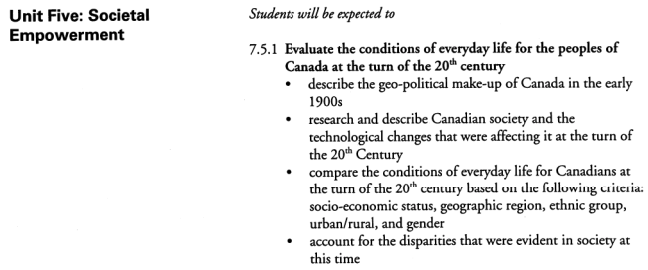
Unit 1 - Introduction: History as a Lens to the Past
Specific Curriculum Outcomes
SCO 1.1 The student will be expected to demonstrate an understanding and appreciation of history
1.1.1 Identify historical sources (e.g., art, documents, photos, stories, artifacts, and music) in their own community. (K)
1.1.2 Examine how historical sources (e.g., art, documents, photos, stories, artifacts, and music) are windows into the past. (A) 1.1.3 Develop a working definition of history. (A)
1.1.4 Distinguish between individual past and collective history. (K)
1.1.5 Explain that history is open to interpretation. (K)
1.1.6 Explain that historians are guided by rules of evidence. (K)
Unit 2 - World Cultures
Students will be expected to:
6.2.1 examine how traditions influence culture in a selected cultural region
6.2.2 describe how government influences culture in a selected country
6.2.3 explain how economic systems influence cultures
Canada: Origins, Histories & Movement Of Peoples
Overview
Grade 7 students will explore the origins, histories and movement of peoples who forged the foundations of Canadian Confederation. They will examine how the political, demographic, economic and social changes that have occurred since Confederation have influenced ways in which contemporary Canada has evolved.
Canada: Origins, Histories & Movement Of Peoples
Overview
Grade 7 students will explore the origins, histories and movement of peoples who forged the foundations of Canadian Confederation. They will examine how the political, demographic, economic and social changes that have occurred since Confederation have influenced ways in which contemporary Canada has evolved.
Identify needs and opportunities for designing, through exploration
Generate ideas from their experiences and interests
Add to others’ ideas
Choose an idea to pursue.
Making
Choose tools and materials
Make a product using known procedures or through modelling of others
Use trial and error to make changes, solve problems, or incorporate new ideas from self or others
Sharing
Decide on how and with whom to share their product
Demonstrate their product, tell the story of designing and making their product, and explain how their product contributes to the individual, family, community, and/or environment
Use personal preferences to evaluate the success of their design solutions
Reflect on their ability to work effectively both as individuals and collaboratively in a group
Use materials, tools, and technologies in a safe manner in both physical and digital environments
Develop their skills and add new ones through play and collaborative work
Explore the use of simple, available tools and technologies to extend their capabilities
Curricular Competencies
Develop mental math strategies and abilities to make sense of quantities
Use technology to explore mathematics
Understanding and solving
Develop, demonstrate, and apply mathematical understanding through play, inquiry, and problem solving
Content
Students are expected to know the following:
Curricular Competencies
Use Social Studies inquiry processes and skills to ask questions; gather, interpret, and analyze ideas; and communicate findings and decisions
Assess the significance of people, places, events, or developments, and compare varying perspectives on their historical significance at particular times and places, and from group to group (significance)
Assess the justification for competing historical accounts after investigating points of contention, reliability of sources, and adequacy of evidence (evidence)
Compare and contrast continuities and changes for different groups at the same time period (continuity and change)
Assess how prevailing conditions and the actions of individuals or groups affect events, decisions, or developments (cause and consequence)
Explain and infer different perspectives on past or present people, places, issues, or events by considering prevailing norms, values, world views, and beliefs (perspective)
Recognize implicit and explicit ethical judgments in a variety of sources (ethical judgment)
Make reasoned ethical judgments about actions in the past and present, and determine appropriate ways to remember and respond (ethical judgment)