
Loading…
Loading…
In this lesson, students will understand that fractions are like a number on the number line and how to represent fractions on a number line diagram.
Welcome to this Minecraft: Education Edition lesson! Before you begin, take a few moments to let us know your thoughts or feedback on how we can improve this lesson in order to better enhance the learning experience that is delivered in your classroom!
Click here or follow the form below to complete the feedback survey once you've completed this lesson. Thank you!
Click and watch this teacher preparation video to help you understand how to teach this lesson. Here is a YouTube link of the teacher video for your reference: https://youtu.be/hB3fdQw13do
Start Here: Teacher Preparation Video
Build and explain Minecraft math models that show fractions, improper fractions, and mixed numbers on number lines.
Label Minecraft math models with correct fractions on signs.
Peer review Minecraft math models and slates of others to check for accuracy.
Document models with pictures in portfolios.
Explain number patterns in fractions, such as “a/a=1, or 2a/a=2”.
Creativity
Critical Thinking
Materials: Math notebooks and pencils (coloured pencils and graph paper are good for this too), slideshow file, whiteboard and markers
The point of the slideshow (see Supporting Files) is to teach how to build and explain the math models.
Once you have figured this out, you can build these models and project them on the board, while your students take notes and write the math in their notebooks.
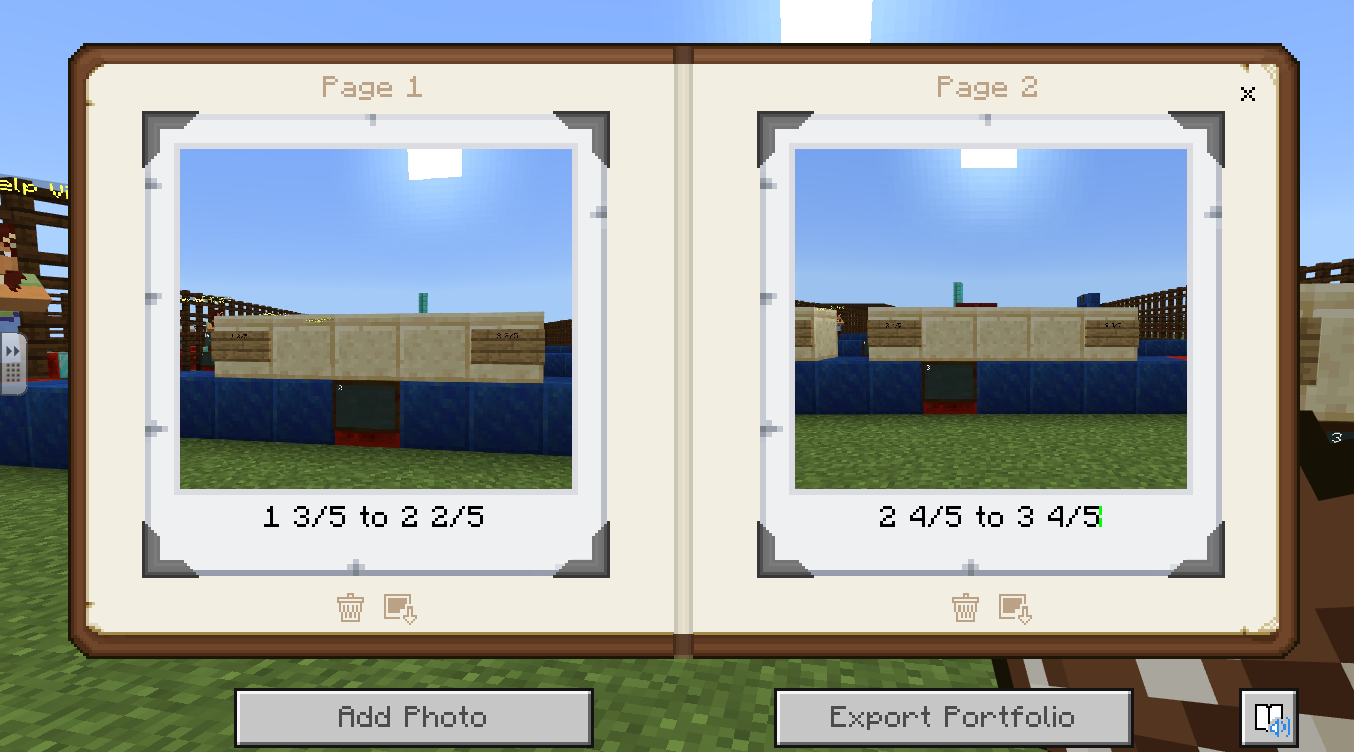
The pictures and student work will look like this. Once you feel your students understand how to show number line fractions with Minecraft, give them their worksheets (also in Supporting Files) and have them sign on to Minecraft, up to 4 students in a world.
The students will enter the game in groups of 2-4 at the game lobby located at coordinates 135, 5, -126 and push the start button. Next they will be teleported with blocks, a pickaxe, signs, a camera, and portfolio to their number lines. The students will then match their worksheets to their Minecraft number lines. After that, they will build the horse jumps by placing blocks representing fractions on the number line.
Once students have completed their number lines, they need to take a picture of at least one of their number lines and write how it is math. Then they will go to peer review and review fellow students’ work. The will check for accuracy and take a photo saying why a number line is correct or not. See the supporting files section for an example of what the portfolio should look like. Next is to play the mini-game.
Once all students in a group have finished and peer reviewed their number lines, push the start game button located just to the right of the stables. The players will be teleported to the area where they choose their stables. (One player must go into the PLAYER 1 stall to correctly start the game.) The students will be teleported to their stable with a horse, 64 wheat, a saddle, a sword, a bow, and arrows. Now they will need to tame their horse. To do this, feed all 64 wheat to the horse by holding the wheat and right clicking the horse. You will know the horse is tame when hearts come out of it and it lets you ride it. To put a saddle on your horse, first you must mount the horse and push “e” to open your inventory. Then drag the saddle into the saddle slot. After all players have tamed and saddled their horses, PLAYER 1 will hit the start button, then a gate will open and the race will begin. When the winner horse crosses the finish line, the horse will disappear, and the winner will be teleported to their podium. They will set off some fireworks and reset the game to play again.
1. What patterns did you see in the fractions on the number lines?
2. What does it mean if the numerator is larger than the denominator?
3. How do we find a mixed number on a number line?
Depth of Knowledge 4 The student did all of the following:
1) The student was able to build and explain Minecraft math models that show fractions, improper fractions, and mixed numbers on number lines.
2) The student was able to label their Minecraft math models with correct fractions on signs.
3) The student was able to peer review the Minecraft math models and slates of others to check for accuracy.
4) The student was able to document their models with pictures in their portfolios. 5) The student was able to explain number patterns in fractions, such as “a/a=1, or 2a/a=2”.
Depth of Knowledge 3 The student did three out of five listed above.
Depth of Knowledge 2 The student did two out of five listed above.
Depth of Knowledge 1 The student did one out of five listed above.
Check out the Tips & Tricks video playlist that will help you and your students better use Minecraft: Education Edition in the classroom:
https://youtube.com/playlist?list=PLkh9rrdH-ARER03ojhFYtmoFDVuACYJLa
More videos added periodically so make sure you check often for more content!
Click and watch the student pause and play video with your class, pausing and playing as needed. This will help your students understand how to navigate through this lesson and Minecraft world and complete the activities located within them. Enjoy!
Check out the YouTube link of this video for your reference: https://youtu.be/gOxkrWUS-8U
Student 'Pause & Play' Video
Specific Outcome 13: Demonstrate an understanding of fractions by:
explaining that a fraction represents a part of a whole
describing situations in which fractions are used
Specific Outcome 8 : Demonstrate an understanding of fractions less than or equal to one by using concrete, pictorial and symbolic representations to:
name and record fractions for the parts of a whole or a set
model and explain that for different wholes, two identical fractions may not represent the same quantity
provide examples of where fractions are used.
Specific Outcome 7: Demonstrate an understanding of fractions by using concrete, pictorial and symbolic representations to:
compare fractions with like and unlike denominators
Specific Outcome 2: Solve problems involving whole numbers and decimal numbers
Identify needs and opportunities for designing, through exploration
Generate ideas from their experiences and interests
Add to others’ ideas
Choose an idea to pursue.
Making
Choose tools and materials
Make a product using known procedures or through modelling of others
Use trial and error to make changes, solve problems, or incorporate new ideas from self or others
Sharing
Decide on how and with whom to share their product
Demonstrate their product, tell the story of designing and making their product, and explain how their product contributes to the individual, family, community, and/or environment
Use personal preferences to evaluate the success of their design solutions
Reflect on their ability to work effectively both as individuals and collaboratively in a group
Use materials, tools, and technologies in a safe manner in both physical and digital environments
Develop their skills and add new ones through play and collaborative work
Explore the use of simple, available tools and technologies to extend their capabilities
Curricular Competencies
Develop mental math strategies and abilities to make sense of quantities
Use technology to explore mathematics
Understanding and solving
Develop, demonstrate, and apply mathematical understanding through play, inquiry, and problem solving
Content
Students are expected to know the following:
- Fraction concepts: Fractions can represent parts of a region, set, or linear model.
- Ordering and comparing fractions: Using concrete and visual models.
- Fractions: Two equivalent fractions are two ways to represent the same amount. Comparing and ordering of fractions and decimals. Equal partitioning.
Improper fractions
Using benchmarks, number line, and common denominators to compare and order, including whole numbers.
Identify needs and opportunities for designing, through exploration
Generate ideas from their experiences and interests
Add to others’ ideas
Choose an idea to pursue.
Making
Choose tools and materials
Make a product using known procedures or through modelling of others
Use trial and error to make changes, solve problems, or incorporate new ideas from self or others
Sharing
Decide on how and with whom to share their product
Demonstrate their product, tell the story of designing and making their product, and explain how their product contributes to the individual, family, community, and/or environment
Use personal preferences to evaluate the success of their design solutions
Reflect on their ability to work effectively both as individuals and collaboratively in a group
Use materials, tools, and technologies in a safe manner in both physical and digital environments
Develop their skills and add new ones through play and collaborative work
Explore the use of simple, available tools and technologies to extend their capabilities
Curricular Competencies
Develop mental math strategies and abilities to make sense of quantities
Use technology to explore mathematics
Understanding and solving
Develop, demonstrate, and apply mathematical understanding through play, inquiry, and problem solving
Content
Students are expected to know the following:
- Fraction concepts: Fractions can represent parts of a region, set, or linear model.
- Ordering and comparing fractions: Using concrete and visual models.
- Fractions: Two equivalent fractions are two ways to represent the same amount. Comparing and ordering of fractions and decimals. Equal partitioning.
Improper fractions
Using benchmarks, number line, and common denominators to compare and order, including whole numbers.
Numbers
B1.6 Fractions use drawings to represent, solve, and compare the results of fair-share problems that involve sharing up to 20 items among 2, 3, 4, 5, 6, 8, and 10 sharers, including problems that result in whole numbers, mixed numbers, and fractional amounts.
Algebra
C3.1 solve problems and create computational representations of mathematical situations by writing and executing code, including code that involves sequential, concurrent, and repeating events
C3.2 read and alter existing code, including code that involves sequential, concurrent, and repeating events, and describe how changes to the code affect the outcomes
Numbers
B1.4 Represent fractions from halves to tenths using drawings, tools, and standard fractional notation, and explain the meanings of the denominator and the numerator.
B1.5 Fractions and Decimals use drawings and models to represent, compare, and order fractions representing the individual portions that result from two different fair-share scenarios involving any combination of 2, 3, 4, 5, 6, 8, and 10 sharers.
B1.9 Fractions and Decimals describe relationships and show equivalences among fractions and decimal tenths, in various contexts
Algebra
C3.1 solve problems and create computational representations of mathematical situations by writing and executing code, including code that involves sequential, concurrent, and repeating events
C3.2 read and alter existing code, including code that involves sequential, concurrent, and repeating events, and describe how changes to the code affect the outcomes
Numbers
B1.3 Fractions, Decimals, and Percents represent equivalent fractions from halves to twelfths, including improper fractions and mixed numbers, using appropriate tools, in various contexts.
B1.5 Fractions, Decimals, and Percents read, represent, compare, and order decimal numbers up to hundredths, in various contexts
B1.7 Describe relationships and show equivalences among fractions, decimal numbers up to hundredths, and whole number percents, using appropriate tools and drawings, in various contexts.
Algebra
C3.1 solve problems and create computational representations of mathematical situations by writing and executing code, including code that involves sequential, concurrent, and repeating events
C3.2 read and alter existing code, including code that involves sequential, concurrent, and repeating events, and describe how changes to the code affect the outcomes
Numbers
B1.3 Rational Numbers compare and order integers, decimal numbers, and fractions, separately and in combination, in various contexts.
B1.4 Fractions, Decimals, and Percents read, represent, compare, and order decimal numbers up to thousandths, in various contexts.
B1.6 Fractions, Decimals, and Percents describe relationships and show equivalences among fractions and decimal numbers up to thousandths, using appropriate tools and drawings, in various contexts
Algebra
C3.1 solve problems and create computational representations of mathematical situations by writing and executing code, including code that involves sequential, concurrent, and repeating events
C3.2 read and alter existing code, including code that involves sequential, concurrent, and repeating events, and describe how changes to the code affect the outcomes
N3.4 Demonstrate understanding of fractions concretely, pictorially, physically, and orally including: • representing • observing and describing situations • comparing • relating to quantity.
N4.6 Demonstrate an understanding of fractions less than or equal to one by using concrete and pictorial representations to: • name and record fractions for the parts of a whole or a set • compare and order fractions • model and explain that for different wholes, two identical fractions may not represent the same quantity • provide examples of where fractions are used.
N5.5 Demonstrate an understanding of fractions by using concrete and pictorial representations to: • create sets of equivalent fractions • compare fractions with like and unlike denominators.
N6.7 Extend understanding of fractions to improper fractions and mixed numbers.
3.N.13. Demonstrate an understanding of fractions by n explaining that a fraction represents a portion of a whole divided into equal parts in describing situations in which fractions are used n comparing fractions of the same whole with like denominators [C, CN, ME, R, V]
· Identify common characteristics of a set of fractions.
· Describe everyday situations where fractions are used.
· Represent a fraction concretely or pictorially.
4.N.8. Demonstrate an understanding of fractions less than or equal to one by using concrete and pictorial representations to n name and record fractions for the parts of a whole or a set n compare and order fractions n model and explain that for different wholes, two identical fractions may not represent the same quantity n provide examples of where fractions are used [C, CN, PS, R, V]
· Represent a fraction using concrete materials.
· Identify a fraction from its concrete representation.
· Represent a fraction pictorially by shading parts of a whole.
· Name fractions between two benchmarks on a number line (horizontal or vertical).
· Order a set of fractions by placing them on a number line (horizontal or vertical) with benchmarks.
5.N.7. Demonstrate an understanding of fractions by using concrete and pictorial representations to n create sets of equivalent fractions n compare fractions with like and unlike denominators [C, CN, PS, R, V]
· Create a set of equivalent fractions and explain why there are many equivalent fractions for any fraction using concrete materials.
· Formulate and verify a rule for developing a set of equivalent fractions.
· Identify equivalent fractions for a fraction.
- Compare fractions with like and unlike denominators, compare fractions with like and unlike denominators
6.N.4. Relate improper fractions to mixed numbers
Fractions:
· Represents a fraction in a variety of ways, based on a whole or a collection of objects.
· Uses objects, diagrams or equations to represent a situation and conversely, describes a situation represented by objects, diagrams or equations (use of different meanings of addition, subtraction and multiplication by a natural number)
· Generates a set of equivalent fractions
· Reduces a fraction to its simplest form (lowest terms)
- Identifies equivalent representations (using objects or drawings)
N13 Demonstrate an understanding of fractions by: • explaining that a fraction represents a part of a whole; • describing situations in which fractions are used; • comparing fractions of the same whole with like denominators.
N8 Demonstrate an understanding of fractions less than or equal to one by using concrete and pictorial representations to: name and record fractions for the parts of a whole or a set; compare and order fractions; model and explain that for different wholes, two identical fractions may not represent the same quantity; provide examples of where fractions are used.
N7 Demonstrate an understanding of fractions by using concrete and pictorial representations to: create sets of equivalent fractions; compare fractions with like and unlike denominators.
N4 Relate improper fractions to mixed numbers.
N13: Students will be expected to demonstrate an understanding of fractions by · explaining that a fraction represents a part of a whole · describing situations in which fractions are used · comparing fractions of the same whole with like denominators.
N08: Students will be expected to demonstrate an understanding of fractions less than or equal to 1 by using concrete, pictorial, and symbolic representations to name and record fractions for the parts of one whole or a set compare and order fractions model and explain that for different wholes, two identical fractions may not represent the same quantity provide examples of where fractions are used
N07: Students will be expected to demonstrate an understanding of fractions by using concrete, pictorial, and symbolic representations to create sets of equivalent fractions compare and order fractions with like and unlike denominators.
N04: Students will be expected to relate improper fractions to mixed numbers and mixed numbers to improper fractions.
3N13 Demonstrate an understanding of fractions by: • explaining that a fraction represents a part of a whole • describing situations in which fractions are used • comparing fractions of the same whole that have like denominators.
4N8 Demonstrate an understanding of fractions less than or equal to one by using concrete, pictorial and symbolic representations to: • name and record fractions for the parts of a whole or a set • compare and order fractions • model and explain that for different wholes, two identical fractions may not represent the same quantity • provide examples of where fractions are used.
5N7 Demonstrate an understanding of fractions by using concrete, pictorial and symbolic representations to: • create sets of equivalent fractions • compare fractions with like and unlike denominators.
N13 Demonstrate an understanding of fractions by: • explaining that a fraction represents a part of a whole; • describing situations in which fractions are used; • comparing fractions of the same whole with like denominators.
N8 Demonstrate an understanding of fractions less than or equal to one by using concrete and pictorial representations to: name and record fractions for the parts of a whole or a set; compare and order fractions; model and explain that for different wholes, two identical fractions may not represent the same quantity; provide examples of where fractions are used.
N7 Demonstrate an understanding of fractions by using concrete and pictorial representations to: create sets of equivalent fractions; compare fractions with like and unlike denominators.
N4 Relate improper fractions to mixed numbers.