
Loading…
Loading…
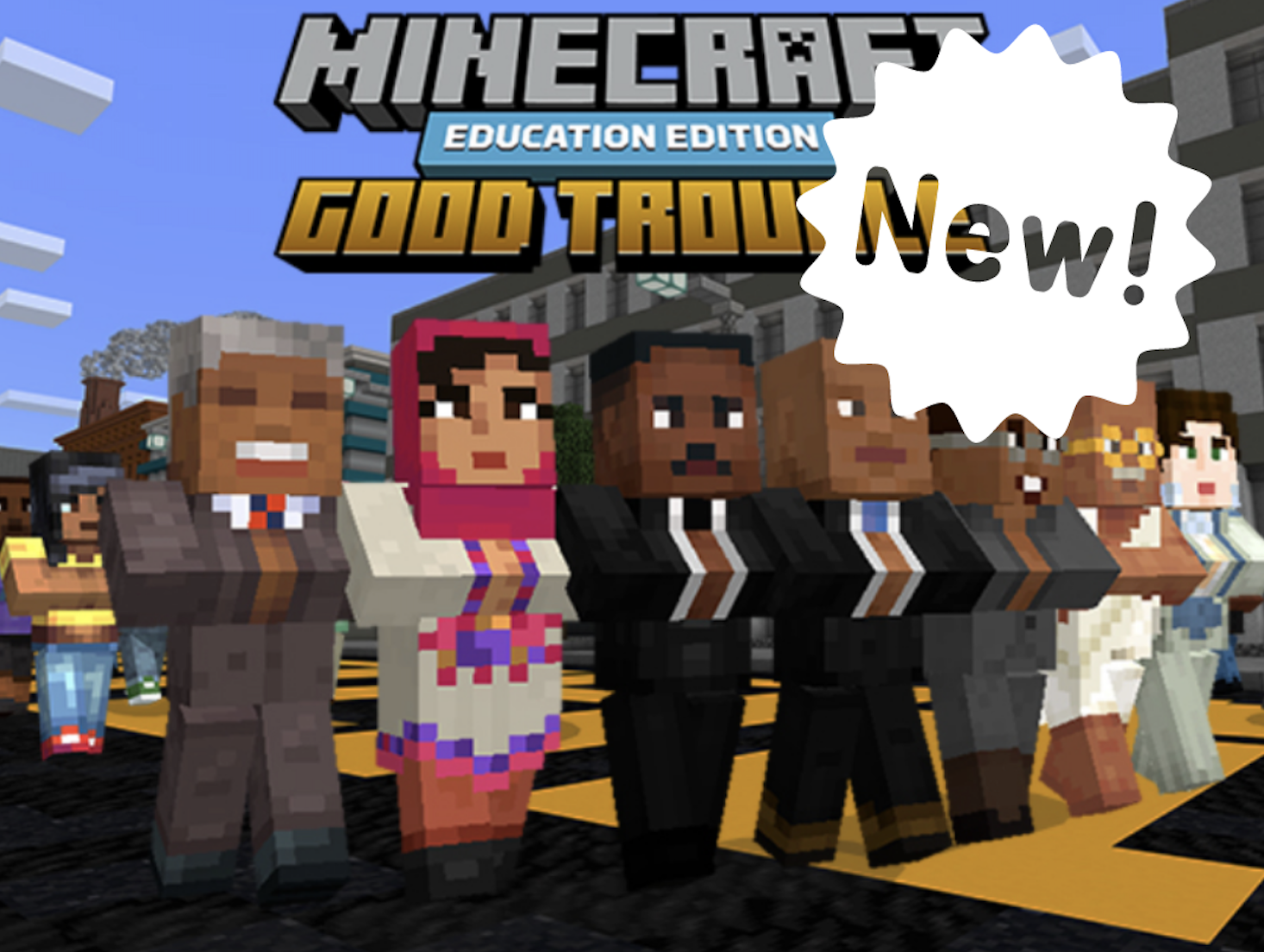
Journey through time with Congressman John Lewis to meet leaders of social justice movements who were catalysts for Good Trouble and positive change.
Welcome to this Minecraft: Education Edition lesson! Before you begin, take a few moments to let us know your thoughts or feedback on how we can improve this lesson in order to better enhance the learning experience that is delivered in your classroom!
Click here or follow the form below to complete the feedback survey once you've completed this lesson. Thank you!
Click and watch this teacher preparation video to help you understand how to teach this lesson. Here is a YouTube link of the teacher video for your reference: https://youtu.be/jmq9Z35KmWU
Start Here: Teacher Preparation Video
SIGNIFICANT CONTEXT: Students will understand social justice movements across history.
HEROIC CONTEXT: Students will research important person(s) across various social justice movements and their role within those movements.
HISTORICAL AWARENESS: Students will understand important social justice movements, the leaders, and the purpose behind them.
SOCIAL JUSTICE MOVEMENT: Students will understand how to make meaningful choices to influence positive change.
Reading Comprehension
Research
Writing
Reflection
Essential Question How have social justice movements around the world influenced positive changes in society or in a community?
Why have social justice movements occurred?
What was/is the context in which these movements have occurred?
What conditions were present that served as a catalyst for the movement?
Who are the leaders of key social justice movements through history?
Women’s suffrage
India's independence
U.S. Civil Rights Movement
Anti-Apartheid
Equal Education for Girls
Black Lives Matter
1. Introductory Questions
What do you think when you hear the word trouble?
What do you think it means to get into good trouble?
The teacher?will begin the lesson sharing this short video of John Lewis sharing his story about getting in good trouble: https://aka.ms/GoodTroubleVideo Students will participate in a class discussion about what it means to get into “Good Trouble”? Within that discussion students will also address how protests and social justice movements are an integral part of human rights. (i.e. In the United States the first amendment protects citizens?"the right of the people peaceably to assemble, and to petition the Government for a?redress?of grievances").? Students will also discuss how all social justice movements face opposition or counter-protest from people with a different point of view.
2. Minecraft Good Trouble World
Have students enter the Good Trouble World to meet NPC Congressman John Lewis who will escort students through the Good Trouble World and introduce students to other activists (NPCs)? who have been catalysts for good trouble around the world.
Students will look for characters in the world with name labels over their heads and right-click to read what they have to say. Note: there are some student activities in the world which pertain to future lessons.
For this lesson, students will take notes using the Minecraft Book and Quill as they learn about John Lewis and other social justice leaders. Students record what the movements set out to achieve, the names of the leaders, where it took place, and examples of how the leaders were catalysts for good trouble from content in Minecraft as well as links to articles and videos in the game.
3. Student Reflection Now that you have learned about John Lewis, Good Trouble, and Social Justice Movements, in your?Book and Quill provide an example of how you have gotten into good trouble standing up for someone else.? Be sure to take a selfie next to the NPC that resonates with you most and add your selfie to your Good Trouble Journal.
4. Sharing Students will close the lesson by sharing their reflection either in person or through a Flipgrid video recording (or a presentation or written reflection) of their experience in the “Good Trouble” world.
How can you be a good activist in your community?
How can you be a catalyst for good trouble?
Have you ever gotten into good trouble where you stood up for someone else? If so, describe your experience.
This lesson will enable students to:
Describe some of the strategies that social justice movements have used to create change.
Students will understand the meaning of "Good Trouble" and how John Lewis and other leaders of social justice movements around the world have fomented social change through history.
Students will understand how social justice movements around the world and through history connect to one another and have influenced each other.
Students will understand how to display a sense of empathy and understanding for others as they explore the reasons for and causes of social justice movements.
Check out the Tips & Tricks video playlist that will help you and your students better use Minecraft: Education Edition in the classroom:
https://youtube.com/playlist?list=PLkh9rrdH-ARER03ojhFYtmoFDVuACYJLa
More videos added periodically so make sure you check often for more content!
Click and watch the student pause and play video with your class, pausing and playing as needed. This will help your students understand how to navigate through this lesson and Minecraft world and complete the activities located within them. Enjoy!
Check out the YouTube link for your reference: https://youtu.be/P3S6bxGHLRE
Student Pause & Play Video
Big Ideas
Contacts and conflicts between peoples stimulated significant cultural, social, political change.
Changing ideas about the world created tension between people wanting to adopt new ideas and those wanting to preserve established traditions.
Curricular Competency
Assess the significance of people, places, events, or developments at particular times and places (significance)
Characterize different time periods in history, including periods of progress and decline, and identify key turning points that mark periods of change (continuity and change
Determine which causes most influenced particular decisions, actions, or events, and assess their short-and long-term consequences (cause and consequence)
Big Ideas
Texts are socially, culturally, and historically constructed.
Curricular Competency
Access information and ideas for diverse purposes and from a variety of sources and evaluate their relevance, accuracy, and reliability
Think critically, creatively, and reflectively to explore ideas within, between, and beyond texts
Recognize and identify the role of personal, social, and cultural contexts, values, and perspectives in texts
Construct meaningful personal connections between self, text, and world
Respond to text in personal, creative, and critical ways
1.1 Discover and explore
1.1.1 Express ideas and develop understanding
Students will:
a. extend and revise their understanding of ideas and information by connecting new and prior knowledge and personal experiences
Reading | Writing | Listening | Speaking | Viewing | Representing
b. extend and revise their understanding of ideas and information by exploring a variety of print and nonprint texts on related topics and themes
Reading | Writing | Listening | Speaking | Viewing | Representing
2.1.2 Use comprehension strategies
Students will:
a. apply appropriate reading strategies to enhance understanding; e.g., skim, read out loud, form questions, make predictions, reread and read slowly)
Reading
e. use metacognition and a variety of other strategies to identify and remember main ideas and relevant information in print and nonprint texts; e.g., concept map, mental rehearsal, paraphrase, question and take notes
Reading | Writing | Listening | Viewing
2.2 Respond to texts
2.2.1 Experience various texts
Students will:
a. explore and experience a range of print and nonprint texts from a variety of cultural traditions and genres; e.g., journals, magazine articles, nature programs, diaries, drama, poetry, mysteries, historical fiction, drawings, prints, photographs, advertisements, Aboriginal oral stories, artifacts, films, essays, electronic and print magazines and realistic fiction
Reading | Listening | Viewing
d. justify their point of view and interpretation using evidence from a text
Reading | Listening | Viewing
3.3.2 Record information
Students will:
a. make notes in point form, summarizing main ideas and supporting details, using appropriate strategies; e.g., headings, subheadings, key words, supporting details and phrases and graphic organizers
Reading | Writing | Viewing
b. record information accurately and completely, in a consistent and appropriate style, using quotations and citing sources within footnotes and using word processing software when appropriate
Reading | Writing | Viewing
c. use appropriate keyboarding techniques, e.g., proper fingering when using alphabet and punctuation keys, and apply appropriate strategies to increase accuracy and speed
Writing
d. reference information sources using appropriate form and consistency
Writing | Speaking | Representing
Reading
1. read and demonstrate an understanding of a variety of literary, graphic, and informational texts, using a range of strategies to construct meaning;
Variety of Texts 1.1 read a wide variety of increasingly complex or difficult texts from diverse cultures, including literary texts (e.g., short stories, novels, poetry, essays, science fiction, memoirs, scripts, satire), graphic texts (e.g., graphs and graphic organizers, charts and tables, surveys, maps, spreadsheets), and informational texts (e.g., essays, Canadian and global print and online sources, electronic texts, textbooks, dictionaries, thesauri, websites, transcripts)
Writing
1. generate, gather, and organize ideas and information to write for an intended purpose and audience;
Research 1.3 gather information to support ideas for writing, using a variety of strategies and a wide range of print and electronic sources (e.g., produce a plan and timeline for carrying out research tasks; interview people with knowledge of the topic; identify and use graphic and multimedia resources; record sources used and information gathered in a form that makes it easy to understand and retrieve)
Reading
Comprehension CR8.1 View, listen to, read, comprehend, and respond to a variety of texts that address identity, social responsibility, and efficacy.
CR8.7 Read independently and demonstrate comprehension of a variety of information texts including understanding the main ideas and supporting evidence, explaining connections between new ideas and information and previous thoughts, and recognizing any biases or false reasoning.
Writing
Context CC8.1 Create various written texts that explore identity, social responsibility and efficacy
7.2.2 Universal Human Rights
KI-007 Describe the impact of discriminatory attitudes and practices on quality of life. Include: racism, prejudice, stereotyping.
KI-008 Describe the influence of various factors on personal identity. Examples: gender and gender images, sexual orientation, physical characteristics, socio-economic situation, peer pressure, media portrayals...
KG-037 Identify universal human rights and explain their importance.
VC-001 Respect the inherent dignity of all people.
7.2.3 Democratic Citizenship and Quality of Life
KC-001 Describe the impact of various factors on citizenship rights in Canada and elsewhere in the world. Examples: laws, culture, labour practices, education...
7.2.4 Power, Wealth, and Justice
KP-042 Identify various individuals who influence world affairs.
KE-045 Give examples of the uneven distribution of wealth and resources in the world and describe the impact on individuals, communities, and nations.
VP-013 Demonstrate concern for people who are affected by discrimination, injustice, or abuse of power.
VP-014 Appreciate the positive contributions of various individuals to world affairs.
Reading Profile
d. Draws on needed background knowledge and experiences related to the social and/or cultural and/or historical context in which the text was produced in order to read critically (e.g. consults other texts written at the same time)
e. Produces a coherent first reading/initial response to a text. See below for what constitutes a first reading/initial response to a text.
First Reading Initial Response
a. Extends/supports/scaffolds first reading/initial response by examining details in the text (e.g. draws on own reading profile; uses information gained through rereading, immersion into texts and exchanges with other readers and teacher
Interpretation of Text
c. Organizes elements of own interpretation in order to achieve coherence and communicate clearly
e. Selects relevant evidence to illustrate and justify own interpretation
Research Process
d. develops a system to keep track of data/information as s/he researches (e.g. notebook, bibliographic references)
Text Complexity
Students select and read independently a variety of literary and information texts. Texts include:
• a wide range of genres; some texts (hybrids) combine genres; longer texts, beyond personal experiences, often requiring cultural, historical or social perspectives
• multidimensional mature/challenging themes/ideas (e.g., human problems: abuse, war, hardship, poverty, racism) that cultivate social awareness and provide insight into the struggles of humanity; age-appropriate characters/information requiring the reader to interpret and connect information/ideas with other texts and subject areas; sometimes themes that evoke alternative interpretations
Literal Response
• respond accurately to most literal questions; skim large amount of text in search of information, locate literal information from a variety of texts
• identify key story elements (setting, characters, events, problem/resolution, theme/ lesson) of a narrative text; explain how events are related to the theme; graphic organizers (e.g., timelines, story maps) may be used
• distinguish between main ideas and supporting details; concisely summarize key information; graphic organizers (e.g., timelines, charts, webs) may be used
Personal/ Critical/ Evaluative Response
• make personal connections; compare/contrast with personal experiences/relevant prior knowledge; make logical text-to-text, text-to-world comparisons; connect characters within and across texts/genres by circumstances, traits, or actions
• make connections between the social/moral issues of the present and those presented in realistic/historical fi ction, biographies, and other genres
Outcome: Learners will plan oral, written, and visual personal and critical responses, in relation to audience and purpose
Plan Formulate- Identify a topic of interest; brainstorm ideas; choose, prioritize, and refine ideas; evaluate choices. Devise a process to solve the problem; execute the steps, modifying as necessary.
Compare Make observations; identify similarities and differences; identify relationships and offer an interpretation; communicate the findings.
Analyse Gather and select appropriate information; determine accuracy, validity, and relevance of the information; identify perspectives, communicate findings.
Outcome: Learners will create oral, written, and visual communication forms for a range of audiences and purposes.
● How do I support my ideas using accurate and relevant details?
Outcome: Learners will comprehend a range of communication forms using listening strategies, reading strategies, and viewing strategies.
Comprehend Determine the overall meaning of the message and identify the details; identify the author’s purpose; use active listening, reading, and viewing strategies; communicate the findings.
Analyse Gather and select appropriate information; determine accuracy, validity, and relevance of the information; identify perspectives, communicate findings.
Reflect Ask questions of experiences and/or concepts; examine further ideas and information; consider ideas, perceptions, and perspectives about experiences and/or concepts; evaluate perceptions and perspectives in relation to experiences and/or concepts; synthesize perceptions and perspectives in relation to experiences and/or concepts; communicate the impact of the process.
Reading and Viewing Strand 2
GCO4. Select, read, and view with understanding a range of literature, information, media, and visual texts.
GCO5. Interpret, select, and combine information using a variety of strategies, resources, and technologies.
GCO6. Respond personally to a range of texts.
GCO7. Respond critically to a range of texts, applying their understanding of language, form, and genre.
SCO 4.1 select texts that address their learning needs and range of special interests
SCO 4.4 read with greater fluency, confidence, and comprehension furthering personal understanding and recognition, and using cueing systems and strategies to read and view increasingly complex texts
SCO 5.1 access appropriate print and non-print sources with increasing independence, and select information to meet specific needs with increasing speed, accuracy, and confidence
SCO 6.1 elaborate personal reactions to what is read and viewed by providing some extended explanations, examples, and supporting arguments
SCO 6.2 state personal points of view about what is read and viewed, and justify views with increasing regularity
GCO8. Use writing and representing to explore, clarify, and reflect on their thoughts, feelings, experiences, and learnings, and to use their imaginations.
SCO 8.3 begin to use various forms of note-making appropriate to various purposes and situations
General Curriculum Outcomes
4. Students will be expected to select, read, and view with understanding a range of literature, information, media, and visual texts.
demonstrate an understanding that information texts are constructed for particular purposes
5. Students will be expected to interpret, select, and combine information using a variety of strategies, resources, and technologies.
independently access and select specific information to meet personal and learning needs
- select, from a wide range, sources appropriate to their purposes
- use available electronic networks
- develop approaches and strategies to conduct their research
6. Students will be expected to respond personally to a range of texts.
respond to some of the material they read or view by questioning, connecting, evaluating, and extending
- move beyond initial understanding to more thoughtful interpretations
8. Students will be expected to use writing and other forms of representation to explore, clarify, and reflect on their thoughts, feelings, experiences, and learnings; and to use their imaginations.
- explore and reflect on their feelings, values, and attitudes
- use note-making to reconstruct knowledge and select effective strategies appropriate to the task
1.1 Discover and explore
1.1.1 Express ideas and develop understanding
Students will:
a. extend and revise their understanding of ideas and information by connecting new and prior knowledge and personal experiences
Reading | Writing | Listening | Speaking | Viewing | Representing
b. extend and revise their understanding of ideas and information by exploring a variety of print and nonprint texts on related topics and themes
Reading | Writing | Listening | Speaking | Viewing | Representing
2.1.2 Use comprehension strategies
Students will:
a. apply appropriate reading strategies to enhance understanding; e.g., skim, read out loud, form questions, make predictions, reread and read slowly)
Reading
e. use metacognition and a variety of other strategies to identify and remember main ideas and relevant information in print and nonprint texts; e.g., concept map, mental rehearsal, paraphrase, question and take notes
Reading | Writing | Listening | Viewing
2.2 Respond to texts
2.2.1 Experience various texts
Students will:
a. explore and experience a range of print and nonprint texts from a variety of cultural traditions and genres; e.g., journals, magazine articles, nature programs, diaries, drama, poetry, mysteries, historical fiction, drawings, prints, photographs, advertisements, Aboriginal oral stories, artifacts, films, essays, electronic and print magazines and realistic fiction
Reading | Listening | Viewing
d. justify their point of view and interpretation using evidence from a text
Reading | Listening | Viewing
3.3.2 Record information
Students will:
a. make notes in point form, summarizing main ideas and supporting details, using appropriate strategies; e.g., headings, subheadings, key words, supporting details and phrases and graphic organizers
Reading | Writing | Viewing
b. record information accurately and completely, in a consistent and appropriate style, using quotations and citing sources within footnotes and using word processing software when appropriate
Reading | Writing | Viewing
c. use appropriate keyboarding techniques, e.g., proper fingering when using alphabet and punctuation keys, and apply appropriate strategies to increase accuracy and speed
Writing
d. reference information sources using appropriate form and consistency
Writing | Speaking | Representing
1.1 Discover and explore
1.1.1 Express ideas and develop understanding
Students will:
a. extend and revise their understanding of ideas and information by connecting new and prior knowledge and personal experiences
Reading | Writing | Listening | Speaking | Viewing | Representing
b. extend and revise their understanding of ideas and information by exploring a variety of print and nonprint texts on related topics and themes
Reading | Writing | Listening | Speaking | Viewing | Representing
2.1.2 Use comprehension strategies
Students will:
a. apply appropriate reading strategies to enhance understanding; e.g., skim, read out loud, form questions, make predictions, reread and read slowly)
Reading
e. use metacognition and a variety of other strategies to identify and remember main ideas and relevant information in print and nonprint texts; e.g., concept map, mental rehearsal, paraphrase, question and take notes
Reading | Writing | Listening | Viewing
2.2 Respond to texts
2.2.1 Experience various texts
Students will:
a. explore and experience a range of print and nonprint texts from a variety of cultural traditions and genres; e.g., journals, magazine articles, nature programs, diaries, drama, poetry, mysteries, historical fiction, drawings, prints, photographs, advertisements, Aboriginal oral stories, artifacts, films, essays, electronic and print magazines and realistic fiction
Reading | Listening | Viewing
d. justify their point of view and interpretation using evidence from a text
Reading | Listening | Viewing
3.3.2 Record information
Students will:
a. make notes in point form, summarizing main ideas and supporting details, using appropriate strategies; e.g., headings, subheadings, key words, supporting details and phrases and graphic organizers
Reading | Writing | Viewing
b. record information accurately and completely, in a consistent and appropriate style, using quotations and citing sources within footnotes and using word processing software when appropriate
Reading | Writing | Viewing
c. use appropriate keyboarding techniques, e.g., proper fingering when using alphabet and punctuation keys, and apply appropriate strategies to increase accuracy and speed
Writing
d. reference information sources using appropriate form and consistency
Writing | Speaking | Representing
Big Ideas
Contacts and conflicts between peoples stimulated significant cultural, social, political change.
Changing ideas about the world created tension between people wanting to adopt new ideas and those wanting to preserve established traditions.
Curricular Competency
Assess the significance of people, places, events, or developments at particular times and places (significance)
Characterize different time periods in history, including periods of progress and decline, and identify key turning points that mark periods of change (continuity and change
Determine which causes most influenced particular decisions, actions, or events, and assess their short-and long-term consequences (cause and consequence)
Big Ideas
Texts are socially, culturally, and historically constructed.
Curricular Competency
Access information and ideas for diverse purposes and from a variety of sources and evaluate their relevance, accuracy, and reliability
Think critically, creatively, and reflectively to explore ideas within, between, and beyond texts
Recognize and identify the role of personal, social, and cultural contexts, values, and perspectives in texts
Construct meaningful personal connections between self, text, and world
Respond to text in personal, creative, and critical ways