
Loading…
Loading…
In this lesson, students will design a prototype of a home and calculate the area and perimeter of it.
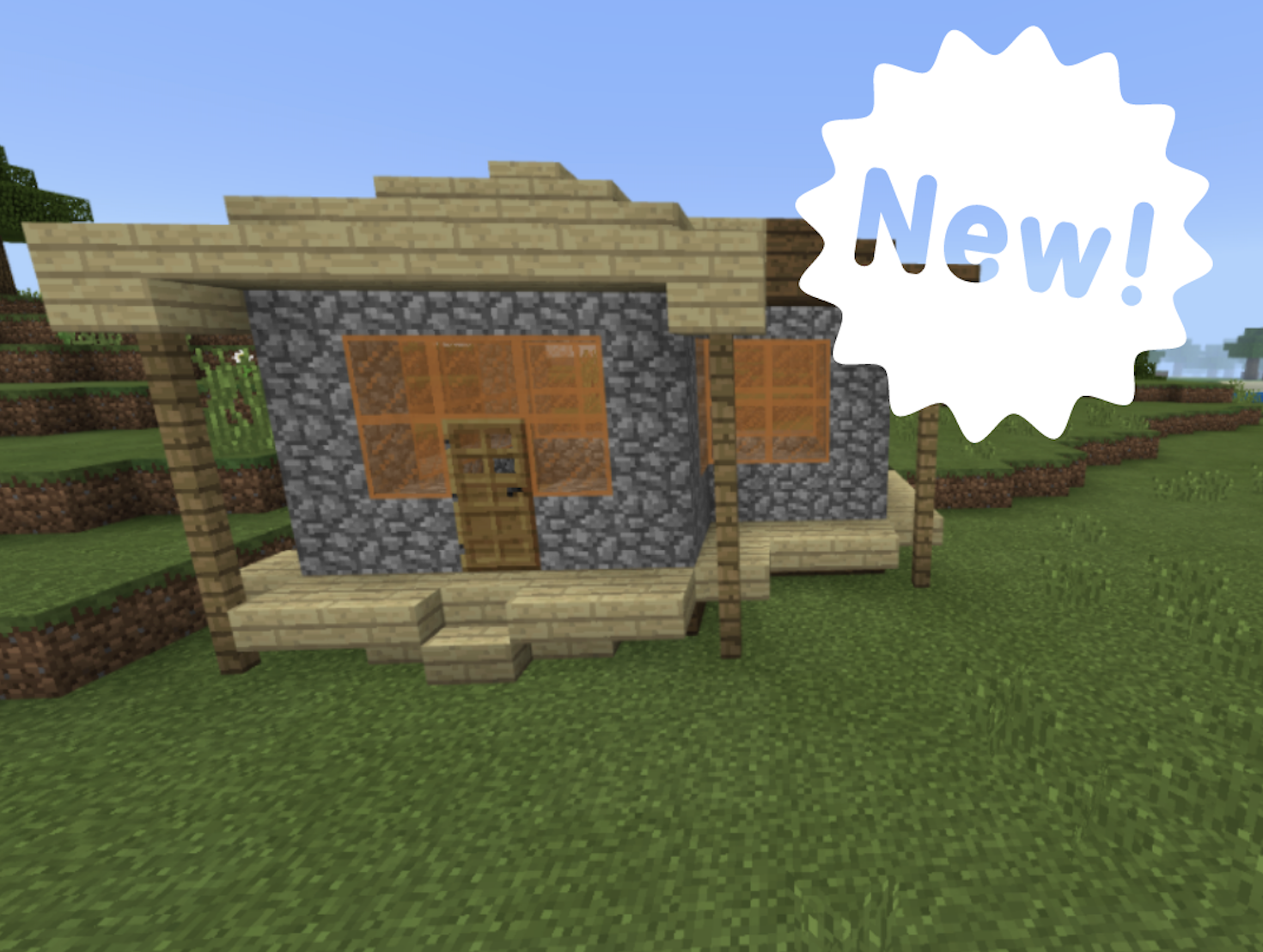
Welcome to this Minecraft: Education Edition lesson! Before you begin, take a few moments to let us know your thoughts or feedback on how we can improve this lesson in order to better enhance the learning experience that is delivered in your classroom!
Click here or follow the form below to complete the feedback survey once you've completed this lesson. Thank you!
Click and watch this teacher preparation video to help you understand how to teach this lesson. Here is a YouTube link of the teacher video for your reference: https://youtu.be/b8IXpoCyD5E
Start Here: Teacher Preparation Video
Students will be able to apply the area and perimeter formulas for rectangles in real world and mathematical problems.
Students will find the width of a rectangular room given the area of the flooring and the length, by viewing the area formula as a multiplication equation with an unknown factor.
Creativity
Critical Thinking
1) Go through the pictures on the slideshow and brainstorm any thoughts and observations of how multiplication and area are related.
2) Once the students have made a connection that math is needed to build homes, unit measurements, area, and perimeter, unveil the Big Idea.
3) Math is needed to construct all buildings and measuring the area and perimeter of shapes are its tools.
Pass out the Blueprint Worksheet and help the students as they design their homes’ foundation by drafting area and perimeters in their plot of land.
As students finish, have them peer review each other's work before entering the Home Prototype World.
To begin, have students load the attached Minecraft world file for Making Homes.
Students will have three activities to complete that will follow the worksheet.
1) Find the area of building plot in Minecraft that is 10 meters by 10 meters.
2) Students will build a foundation consisting of two rectangles, find the area of each and then find the total area. Refer to the powerpoint for visuals. They will show work of their measurements with slates and pictures taken with the in-game camera.
3) Then students will measure and build a perimeter on top of their foundation.
Note: some students might notice that their perimeter might be a larger number than the amount of blocks that are in the perimeter. This is an example of higher level thinking and happens because we added up the perimeter in meters and built in blocks, so the corner pieces get counted on two sides. Encourage them to explain why this happens and ask them to adjust the equation to count blocks and not meters. Over all, this is not in the main lesson plan because we don’t want to overwhelm students with changes to the basic perimeter problems: however, you can still use this to look for higher level thinking skills.
1. What is a unit square and how can I prove it? 1x1=1
2. How can math help you build a home?
3. How is perimeter different from area?
Depth of Knowledge 3 The student completed four out of the six activities
Depth of Knowledge 2 The student completed three out of the six activities
Depth of Knowledge 1 The student completed two out of the six activities
Check out the Tips & Tricks video playlist that will help you and your students better use Minecraft: Education Edition in the classroom:
https://youtube.com/playlist?list=PLkh9rrdH-ARER03ojhFYtmoFDVuACYJLa
More videos added periodically so make sure you check often for more content!
Click and watch the student pause and play video with your class, pausing and playing as needed. This will help your students understand how to navigate through this lesson and Minecraft world and complete the activities located within them. Enjoy!
Check out the YouTube link of this video for your reference: https://youtu.be/66jMCXe_3DE
Student 'Pause & Play' Video
Shape and Space
Specific Outcome 5: Demonstrate an understanding of perimeter of regular and irregular shapes by:
• estimating perimeter, using referents for cm or m
• measuring and recording perimeter (cm, m)
• constructing different shapes for a given perimeter (cm, m) to demonstrate that many shapes are possible for a perimeter.
Shape and Space
Specific Outcome 3 : Demonstrate an understanding of area of regular and irregular 2-D shapes by:
• recognizing that area is measured in square units
• determining and recording area (cm2 or m2 )
Shape and Space
Specific Outcome 2: Design and construct different rectangles, given either perimeter or area, or both (whole numbers), and make generalizations.
Shape and Space
Specific Outcome 3 : Develop and apply a formula for determining the:
• perimeter of polygons
• area of rectangles
Identify needs and opportunities for designing, through exploration
Generate ideas from their experiences and interests
Add to others’ ideas
Choose an idea to pursue.
Making
Choose tools and materials
Make a product using known procedures or through modelling of others
Use trial and error to make changes, solve problems, or incorporate new ideas from self or others
Sharing
Decide on how and with whom to share their product
Demonstrate their product, tell the story of designing and making their product, and explain how their product contributes to the individual, family, community, and/or environment
Use personal preferences to evaluate the success of their design solutions
Reflect on their ability to work effectively both as individuals and collaboratively in a group
Use materials, tools, and technologies in a safe manner in both physical and digital environments
Develop their skills and add new ones through play and collaborative work
Explore the use of simple, available tools and technologies to extend their capabilities
Curricular Competencies
Develop mental math strategies and abilities to make sense of quantities
Use technology to explore mathematics
Understanding and solving
Develop, demonstrate, and apply mathematical understanding through play, inquiry, and problem solving
Content
Students are expected to know the following:
Measurement, using standard units:
Introduce concepts of perimeter, area, and circumference (the distance around); use of formula and pi to calculate not intended — the focus is on the concepts.
Area measurement, using square units (standard and non-standard)
Perimeter: using geoboards and grids to crate, represent, measure, and calculate perimeter.
Relationships between area and perimeter:
Measuring area of squares and rectangles, using tiles, geoboards, grid paper
Investigating perimeter and area and how they are related to but not dependent on each other
Perimeter: A complex shape is a group of shapes with no holes (e.g., use colour tiles, pattern blocks, tangrams).
Area:
Grid paper explorations
Deriving formulas
Making connections between area of parallelogram and area of rectangle
Identify needs and opportunities for designing, through exploration
Generate ideas from their experiences and interests
Add to others’ ideas
Choose an idea to pursue.
Making
Choose tools and materials
Make a product using known procedures or through modelling of others
Use trial and error to make changes, solve problems, or incorporate new ideas from self or others
Sharing
Decide on how and with whom to share their product
Demonstrate their product, tell the story of designing and making their product, and explain how their product contributes to the individual, family, community, and/or environment
Use personal preferences to evaluate the success of their design solutions
Reflect on their ability to work effectively both as individuals and collaboratively in a group
Use materials, tools, and technologies in a safe manner in both physical and digital environments
Develop their skills and add new ones through play and collaborative work
Explore the use of simple, available tools and technologies to extend their capabilities
Curricular Competencies
Develop mental math strategies and abilities to make sense of quantities
Use technology to explore mathematics
Understanding and solving
Develop, demonstrate, and apply mathematical understanding through play, inquiry, and problem solving
Content
Students are expected to know the following:
Measurement, using standard units:
Introduce concepts of perimeter, area, and circumference (the distance around); use of formula and pi to calculate not intended — the focus is on the concepts.
Area measurement, using square units (standard and non-standard)
Perimeter: using geoboards and grids to crate, represent, measure, and calculate perimeter.
Relationships between area and perimeter:
Measuring area of squares and rectangles, using tiles, geoboards, grid paper
Investigating perimeter and area and how they are related to but not dependent on each other
Perimeter: A complex shape is a group of shapes with no holes (e.g., use colour tiles, pattern blocks, tangrams).
Area:
Grid paper explorations
Deriving formulas
Making connections between area of parallelogram and area of rectangle
Shape and Space
E2.7 Compare the areas of two-dimensional shapes by matching, covering, or decomposing and recomposing the shapes, and demonstrate that different shapes can have the same area
E2.9 use square centimetres (cm2) and square metres (m2) to estimate, measure, and compare the areas of various two-dimensional shapes.
Algebra
C3.1 solve problems and create computational representations of mathematical situations by writing and executing code, including code that involves sequential, concurrent, and repeating events
C3.2 read and alter existing code, including code that involves sequential, concurrent, and repeating events, and describe how changes to the code affect the outcomes
Shape and Space
E2.5 Use the row and column structure of an array to measure the areas of rectangles and to show that the area of any rectangle can be found by multiplying its side lengths.
Algebra
C3.1 solve problems and create computational representations of mathematical situations by writing and executing code, including code that involves sequential, concurrent, and repeating events
C3.2 read and alter existing code, including code that involves sequential, concurrent, and repeating events, and describe how changes to the code affect the outcomes
Shape and Space
E2.6 Show that two- dimensional shapes with the same area can have different perimeters, and solve related problems.
Algebra
C3.1 solve problems and create computational representations of mathematical situations by writing and executing code, including code that involves sequential, concurrent, and repeating events
C3.2 read and alter existing code, including code that involves sequential, concurrent, and repeating events, and describe how changes to the code affect the outcomes
SS3.3 Demonstrate understanding of linear measurement (cm and m) including:
measuring and recording length, width, height, and perimeter.
SS4.2 Demonstrate an understanding of area of regular and irregular 2-D shapes by:
recognizing that area is measured in square units
selecting and justifying referents for the units cm² or m²
estimating area by using referents for cm² or m²
determining and recording area (cm² or m²)
SS5.1 Design and construct different rectangles given either perimeter or area, or both (whole numbers), and draw conclusions.
SS6.2 Extend and apply understanding of perimeter of polygons, area of rectangles, and volume of right rectangular prisms (concretely, pictorially, and symbolically) including: relating area to volume, comparing perimeter and area comparing area and volume.
3.SS.5 Demonstrate an understanding of perimeter of regular and irregular shapes by:
· estimating perimeter using referents for centimetre or metre
· measuring and recording perimeter (cm, m)
· constructing different shapes for a given perimeter (cm, m) to demonstrate that many shapes are possible for a perimeter
4.SS.3. Demonstrate an understanding of area of regular and irregular 2-D shapes by
· recognizing that area is measured in square units
· determining and recording area (cm2 or m2 )
· constructing different rectangles for a given area (cm2 or m2 ) in order to demonstrate that many rectangles may have the same
area.
5.SS.1. Design and construct different rectangles given either perimeter or area, or both (whole numbers), and draw conclusions.
6.SS.3. Develop and apply a formula for determining the
· perimeter of polygons
· area of rectangles
Measurement:
· Lengths: estimating and measuring – perimeter, calculating the perimeter
6. Calculates the perimeter of plane figures.
B. Surface areas
1. Estimates and measures surface area
a. using unconventional units
b. using conventional units
SS5: Demonstrate an understanding of perimeter of regular and irregular shapes by: measuring and recording perimeter (cm, m), constructing different shapes for a given perimeter (cm, m) to demonstrate that many shapes are possible for a perimeter.
SS3: Demonstrate an understanding of area of regular and irregular 2-D shapes by: estimating area by using referents for cm2 or m2; determining and recording area’ constructing different rectangles for a given area (cm2 or m2 ) in order to demonstrate that many different rectangles may have the same area.
SS1: Design and construct different rectangles given either perimeter or area, or both (whole numbers) and draw conclusions.
SS3: Develop and apply a formula for determining the: perimeter of polygons; area of rectangles; volume of right rectangular prisms.
M05: Students will be expected to demonstrate an understanding of perimeter of regular, irregular, and composite shapes by: measuring and recording perimeter (cm, m), create different shapes for a given perimeter (cm, m) to demonstrate that many shapes are possible for a perimeter
M03: Students will be expected to demonstrate an understanding of area of regular and irregular 2-D shapes by: recognizing that area is measured in square units, determining and recording area (cm2 or m2), constructing different rectangles for a given area (cm2 or m2) in order to demonstrate that many different rectangles may have the same area
M01: Students will be expected to design and construct different rectangles, given a perimeter or an area or both (whole numbers), and make generalizations.
M03: Students will be expected to develop and apply a formula for determining the: perimeter of polygons, area of rectangles
3SS5 Demonstrate an understanding of perimeter of regular and irregular shapes by: measuring and recording perimeter (cm, m), constructing different shapes for a given perimeter (cm, m) to demonstrate that many shapes are possible for a perimeter.
4SS3 Demonstrate an understanding of area of regular and irregular 2-D shapes by: recognizing that area is measured in square units, constructing different rectangles for a given area (cm² or m²) in order to demonstrate that many different rectangles may have the same area.
5SS1 Design and construct different rectangles given either perimeter or area, or both (whole numbers), and draw conclusions.
6SS3 Develop and apply a formula for determining the: perimeter of polygons, area of rectangles, volume of right rectangular prisms
SS5: Demonstrate an understanding of perimeter of regular and irregular shapes by: measuring and recording perimeter (cm, m), constructing different shapes for a given perimeter (cm, m) to demonstrate that many shapes are possible for a perimeter.
SS3: Demonstrate an understanding of area of regular and irregular 2-D shapes by: estimating area by using referents for cm2 or m2; determining and recording area’ constructing different rectangles for a given area (cm2 or m2 ) in order to demonstrate that many different rectangles may have the same area.
SS1: Design and construct different rectangles given either perimeter or area, or both (whole numbers) and draw conclusions.
SS3: Develop and apply a formula for determining the: perimeter of polygons; area of rectangles; volume of right rectangular prisms.