
Loading…
Loading…
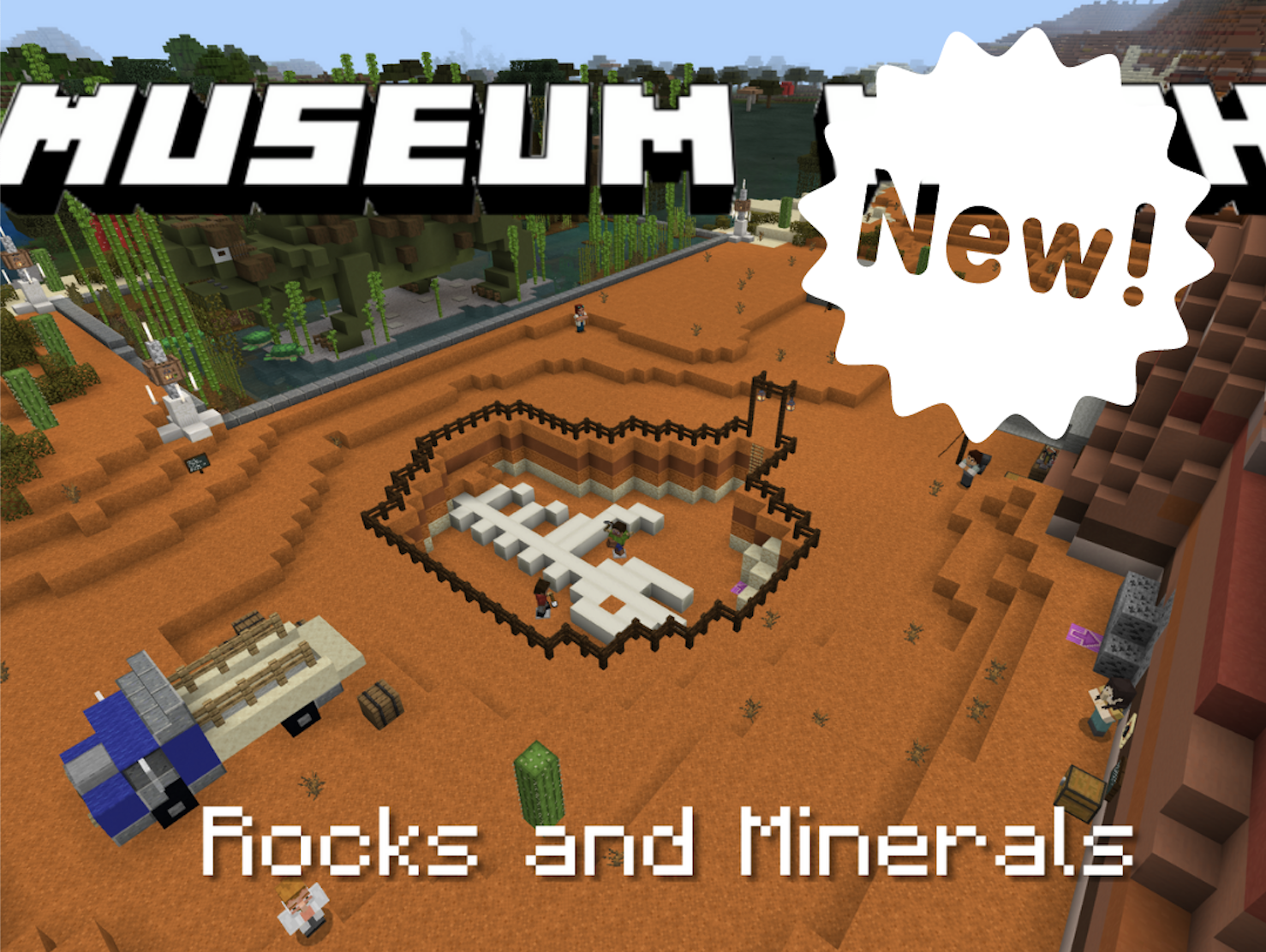
In this lesson, students will discover that three scientists from the Royal Ontario Museum are visiting Rocklandia to learn more about igneous, sedimentary, and metamorphic rocks, and they need your students’ help!
Welcome to this Minecraft: Education Edition lesson! Before you begin, take a few moments to let us know your thoughts or feedback on how we can improve this lesson in order to better enhance the learning experience that is delivered in your classroom!
Click here or follow the form below to complete the feedback survey once you've completed this lesson. Thank you!
Click and watch this teacher preparation video to help you understand how to teach this lesson. Here is a YouTube link of the teacher video for your reference: https://youtu.be/7lJlSWITd9Y
Museum Math Rocks & Minerals Teacher
Students will:
Make observations and gather information about igneous, sedimentary, and metamorphic rocks and minerals.
Use consecutive, concurrent, repeated, and nested coding to overcome a series of obstacles.
Create a museum of rocks and minerals to reflect their learning, with an emphasis on inclusivity and accessibility.
Critical Thinking
Creativity
Project Based Learning
If doing the independent version of this lesson, it is strongly recommended that teachers complete Minecraft Teacher Academy, particularly Module 9: Minecraft Apply and Enrich: Introduction to Coding.
It is also highly recommended that you play through the Code Basics lessons on your own. From the play screen in Minecraft: Education Edition, go to: View Library > Lessons > Computer Science > Block Based Coding > Coding Fundamentals > Coding Fundamentals: 1.
The coding covered in Lessons 1-4 provide a solid foundation to support your students through the coding challenges in Museum Math: Rocks and Minerals.
Please review the Program Structure on the Teacher Support Site before beginning this lesson with your class.
If you wish to participate in the guided version of this lesson, which connects your class with a Museum Educator through Virtual Visits and Flipgrid Topics, please visit: https://www.rom.on.ca/en/learning/rom-minecraft
Please complete the usage form to help us continue to produce programs like this one.
Welcome to the world of Rocklandia!
Students will enter the world at the Rocklandia Research Centre. As they explore the Research Centre, students will discover that three different scientists from the Royal Ontario Museum are visiting Rocklandia to learn more about igneous, sedimentary, and metamorphic rocks. But these real ROM scientists need your students help!
Students will travel to three different research sites to gather samples, make observations, talk to scientists, take photos with their camera, and document their learning using the book and quill. Each site holds environmental clues that help students learn how the rocks found at each site were formed.
Along the way, students encounter obstacles blocking their paths. Students will need to use consecutive, concurrent, repeated, and nested coding to program their agent to help them overcome the obstacles.
Guiding Questions for Phase 1
· What types of rocks did you find at each research site?
· What clues did you find in each of the research sites about how the rocks there were formed?
· What obstacles are you encountering?
· How can your agent help you overcome these obstacles?
Guiding Questions for Phase 2
· What is the difference between rocks and minerals?
· What are the 3 rock types and how are they formed?
· What are different rocks and minerals used for?
· Why is it important for Indigenous scientists to be part of the research team?
· Which ROM Scientist’s research would you like to learn more about?
· Why is it important to understand rocks and minerals?
· How does our use of rocks and minerals affect people and the environment?
· Why is studying rocks and minerals in space important for life on Earth?
1. Students will go through the white door and travel to the Volcano Camp.
2. Along the way, students will encounter Indigenous Scientist Sarabeth, who will inform them that the path to the camp has been flooded with lava.
3. Students must code their agent using a chain of consecutive commands to navigate the tunnel and activate the emergency cooling system.
4. Students will continue through the tunnel to meet ROM Scientist Katherine Dunnell at the Volcano Camp.
5. Students will collect rock samples from the Volcano Camp.
6. Students will learn facts and examine images of Royal Ontario Museum rock and mineral specimens by interacting with non-player characters (NPCs) around the camp.
7. Students will use their camera and book & quill to document clues in the environment that help them figure out what type of rocks they are collecting (igneous, sedimentary, and/or metamorphic) and how those rocks were formed.
1. Students will encounter Aaron at the Volcano camp, who needs help sorting the rocks found at the Volcano Camp into intrusive (cooled slowly inside the Earth) and extrusive (cooled quickly outside the Earth).
2. Students will use environmental clues, NPC dialogue, and links to images from Royal Ontario Museum Collections to determine if the rocks they have collected are intrusive or extrusive.
3. Students will stack the rocks by type to create a 2-column bar graph.
1. Students will go through the blue door and travel to the Dig Site.
2. Along the way, students will encounter Indigenous Scientist Cedar, who will inform them that the bridge across their path has washed out.
3. Students must code their agent, using consecutive, repeated, and nested code, to rebuild the broken bridge.
4. Further down the path, students encounter Indigenous Scientist Felix, who tells them about the controlled burn of the savannah, and how a dead tree has fallen to block the path.
5. Students talk to ROM Intern Jakub, who has a partial code to break through the tree, but his code isn’t working.
6. Students must debug Jakub’s code and complete it so that they can break a path through the tree that is wide and tall enough to ride their horse through.
7. Students continue down the path to meet ROM Scientist Veronica DiCecco at the Dig Site.
8. Students will collect rock samples from the Dig Site.
9. Students will learn facts and examine images of Royal Ontario Museum rock and mineral specimens by interacting with NPCs around the camp.
10. Students will use their camera and book & quill to document clues in the environment that help them figure out what type of rocks they are collecting (igneous, sedimentary, and/or metamorphic) and how those rocks were formed.
1. Students will go through the red door and travel to the Mountain Camp.
2. Along the way, students will encounter Indigenous Scientist Jesse, who informs them that an invasive species brought by settlers has taken over the path and will harm the player and their horse if they try to ride through it.
3. Students must code their agent, using consecutive, concurrent, repeated, and nested code, to destroy the bushes blocking the path.
4. Further down the path, students encounter Indigenous Scientist Dio on the shore of a large body of water. Dio informs them that their horse can’t swim and they must find some way to connect the islands so that the students can ride their horses across.
5. Students apply skills from all previous coding challenges to have their agent build a series of bridges between islands and the opposite shores.
6. Students continue down the path to meet ROM Scientist Dr. Kim Tait at the Mountain Camp.
7. Students will collect rock samples from the Mountain Camp.
8. Students will learn facts and examine images of Royal Ontario Museum rock and mineral specimens by interacting with NPCs around the camp.
9. Students will use their camera and book & quill to document clues in the environment that help them figure out what type of rocks they are collecting (igneous, sedimentary, and/or metamorphic) and how those rocks were formed.
1. Students will encounter Hassan on the upper level of the Research Centre, who needs help sorting the rocks the students have collected into igneous, sedimentary, and metamorphic.
2. Students will use environmental clues, NPC dialogue, and links to images from Royal Ontario Museum Collections to determine if the rocks they have collected are igneous, sedimentary, or metamorphic.
3. Students will stack the rocks by type to create a 3-column bar graph.
1. Students will encounter Wei on the upper level of the Research Centre, who needs help sorting samples from Rocklandia into rocks and minerals
2. Students will use environmental clues, NPC dialogue, and links to images from Royal Ontario Museum Collections to determine if the samples in Wei’s chest are rocks or minerals.
3. Students will stack the blocks by type to create a 2-column bar graph.
1. Students will pass through the yellow door to the build site. ROM Interpretive Planner Courtney informs the students about the job of an Interpretive Planner and allows them to switch into Build Mode (creative).
2. Students must design and build a museum to showcase their learning about rocks and minerals.
3. Museum designs should give thought to inclusivity (whose voices are represented and whose stories are being told) and accessibility (who is able to physically access exhibitions and galleries, what obstacles might they face, and how can you build accommodations into your museum).
4. Students should create a culminating Museum Tour or Museum Guide using Flipgrid or the Camera and Book & Quill.
10-15 class periods
This lesson will enable students to:
Use environmental clues to interpret and understand the formation of several types of rocks and minerals.
Use computational thinking to code solutions to problems using consecutive, concurrent, repeating, and nested code.
Apply their knowledge to create in-game displays and labels that communicate their learning to others.
Minecraft Teacher Academy: https://education.microsoft.com/en-us/learningPath/3eede2ae
ROM Minecraft: https://www.rom.on.ca/en/learning/rom-minecraft
Teacher Support Site: https://sites.google.com/view/mmrocksandminerals-indyteacher/program-home
Student Support Site: https://sites.google.com/view/mmrocksandminerals/home
Check out the Tips & Tricks video playlist that will help you and your students better use Minecraft: Education Edition in the classroom:
https://youtube.com/playlist?list=PLkh9rrdH-ARER03ojhFYtmoFDVuACYJLa
More videos added periodically so make sure you check often for more content!
Click and watch the student pause and play video with your class, pausing and playing as needed. This will help your students understand how to navigate through this lesson and Minecraft world and complete the activities located within them. Enjoy!
Check out the YouTube link for your reference: https://youtu.be/qAcKVPK993I
Museum Math Rocks & Minerals Student
208-5 state a prediction and a hypothesis based on background information or an observed pattern of events
208-2 identify questions to investigate arising from practical problems and issues
209-1 carry out procedures controlling the major variables
211-2 communicate questions, ideas, intentions, plans, and results, using lists, notes in point form, sentences, data tables, graphs, drawings, oral language, and other means
211-5 defend a given position on an issue or problem on the basis of their findings