
Loading…
Loading…
Description In this lesson, students will explore how outflow (wastewater) gets from a home to a water treatment plant. They will also understand that biosolids are used in composting and learn how ou
Welcome to this Minecraft: Education Edition lesson! Before you begin, take a few moments to let us know your thoughts or feedback on how we can improve this lesson in order to better enhance the learning experience that is delivered in your classroom!
Click here or follow the form below to complete the feedback survey once you've completed this lesson. Thank you!
Click and watch this teacher preparation video to help you understand how to teach this lesson. Here is a YouTube link of the teacher video for your reference: https://youtu.be/8jWI5YDfBgU
Start Here: Teacher Preparation Video
Students will explore how outflow (wastewater) gets from a home to a water treatment plant.
Students will understand that biosolids are used in composting.
Students will learn how outflow is treated in order to go back into the city system.
Citizenship
Critical thinking
Project Based Learning
Students will begin their exploration in the school and right-click on the teacher. They should click Lesson 2. In doing this, they will follow the trail across the street to the water treatment plant. Here, students will learn how outflow is cleaned to be used again by farmers for irrigation. Finally, they will learn how outflow from the water treatment processes is used to make nutrient-rich compost.
What are examples of outflow?
Where does outflow go once it goes down a drain?
How can water be treated to reuse it?
Why is clean water important, even if it is being used for farm irrigation systems?
- K-ESS3-3: Communicate solutions that will reduce the impact of humans on the land, water, air, and/or other living things in the local environment.
- MS-ESS3-3: Apply scientific to design a method for monitoring and minimizing a human impact on the environment.
The teacher should prepare three clear cups that contain the following: extremely dirty water, somewhat dirty water, and clean water.
For the closing activity, each group of students will need various materials to create a water filtration system. These can include litre soda bottles, coffee filters, cotton balls, rocks, etc. The teacher should cut the top portion off of the litre bottle ahead of time if this is being done with younger children—see “Make a Water Filter” link.
The following vocabulary will be used in this lesson and the teacher may want to introduce these to the students beforehand.
Reclamation
Clarification
Biosolid
Weir
Aeration
Microbes
The teacher will gather students for examples of outflow (wastewater) and jot these down on the board. Then, s/he will ask students to think about where this outflow goes. Students should take a moment to discuss this with their neighbours before sharing their answers.
Next, the teacher will bring out three clear cups. One will have extremely dirty water, one will have somewhat dirty water, and one will have clean water. S/he will ask students which cup of water they would rather use to water a plant or drink (the one with the clean water) and why. The teacher will ask students to think about what it means to have clean water and how the process of treating water may happen.
Students should take notes on what they learn as they complete this exploration.
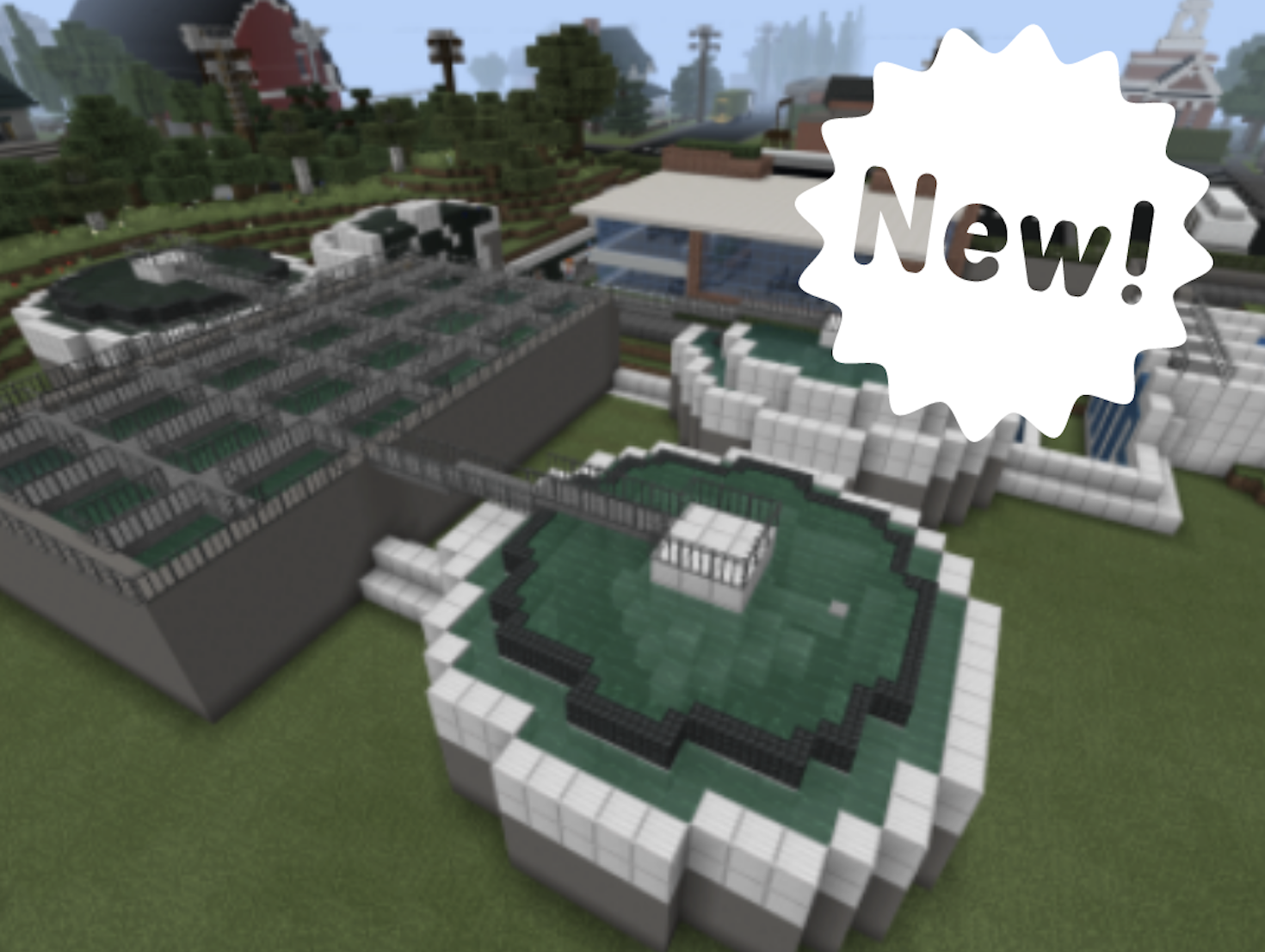
Students will begin their exploration in the school by the teacher. They should right-click on her and choose Lesson 2. They will find themselves guided to the city’s water treatment plant. They will need to begin at the front where they will be introduced to the NPC who explains what an outflow reclamation plant is and does (PE1). Next, the student will make his/her way around the outside of the plant, learning about the process of water treatment. It is important that students take note of the changing color of the water as it goes through the treatment process. This can be seen behind the NPCs (PE2, PE3). Each NPC explains a particular process in the water treatment process.
After learning about disinfection, students will walk to an NPC that will explain that clean water can now be used for farm irrigation (PE2, PE3). Then, students will follow the trail to the NPC that explains how biosolids taken from treating the outflow can be used to create nutrient-rich compost.
Students can click the “Compost” button to be transported to that area. If they do, they will read about how biosolids are used in the composting process. Students may explore this area, but it is not required.
Note: See Full Lesson plan in Supporting Resources section for all activities.
Students will be able to:
Give examples of outflow and where this water goes.
Explain how outflow can be treated to be reused by farmers.
Explain why treating outflow is important before reusing it.
Understand basic water filtration systems to be used in the classroom.
National Geographic - Make a Water Filter: https://kids.nationalgeographic.com/books/article/water-wonders
How to Make a Simple Composter for the Classroom: http://blogs.gonzaga.edu/science-in-action/2020/04/23/how-to-make-a-simple-inexpensive-worm-bin-composter-for-the-classroom-or-home/
Check out the Tips & Tricks video playlist that will help you and your students better use Minecraft: Education Edition in the classroom:
https://youtube.com/playlist?list=PLkh9rrdH-ARER03ojhFYtmoFDVuACYJLa
More videos added periodically so make sure you check often for more content!
Click and watch the student pause and play video with your class, pausing and playing as needed. This will help your students understand how to navigate through this lesson and Minecraft world and complete the activities located within them. Enjoy!
Check out the YouTube link for your reference: https://youtu.be/en4GutYVb0M
Student 'Pause & Play' Video