
Loading…
Loading…
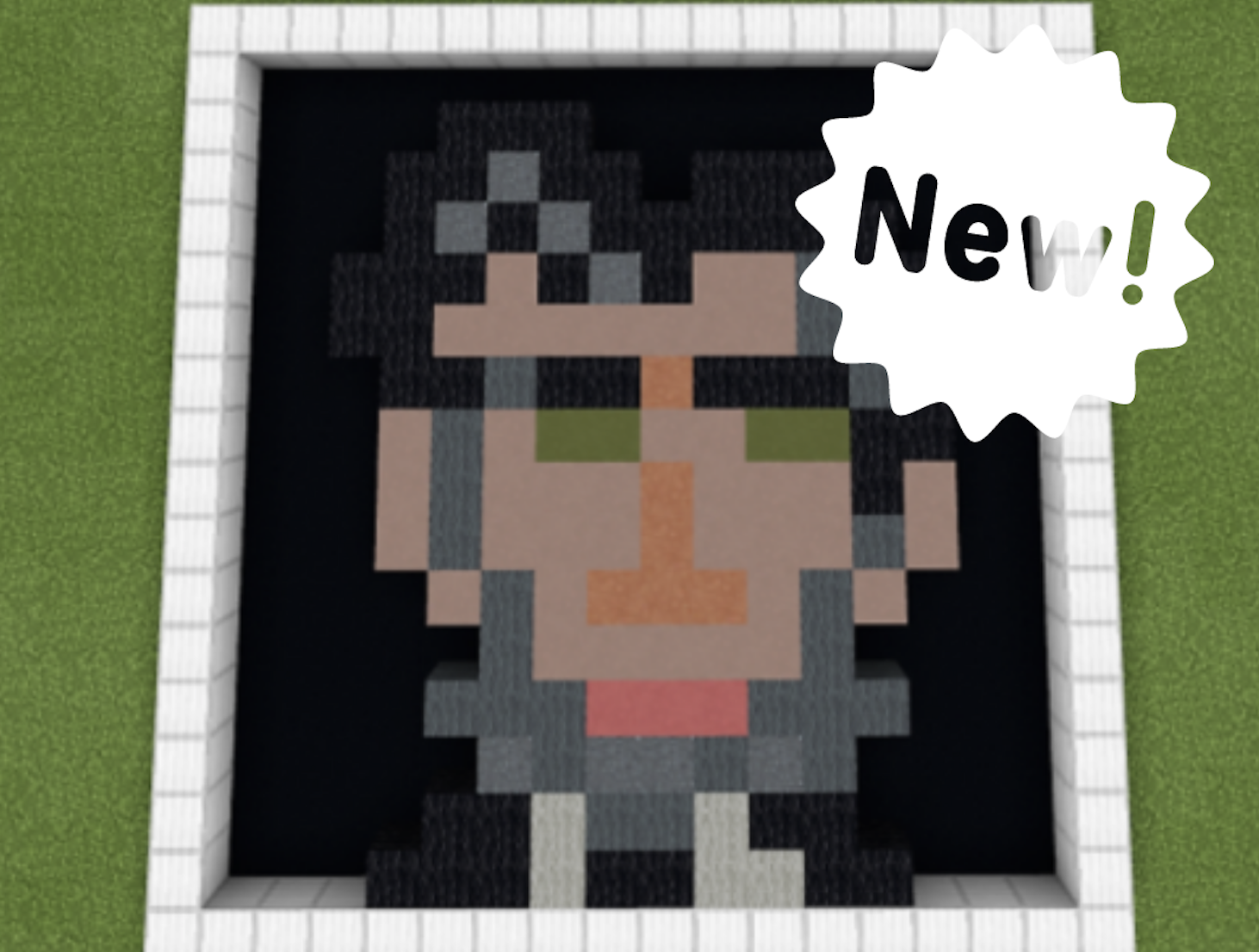
In this lesson, students will use Minecraft blocks as “pixels” to produce pixel art versions of themselves, portrait or full body.
Welcome to this Minecraft: Education Edition lesson! Before you begin, take a few moments to let us know your thoughts or feedback on how we can improve this lesson in order to better enhance the learning experience that is delivered in your classroom!
Click here or follow the form below to complete the feedback survey once you've completed this lesson. Thank you!
Click and watch this teacher preparation video to help you understand how to teach this lesson. Here is a YouTube link of the teacher video for your reference: https://youtu.be/-JYjsNjLyjE
Start Here: Teacher Preparation Video
Students will be able to recreate a self-portrait using Minecraft blocks.
Students will be able to use spatial, estimation, and aesthetic sense to create these self-portraits.
Students will be able to judge whether small or large portraits are difficult to recreate in Minecraft.
Creativity
Character
Critical Thinking
Introduce students to the challenge.
Show examples of pixel art in Minecraft and other games.
Show examples of pixel art self-portraits.
Explain how pixel art has limited details, and that they can choose one of three sizes to work from: 16x16, 32x32, or 48x48 pixels.
Allow students to work independently or in pairs.
Have students research pixel art for inspiration.
Help them choose a size based on their Minecraft skill (16x16, 32x32, or 48x48)
If possible, allow students to use a webcam to take their own headshot. Have them zoom or shrink the image to see what it looks like on a small scale.
Also if possible, allow students to print images for easy reference.
Give students a few minutes of planning time with graph paper before going into Minecraft. Ask them to strategize which blocks they will use for each colour used in their art. Much of the time, coloured wool blocks will suffice, but sometimes more subtle colours require other blocks.
*Have students enter the game and find a space to build. Be sure no one goes too far away from start but that everyone still feels comfortable with their proximity to their neighbours. As they build, float around to offer support. Be sure students are titling and signing their work.
Let students explore and see the progress of the others and leave positive feedback signs.
Optional: Students can share suggestions on feedback signs as well.
Give students some time to make final adjustments to their work and to take screenshots to document what they achieved.
Famous Self-Portraits from Around the World: https://www.widewalls.ch/magazine
Check out the Tips & Tricks video playlist that will help you and your students better use Minecraft: Education Edition in the classroom:
https://youtube.com/playlist?list=PLkh9rrdH-ARER03ojhFYtmoFDVuACYJLa
More videos added periodically so make sure you check often for more content!
Click and watch the student pause and play video with your class, pausing and playing as needed. This will help your students understand how to navigate through this lesson and Minecraft world and complete the activities located within them. Enjoy!
Check out the YouTube link of this video for your reference: https://youtu.be/TpGldXyYLZ8
Student 'Pause & Play' Video
Component 3 APPRECIATION:
Students will interpret artworks by examining their context and less visible characteristics.
C. Technological change affects types of art.
Component 4 MAIN FORMS AND PROPORTIONS:
Students will perfect forms and develop more realistic treatments.
C. Images can be portrayed in varying degrees of realism.
Component 10 (iii) MEDIA AND TECHNIQUES:
Students will use media and techniques, with an emphasis on mixing media and perfecting techniques in drawing, painting, print making, sculpture, fabric arts, photography and techno-graphic arts.
Identify needs and opportunities for designing, through exploration
Generate ideas from their experiences and interests
Add to others’ ideas
Choose an idea to pursue.
Making
Choose tools and materials
Make a product using known procedures or through modelling of others
Use trial and error to make changes, solve problems, or incorporate new ideas from self or others
Sharing
Decide on how and with whom to share their product
Demonstrate their product, tell the story of designing and making their product, and explain how their product contributes to the individual, family, community, and/or environment
Use personal preferences to evaluate the success of their design solutions
Reflect on their ability to work effectively both as individuals and collaboratively in a group
Use materials, tools, and technologies in a safe manner in both physical and digital environments
Develop their skills and add new ones through play and collaborative work
Explore the use of simple, available tools and technologies to extend their capabilities
Curricular Competencies
Develop mental math strategies and abilities to make sense of quantities
Use technology to explore mathematics
Understanding and solving
Develop, demonstrate, and apply mathematical understanding through play, inquiry, and problem solving
Exploring and creating
Explore elements, processes, materials, movements, technologies, tools, and techniques of the arts
Create artistic works collaboratively and as an individual using ideas inspired by imagination, inquiry, experimentation, and purposeful play
Communicating and documenting
Experience, document and share creative works in a variety of ways
Reasoning and reflecting
Connect knowledge and skills from other areas of learning in planning, creating, interpreting, and analyzing works for art
Identify needs and opportunities for designing, through exploration
Generate ideas from their experiences and interests
Add to others’ ideas
Choose an idea to pursue.
Making
Choose tools and materials
Make a product using known procedures or through modelling of others
Use trial and error to make changes, solve problems, or incorporate new ideas from self or others
Sharing
Decide on how and with whom to share their product
Demonstrate their product, tell the story of designing and making their product, and explain how their product contributes to the individual, family, community, and/or environment
Use personal preferences to evaluate the success of their design solutions
Reflect on their ability to work effectively both as individuals and collaboratively in a group
Use materials, tools, and technologies in a safe manner in both physical and digital environments
Develop their skills and add new ones through play and collaborative work
Explore the use of simple, available tools and technologies to extend their capabilities
Curricular Competencies
Develop mental math strategies and abilities to make sense of quantities
Use technology to explore mathematics
Understanding and solving
Develop, demonstrate, and apply mathematical understanding through play, inquiry, and problem solving
Exploring and creating
Explore elements, processes, materials, movements, technologies, tools, and techniques of the arts
Create artistic works collaboratively and as an individual using ideas inspired by imagination, inquiry, experimentation, and purposeful play
Communicating and documenting
Experience, document and share creative works in a variety of ways
Reasoning and reflecting
Connect knowledge and skills from other areas of learning in planning, creating, interpreting, and analyzing works for art
D1. Creating and Presenting
D1.2 demonstrate an understanding of composition, using selected principles of design to create narrative art works or art works on a theme or topic
D1.4 use a variety of materials, tools, and techniques to determine solutions to design challenges
D2. Reflecting, Responding, and Analyzing
D2.4 identify and document their strengths, their interests, and areas for improvement as creators and viewers of art
CP3.8 Create art works using a variety of visual art concepts (e.g., contour lines), forms (e.g., drawing, sculpture), and media (e.g., pencils, pastels, found objects).
CP4.8 Create art works using a variety of visual art concepts (e.g., organic shapes), forms (e.g., kinetic sculpture, mural), and media (e.g., wood, wire, and found objects).
CP5.8 Create art works using a variety of visual art concepts (e.g., positive space), forms (e.g., graphic design, photography), and media (e.g., mixed media, paint).
Making (VA–M1) The learner demonstrates an understanding of the elements and principles of artistic design in a variety of contexts.
use repetition and variety to create and modify patterns using various art media.
integrate knowledge of different art media to create multimedia* or mixed-media** images and/or objects.
Responding (VA–R1) The learner generates initial reactions to visual art experiences.
take time to perceive visual arts experiences before sharing opinions and making judgments.
Competencies 1 and 2
Using computers for the creation of individual and media-related visual arts productions
Using computers to save his/her individual and media-related visual arts productions
DEVELOPMENT OF IMAGERY
generate and select ideas for art work
use a variety of sources to stimulate ideas on art work, e.g., poems, songs, the environment
demonstrate self-confidence and eagerness toward their art production, expression and discussion
develop observational skills, e.g., details to enrich personal images
Learners will create artworks that express feelings, ideas, and understandings.
Learners will plan personal responses to a variety of artworks.
2. create and/or present, collaboratively and independently, expressive products in the arts for a range of audiences and purposes;
1.2.3 Experiment with a variety of materials, tools, equipment, and processes.
1.2.4 Develop and create imagery that draws upon observation, imagination, memory, and the interpretation of sensory experiences.
2.2.2 Choose, display, and describe work from their own portfolio.
DEVELOPMENT OF IMAGERY
generate and select ideas for art work
use a variety of sources to stimulate ideas on art work, e.g., poems, songs, the environment
demonstrate self-confidence and eagerness toward their art production, expression and discussion
develop observational skills, e.g., details to enrich personal images