
Loading…
Loading…
In this lesson, students will take their imagination to wherever they would like as they write a narrative about a mysterious shipwreck.
Welcome to this Minecraft: Education Edition lesson! Before you begin, take a few moments to let us know your thoughts or feedback on how we can improve this lesson in order to better enhance the learning experience that is delivered in your classroom!
Click here or follow the form below to complete the feedback survey once you've completed this lesson. Thank you!
Click and watch this teacher preparation video to help you understand how to teach this lesson. Here is a YouTube link of the teacher video for your reference: https://youtu.be/8lGblWoKrW0
Start Here: Teacher Preparation Video
By the end of the lesson, students will:
Write informative/explanatory texts to examine a topic and convey ideas and information clearly.
Introduce a topic and group related information together; include illustrations when useful to aiding comprehension.
Develop the topic with facts, definitions, and details.
Communication
Creativity
Critical thinking
Choose a variety of narrative examples from a book students have read in class or from a popular work of fiction.
Share passages with the class (or have students volunteer to read) that showcase detailed descriptions of places, people, or objects.
Look at illustrations from the stories and compare the descriptions to what is represented visually.
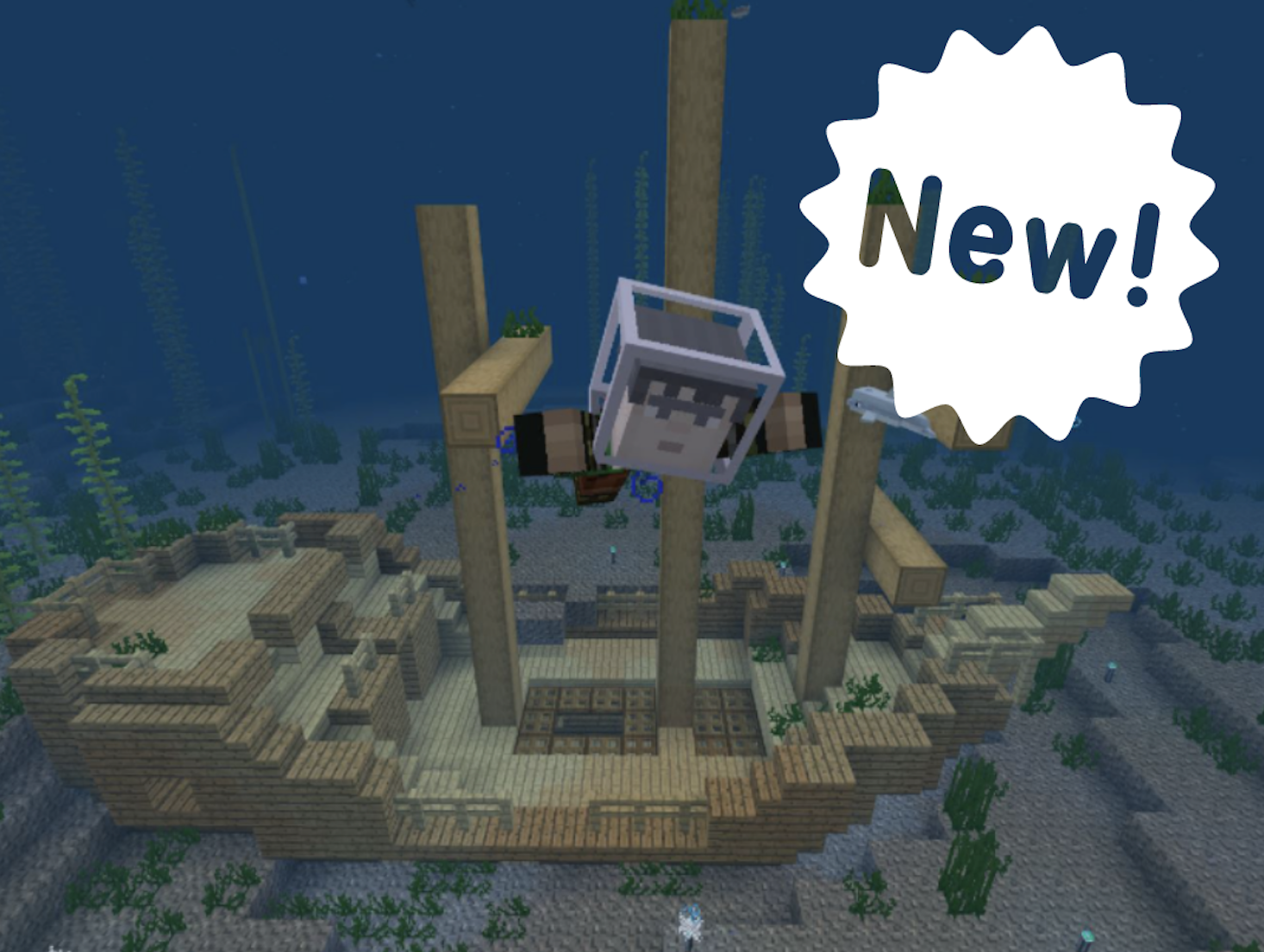
Load the supplied Minecraft world, which features a shipwreck, or find your own in the game by using the slash command /locate in the chat window.
Students should observe the details of the shipwreck and take notes on what they see.
Outside of the game, have each student write a narrative about how the ship ended up in this condition.
Consider offering prompts, such as:
Who might have been on the ship?
What cargo was it carrying?
Where might the ship have been going?
Have students return to the game and build onto the shipwreck within Minecraft to add details and evidence to support their narrative.
Once complete, take a screenshot, or use the in-game camera and portfolio to create digital illustrations for the student’s stories.
Students completed an informative/explanatory piece of writing that describes the shipwreck and what took place to make it sink.
Students use facts and details to support their narrative.
Students created digital illustrations within Minecraft that demonstrate important details from their narrative.
Check out the Tips & Tricks video playlist that will help you and your students better use Minecraft: Education Edition in the classroom:
https://youtube.com/playlist?list=PLkh9rrdH-ARER03ojhFYtmoFDVuACYJLa
More videos added periodically so make sure you check often for more content!
Click and watch the student pause and play video with your class, pausing and playing as needed. This will help your students understand how to navigate through this lesson and Minecraft world and complete the activities located within them. Enjoy!
Check out the YouTube link of this video for your reference: https://youtu.be/7mx0sc42aOk
Student 'Pause & Play' Video
Read, write, represent and talk to explore personal understandings of new ideas and information
Use own experiences as a basis for exploring and expressing opinions and understanding
Use talk, notes, personal writing and representing to explore relationships among own ideas and experiences, those of others and those encountered in oral, print and other media texts
Applied Design
Prototyping
Outline a general plan, identifying tools and materials
Construct a first version of the product, making changes to tools, materials, and procedures as needed
Record iterations of prototyping
Testing
Test the product
Gather peer feedback and inspiration
Make changes and test again, repeating until satisfied with the product
Making
Construct the final product, incorporating planned change
Exchange ideas and perspectives to build shared understanding
Use writing and design processes to plan, develop, and create texts for a variety of purposes and audiences
Use language in creative and playful ways to develop style
Communicate in sentences and paragraphs, applying conventions of Canadian spelling, grammar, and punctuation
Develop and apply expanding word knowledge
Transform ideas and information to create original texts
Applied Design
Prototyping
Outline a general plan, identifying tools and materials
Construct a first version of the product, making changes to tools, materials, and procedures as needed
Record iterations of prototyping
Testing
Test the product
Gather peer feedback and inspiration
Make changes and test again, repeating until satisfied with the product
Making
Construct the final product, incorporating planned change
Exchange ideas and perspectives to build shared understanding
Use writing and design processes to plan, develop, and create texts for a variety of purposes and audiences
Use language in creative and playful ways to develop style
Communicate in sentences and paragraphs, applying conventions of Canadian spelling, grammar, and punctuation
Develop and apply expanding word knowledge
Transform ideas and information to create original texts
OVERALL EXPECTATIONS
Students will:
generate, gather, and organize ideas and information to write for an intended purpose and audience;
draft and revise their writing, using a variety of informational, literary, and graphic forms and stylistic elements appropriate for the purpose and audience;
use editing, proofreading, and publishing skills and strategies, and knowledge of language conventions, to correct errors, refine expression, and present their work effectively;
reflect on and identify their strengths as writers, areas for improvement, and the strategies they found most helpful at different stages in the writing process.
CC4.1 Compose and create a range of visual, multimedia, oral, and written texts that explore:
• identity (e.g., Expressing Myself)
• community (e.g., Celebrating and Honouring Others)
• social responsibility (e.g., Within My Circle) through personal experiences and inquiry.
CC4.2 Create a variety of clear representations that communicate straightforward ideas and information relevant to the topic and purpose, including short, illustrated reports, dramatizations, posters, and other visuals such as displays and drawings.
CC4.3 Speak to present and express a range of ideas and information in formal and informal speaking situations (including giving oral explanations, delivering brief reports or speeches, demonstrating and describing procedures) for differing audiences and purposes.
CC4.4 Use a writing process to produce descriptive, narrative, and expository compositions that focus on a central idea, have a logical order, explain point of view, and give reasons or evidence.
Elements
Manage information and ideas.
Invent, take risks, and reflect to create possibilities.
Grade Band Descriptors
Learners are making design choices for different purposes.
Learners are actively partaking in communities to explore ideas and deepen thinking.
Learners are using different sources to explore ideas and deepen and extend thinking.
Learners are imagining and exploring different ways to represent thinking and ideas.
Using Structures and Features of Text:
Use of knowledge of structures and features of different text types to interpret texts
Explanation of purposes for structures and features of different texts
Organizing texts:
Application of a logical sequence of events when producing written and media self-expressive and narrative texts (beginning, middle, end)
Selection of relevant information from resources and own research
Use of standard structures for developing narrative and information-based written and media texts
Selection of a process when producing written and media texts
Form: Narrative
Purpose: to entertain with an imaginative experience:
Orientation (time, place and characters) - introduces characters and setting (Once there was a girl named Aleesha. She was watching TV...)
Problem – establishes a problem at the beginning (Mom, I want to be a butterfly dancer!) Events – may include some character description but tends to focus on actions, not always clearly connected, to develop plot
Resolution – includes a brief but reasonable ending and may have some “loose ends” Special Features - may include a title or illustrations - connecting words related to time (first, next, later) - past tense - usually first (I, we) or third person (he, she, they) - action verbs and verbs related to character’s thoughts and feelings - may include dialogue (with change in tense from past to present
Outcomes
Learners will use writing and other representations to explore, clarify and reflect upon thoughts and experiences.
Learners will create text, independently and collaboratively, using a variety of types of writing for a range of audiences and purposes.
Learners will use a range of strategies within the writing process to enhance the clarity, precision, and effectiveness of their writing.
GCO 8: Students will be expected to use writing and other forms of representation to explore, clarify, and reflect on their thoughts, feelings, experiences, and learnings; and to use their imaginations.
use a range of strategies in writing and other ways of representing
to frame questions and design investigations to answer their questions
find topics of personal importance
record, develop and reflect on ideas
compare their own thoughts and beliefs to those of others
describe feelings, reactions, values and attitudes
practice and apply strategies for monitoring learning
formulate goals for learning
select appropriate note-making strategies from a growing repertoire
make language choices to enhance meaning and achieve interesting effect in imaginative writing and other ways of representing
8.1 express feelings and imaginative ideas through writing and representing
8.2 reflect on their learning through writing and representing
Form: Narrative
Purpose: to entertain with an imaginative experience
Orientation (time, place and characters) – introduces characters and setting (Once there was a girl named Aleesha. She was watching TV...)
Problem – establishes a problem at the beginning (Mom, I want to be a butterfly dancer!) Events – may include some character description but tends to focus on actions, not always clearly connected, to develop plot
Resolution – includes a brief but reasonable ending and may have some “loose ends” Special Features - may include a title or illustrations - connecting words related to time (first, next, later) - past tense - usually first (I, we) or third person (he, she, they) - action verbs and verbs related to character’s thoughts and feelings - may include dialogue (with change in tense from past to present