
Loading…
Loading…
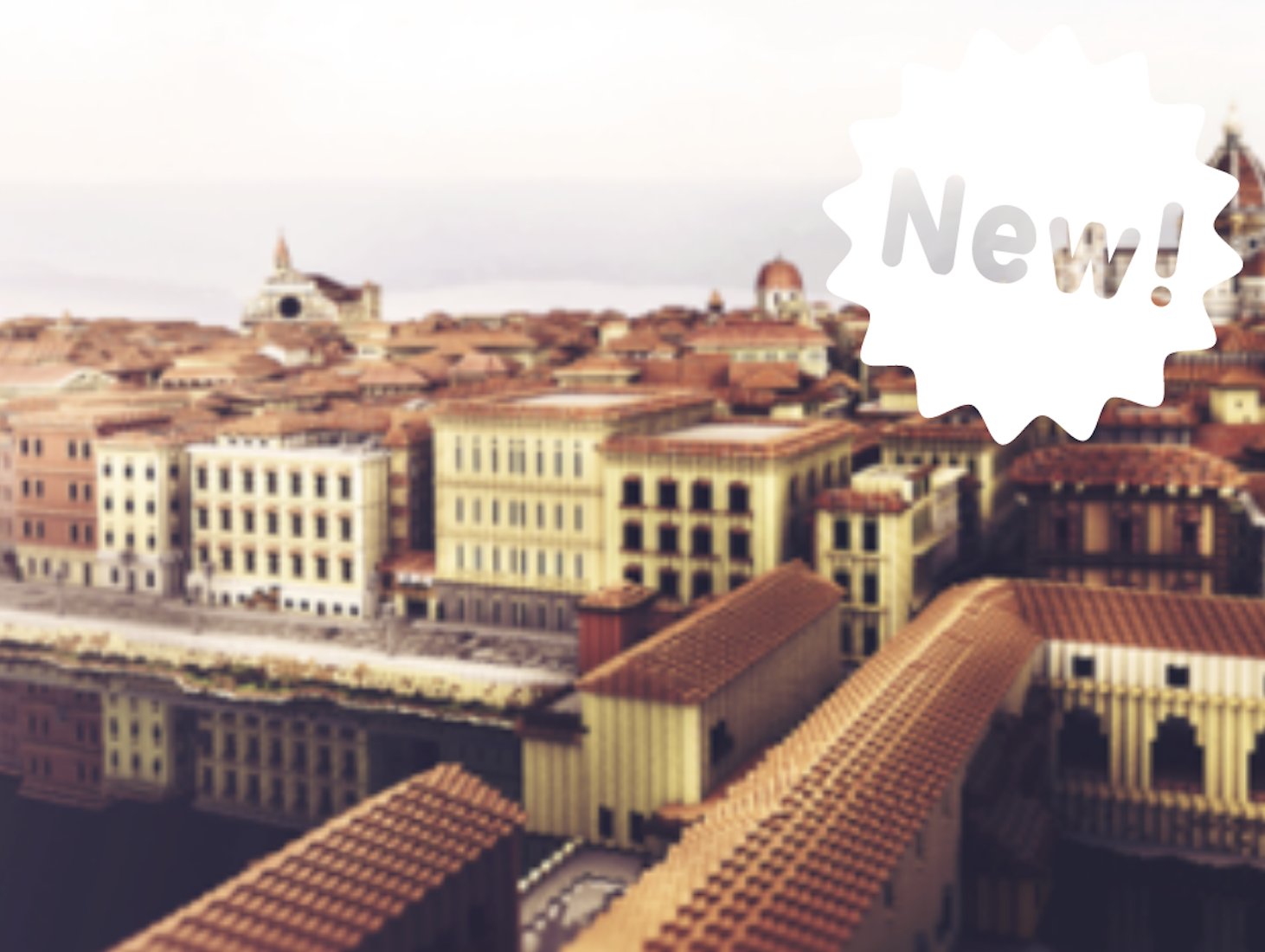
In this lesson, students will discover the history of the beautiful city of Florence: Piazza del Duomo, Palazzo Vecchio, Santa Maria Novella, Campanile di Giotto, Ponte Vecchio.
Welcome to this Minecraft: Education Edition lesson! Before you begin, take a few moments to let us know your thoughts or feedback on how we can improve this lesson in order to better enhance the learning experience that is delivered in your classroom!
Click here or follow the form below to complete the feedback survey once you've completed this lesson. Thank you!
Click and watch this teacher preparation video to help you understand how to teach this lesson. Here is a YouTube link of the teacher video for your reference: https://youtu.be/8ZItw6EBR8U
Start Here: Teacher Preparation Video
To learn about Piazza del Duomo and interact with NPCs. Piazza del Duomo is located in the heart of the historic centre of Florence.
To learn about Piazza della Signoria and interact with NPCs. Piazza della Signoria is an L-shaped square in front of the Palazzo Vecchio. While at Piazza della Signoria have a look at Palazzo Vecchio. It is the town hall of Florence.
To learn about Piazzale degli Uffizi, a narrow courtyard between palace's two wings with view toward the Arno. There is a "quite" famous museum
To learn about a medieval stone closed-spandrel segmental arch bridge over the Arno River: Ponte Vecchio
To learn about Piazza della Repubblica marks the site of the forum, the centre of the Roman city
To learn about Piazza di Santa Maria Novella one of the main and most beautiful squares in Florence is dominated by the great Basilica di Santa Maria Novella
To learn about Museo Novecento just in front of Piazza di Santa Maria Novella
Communication
Citizenship
Collaboration
Piazza del Duomo: it is one of the most visited places in Europe and the world; here we can find the Florence Cathedral with the Cupola del Brunelleschi, the Giotto's Campanile, the Florence Baptistery, the Loggia del Bigallo, the Opera del Duomo Museum, and the Arcivescovile and Canonici's palace. The west zone of this square is called San Giovanni square.
Piazza della Signoria: It was named after the Palazzo della Signoria, also called Palazzo Vecchio. It is the focal point of the origin and of the history of the Florentine Republic and still maintains its reputation as the political hub of the city. It is the meeting place of Florentines as well as the numerous tourists, located near Palazzo Vecchio and Piazza del Duomo and gateway to Uffizi Gallery
Palazzo Vecchio: It overlooks the Piazza della Signoria with its copy of Michelangelo's David statue as well as the gallery of statues in the adjacent Loggia dei Lanzi.
At the Piazzale degli Uffizi you can find the Uffizi Gallery, one of the most important Italian museums. It is also one of the largest and best known in the world, and holds a collection of priceless works, particularly from the period of the Italian Renaissance. Discover the story behind the 28 statues representing famous Florentine figures.
Ponte Vecchio is one of the most beautiful place where you can stay for hours simply looking around you. It's so strange: over the bridge there is a corridor. Discover what was its purpose.
Piazza della Repubblica: the actual aspect of the square is the cause of the urban interventions implemented following the proclamation of Florence capital of Italy for a brief period. Discover what interesting complex and building were found around Piazza della Repubblica.
Basilica di Santa Maria Novella: chronologically, it is the first great basilica in Florence, and is the city's principal Dominican church. Discover why the church is called "Novella" (New) and which art treasures and funerary monuments it contains.
The Museo Novecento is dedicated to the Italian art of the 20th century. It offers a selection of around 300 works located in 15 exhibition areas, in addition to a study room, a cabinet for drawings and prints and a room for conferences and projections.
It is recommended to use wikipedia link in the Italian language because it is more completed than the English version
While at Piazza del Duomo students can start from here and delve into what they prefer: https://it.wikipedia.org/wiki/Piazza_del_Duomo_(Firenze)
While at Piazza della Signoria students can start from here and delve into what they prefer: https://it.wikipedia.org/wiki/Piazza_della_Signoria
In front of Palazzo Vecchio some statues are missing: the copy of Michelangelo's David statue as well as the statues in the Loggia dei Lanzi. Students can start rebuilding them: https://it.wikipedia.org/wiki/Palazzo_Vecchio https://it.wikipedia.org/wiki/Loggia_della_Signoria
In the Piazzale degli Uffizi there should be 28 statues of famous Italian people of Florence: engineers, poets, painters, sculptors, explorators. Sometimes someone was all this at the same time!!! Have you ever heard about Dante, Petrarca, Botticelli, Machiavelli, Mascagni? Do you know Leonardo, Michelangelo, Donatello and Raffaello ? Mmmm ... I'm not talking about the Ninja Turtles of course ... Does it ring a bell if I say "Amerigo Vespucci" ? How can you related him to the "New World" ... the Americas ? What was the role of Galileo Galilei in the scientific revolution of the seventeenth century ? https://it.wikipedia.org/wiki/Galleria_degli_Uffizi
Ponte Vecchio is a small place with a lot of interesting history. It is believed that a bridge was first built in Roman times: do you think it was destroyed World War II or by a flood ? In order to connect the Palazzo Vecchio with the Palazzo Pitti, in 1565 Cosimo I de' Medici had Giorgio Vasari build the Vasari Corridor above it. But ... where is Palazzo Pitti ? Can you help me to build it ? https://it.wikipedia.org/wiki/Ponte_Vecchio
Have you ever heard the words: cardo and decumanus ? How is it called the intense activity in Piazza della Repubblica between 1885 and 1895 ? Can you find the porticos with the triumphal arch, called the "Arcone" ? Above it there should be a pompous inscription: "L'ANTICO CENTRO DELLA CITTÀ DA SECOLARE SQUALLORE A VITA NUOVA RESTITUITO". Can you translate it ? https://it.wikipedia.org/wiki/Piazza_della_Repubblica_(Firenze)
What is the meaning of "Novella" ? How many years did they use to build it ? Do you know how many artists produced items for the church ? https://it.wikipedia.org/wiki/Basilica_di_Santa_Maria_Novella
Museo Novecento offers to the public a rich program of exhibitions and activities to approach the 20th century’s arts and their protagonists. Do you know the museum offers several activities and laboratories, that change according to children’s age and lot of them are dedicated to families ?
Students will love the beauty of the City Of Florence and will learn so much about its monuments, artists and buildings. Want to teleport quickly to the different areas around Florence? Use these coordinates to help you:
Piazza di S.Maria Novella / Museo Novecento /tp @p 547 17 3346
Piazza della Repubblica /tp @p 993 17 3538
Piazza del Duomo / Basilica di Santa Maria del Fiore / Campanile di Giotto /tp @p 1053 17 3339
Ponte Vecchio /tp @p 916 17 4014
Piazza della Signoria Palazzo Vecchio / Uffizi coordinates: /tp @p 1156 17 3798
This world was not possible without the passion of:
The City Of Florence: www.comune.fi.it
Mus.E Firenze: musefirenze.it
Museo Novecento: www.museonovecento.it
Creatubbles: the safe social platform for artists from all around the world
ShapeScape: the map builders behind the impressive rebuild of the City of Florence
Marco Vigelini aka me: the project manager of this world
Check out the Tips & Tricks video playlist that will help you and your students better use Minecraft: Education Edition in the classroom:
https://youtube.com/playlist?list=PLkh9rrdH-ARER03ojhFYtmoFDVuACYJLa
More videos added periodically so make sure you check often for more content!
Click and watch the student pause and play video with your class, pausing and playing as needed. This will help your students understand how to navigate through this lesson and Minecraft world and complete the activities located within them. Enjoy!
Check out the YouTube link for your reference: https://youtu.be/Kv0soA_IBNw
Student 'Pause & Play' Video
Big Ideas
· Contacts and conflicts between peoples stimulated significant cultural, social, political change.
· Changing ideas about the world created tension between people wanting to adopt new ideas and those wanting to preserve established traditions.
Curricular Competency
· Identify what the creators of accounts, narratives, maps, or texts have determined is significant (significance)
Key question: Which had more impact on the world: Indian Ocean trade or the Italian Renaissance?
Content
· interactions and exchanges of resources, ideas, arts, and culture between and among different civilizations
· General Outcome 8.2: Origins of a Western Worldview: Renaissance Europe
· Through an examination of Renaissance Europe, students will demonstrate an understanding and appreciation of how the exchange of ideas and knowledge contributed to shaping the worldview of the
Western world.
· Changing ideas about the world created tension between people wanting to adopt new ideas and those wanting to preserve established traditions.
8.2.4 examine, critically, the factors that shaped the worldview evolving in western Europe
during the Renaissance by exploring and reflecting upon the following questions and
issues:
· What was the Renaissance? (TCC, LPP)
· How did the Renaissance spark the growth and exchange of ideas and knowledge across
· Europe (i.e., astronomy, mathematics, science, politics, religion, arts)? (TCC, ER, PADM, GC)
A1. Application: compare key aspects of life in a few early societies (3000 BCE–1500 CE), each from a
different region and era and representing a different culture, and describe some key similarities and
differences between these early societies and present-day Canadian society (FOCUS ON: Continuity
and Change; Perspective)
· A1.2d compare aspects of the daily lives of different groups in an early society
E1. Social, Cultural, and Political Heritage: analyze the socio-economic, cultural, and political legacies of societies/civilizations from three or more regions and from different periods prior to 1500
· E1.2 analyze the legacy of art and literature from various societies/civilizations
· E1.3 analyze the architectural legacy of various societies/civilizations
· 8.5.3 Renaissance and Reformation
· KI-020 Give examples of the expression of the Renaissance in its art, architecture, philosophy, literature, science, or technology from the fourteenth to sixteenth centuries
· KH-036 Identify individuals and ideas of the Renaissance and describe the historical significance of this period.
The course has six broad chronological divisions: The Evolution of Human Beings; The Birth of Civilizations (including Mesopotamia, Egypt, China, Africa, and the Americas); Greece; Rome; The Middle Ages; and The Renaissance and Reformation. Each of these divisions can be considered from a number of points of view, including geography, archaeology, society, language, religion, and politics. Major themes could be developed spanning the broad chronological period (for example, agriculture, development of government, religion, and revolutions).
(note: there is currently no curriculum guide for this course)
Students will be expected to:
5.0 explain how ideas influence the human experience
5.2 explain the factors that contributed to a change in worldview at the beginning of the late Pre-Modern Era
· General Outcome 8.2: Origins of a Western Worldview: Renaissance Europe
· Through an examination of Renaissance Europe, students will demonstrate an understanding and appreciation of how the exchange of ideas and knowledge contributed to shaping the worldview of the
Western world.
· Changing ideas about the world created tension between people wanting to adopt new ideas and those wanting to preserve established traditions.
8.2.4 examine, critically, the factors that shaped the worldview evolving in western Europe
during the Renaissance by exploring and reflecting upon the following questions and
issues:
· What was the Renaissance? (TCC, LPP)
· How did the Renaissance spark the growth and exchange of ideas and knowledge across
· Europe (i.e., astronomy, mathematics, science, politics, religion, arts)? (TCC, ER, PADM, GC)
· General Outcome 8.2: Origins of a Western Worldview: Renaissance Europe
· Through an examination of Renaissance Europe, students will demonstrate an understanding and appreciation of how the exchange of ideas and knowledge contributed to shaping the worldview of the
Western world.
· Changing ideas about the world created tension between people wanting to adopt new ideas and those wanting to preserve established traditions.
8.2.4 examine, critically, the factors that shaped the worldview evolving in western Europe
during the Renaissance by exploring and reflecting upon the following questions and
issues:
· What was the Renaissance? (TCC, LPP)
· How did the Renaissance spark the growth and exchange of ideas and knowledge across
· Europe (i.e., astronomy, mathematics, science, politics, religion, arts)? (TCC, ER, PADM, GC)
Big Ideas
· Contacts and conflicts between peoples stimulated significant cultural, social, political change.
· Changing ideas about the world created tension between people wanting to adopt new ideas and those wanting to preserve established traditions.
Curricular Competency
· Identify what the creators of accounts, narratives, maps, or texts have determined is significant (significance)
Key question: Which had more impact on the world: Indian Ocean trade or the Italian Renaissance?
Content
· interactions and exchanges of resources, ideas, arts, and culture between and among different civilizations