
Loading…
Loading…
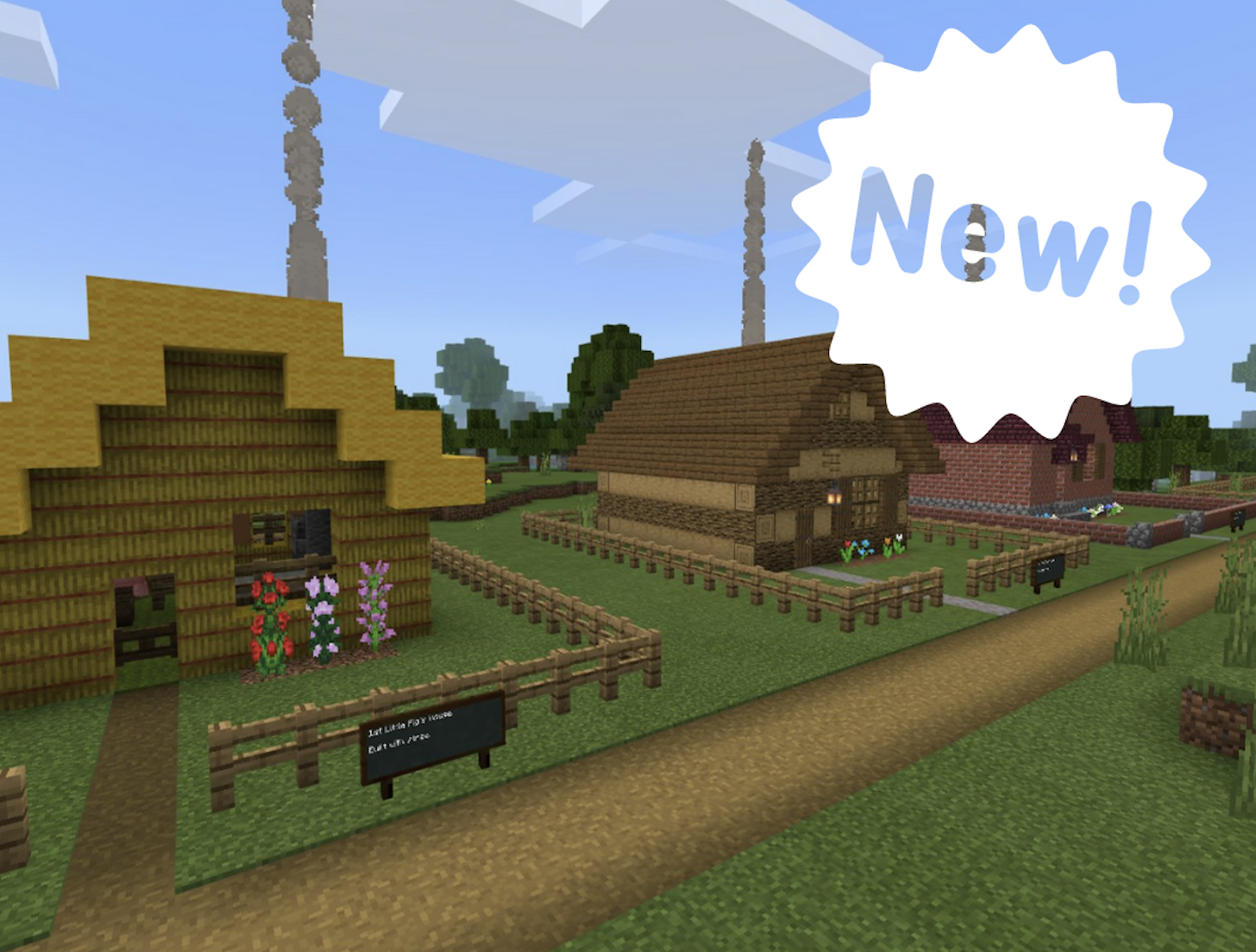
In this lesson, students will complete a challenge to examine the houses of the three little pigs, and then build a house for a fourth little pig using better, stronger materials that will be more durable against external forces.
Welcome to this Minecraft: Education Edition lesson! Before you begin, take a few moments to let us know your thoughts or feedback on how we can improve this lesson in order to better enhance the learning experience that is delivered in your classroom!
Click here or follow the form below to complete the feedback survey once you've completed this lesson. Thank you!
Click and watch this teacher preparation video to help you understand how to teach this lesson. Here is a YouTube link of the teacher video for your reference: https://youtu.be/UX2VnisPn4I
Start Here: Teacher Preparation Video
Students will then be tasked with building a structure for a fourth little pig, and will learn:
About the relative strengths of materials, namely hay, wood, or brick.
How to judge the strengths of potentially better materials.
How certain structures are stronger against certain forces due to their design
Collaboration
Communication
Creativity
Critical Thinking
Project Based Learning
Problem Solving
Different forces in nature have different effects on different designs of structure and different building materials.
Our rivers, lakes and drinking water
The air we breathe
Agriculture, including farming of plants and animals
The food chain
Wildlife and species that are very sensitive to pollution
Our health
As a contributing factor of global warming
Individually or in small groups, students will assess the structures of the first three little pig’s homes, and consider the durability of the materials used in each (hay, wood, brick) and how they will stand up to the Big Bad Wolf blowing them down.
Students will make educated guesses as to the outcome of a wold attack by writing what they think will happen in the slate, poster, board or NPCs.
Students will simulate the attack based on an agreed amount of TNT blocks on each of the existing structures (suggest no more than 12 blocks of TNT).
Based on the results they observe, they will construct their own structure.
Students will again make educated guesses, writing their assumptions on slates, posters, boards or NPCs as to what will occur to their structure in a simulated test with TNT.
Students will simulate another attack using the same amount of TNT as above.
Students will analyse the results, again writing them down.
Students will also consider the following questions:
Did your structure survive completely, was there only some damage, a lot of damage, or did it get completely blown away?
Did the 4th Little Pig survive the simulated attack?
Based on what you’ve observed, was your design and the materials strong enough?
What would you do next time to improve the structure and make it more resilient (stronger) against another test?
If there is time, allow the student to make another copy of their structure, make improvements and try the test again.
The process as above is the same, but instead of written answers, focus on classroom group discussion.
Recommendations
Students should make copies of their world after completing their builds. Tests should be performed on the copies, allowing the original build to remain intact.
Students should place their slates, posters, boards and NPCs as far away from the blast area as they can.
Students will demonstrate their understanding of the strength of various materials and structure designs, by building a better structure that survives or is relatively resilient against the TNT simulation.
Check out the Tips & Tricks video playlist that will help you and your students better use Minecraft: Education Edition in the classroom:
https://youtube.com/playlist?list=PLkh9rrdH-ARER03ojhFYtmoFDVuACYJLa
More videos added periodically so make sure you check often for more content!
Click and watch the student pause and play video with your class, pausing and playing as needed. This will help your students understand how to navigate through this lesson and Minecraft world and complete the activities located within them. Enjoy!
Check out the YouTube link of this video for your reference: https://youtu.be/1jpj7yiuirA
Student 'Pause & Play' Video
Specific Outcome 13: Demonstrate an understanding of fractions by:
explaining that a fraction represents a part of a whole
describing situations in which fractions are used
3–3 Investigate a practical problem, and develop a possible solution. Note: The problem will involve building a rigid or semi-rigid structure, using available materials.
3–7 Construct structures, using a variety of materials and designs, and compare the effectiveness of the various materials and designs for their intended purposes.
Specific Outcome 8 : Demonstrate an understanding of fractions less than or equal to one by using concrete, pictorial and symbolic representations to:
name and record fractions for the parts of a whole or a set
model and explain that for different wholes, two identical fractions may not represent the same quantity
provide examples of where fractions are used.
4–3 Investigate a practical problem, and develop a possible solution. Note: The problem will involve building a structure with moving parts, using available materials.
Specific Outcome 7: Demonstrate an understanding of fractions by using concrete, pictorial and symbolic representations to:
compare fractions with like and unlike denominators
Specific Outcome 2: Solve problems involving whole numbers and decimal numbers
Identify needs and opportunities for designing, through exploration
Generate ideas from their experiences and interests
Add to others’ ideas
Choose an idea to pursue.
Making
Choose tools and materials
Make a product using known procedures or through modelling of others
Use trial and error to make changes, solve problems, or incorporate new ideas from self or others
Sharing
Decide on how and with whom to share their product
Demonstrate their product, tell the story of designing and making their product, and explain how their product contributes to the individual, family, community, and/or environment
Use personal preferences to evaluate the success of their design solutions
Reflect on their ability to work effectively both as individuals and collaboratively in a group
Use materials, tools, and technologies in a safe manner in both physical and digital environments
Develop their skills and add new ones through play and collaborative work
Explore the use of simple, available tools and technologies to extend their capabilities
Curricular Competencies
Develop mental math strategies and abilities to make sense of quantities
Use technology to explore mathematics
Understanding and solving
Develop, demonstrate, and apply mathematical understanding through play, inquiry, and problem solving
Content
Students are expected to know the following:
- Fraction concepts: Fractions can represent parts of a region, set, or linear model.
- Ordering and comparing fractions: Using concrete and visual models.
Identify needs and opportunities for designing, through exploration
Generate ideas from their experiences and interests
Add to others’ ideas
Choose an idea to pursue.
Making
Choose tools and materials
Make a product using known procedures or through modelling of others
Use trial and error to make changes, solve problems, or incorporate new ideas from self or others
Sharing
Decide on how and with whom to share their product
Demonstrate their product, tell the story of designing and making their product, and explain how their product contributes to the individual, family, community, and/or environment
Use personal preferences to evaluate the success of their design solutions
Reflect on their ability to work effectively both as individuals and collaboratively in a group
Use materials, tools, and technologies in a safe manner in both physical and digital environments
Develop their skills and add new ones through play and collaborative work
Explore the use of simple, available tools and technologies to extend their capabilities
Curricular Competencies
Develop mental math strategies and abilities to make sense of quantities
Use technology to explore mathematics
Understanding and solving
Develop, demonstrate, and apply mathematical understanding through play, inquiry, and problem solving
Content
Students are expected to know the following:
- Fraction concepts: Fractions can represent parts of a region, set, or linear model.
- Ordering and comparing fractions: Using concrete and visual models.
Number
B1.6 Fractions use drawings to represent, solve, and compare the results of fair-share problems that involve sharing up to 20 items among 2, 3, 4, 5, 6, 8, and 10 sharers, including problems that result in whole numbers, mixed numbers, and fractional amounts.
Algebra
C3.1 solve problems and create computational representations of mathematical situations by writing and executing code, including code that involves sequential, concurrent, and repeating events
C3.2 read and alter existing code, including code that involves sequential, concurrent, and repeating events, and describe how changes to the code affect the outcomes
Understanding Structures and Mechanisms
2.5 use appropriate science and technology vocabulary, including compression, tension, strut, ties, strength, and stability, in oral and written communication
3.1 define a structure as a supporting framework, with a definite size, shape, and purpose, that holds a load (e.g., a running shoe, a tepee, a bicycle, an igloo)
3.2 identify structures in the natural environment (e.g., a tree, a bees’ nest/hive) and in the built environment (e.g., a totem pole, a fence, a pyramid, the CN Tower)
3.3 identify the strength of a structure as its ability to support a load
3.4 identify the stability of a structure as its ability to maintain balance and stay fixed in one spot
3.5 identify properties of materials (e.g., strength, flexibility, durability) that need to be considered when building structures 3.6 describe ways in which the strength of different materials can be altered (e.g., by folding, adding layers, twisting/braiding, changing their shape)
3.7 describe ways to improve a structure’s strength (e.g., by using triangulation or crossmembers) and stability (e.g., by lowering the centre of gravity) 3.8 explain how strength and stability enable a structure (e.g., bridge, tent) to perform a specific function 3.9 describe ways in which different forces can affect the shape, balance, or position of structures (e.g., a load may cause a cardboard box to buckle) 3.10 identify the role of struts and ties in structures under load (e.g., a strut is added to a wooden frame to resist compression that might cause its collapse; a tie is added to a roof truss to resist tension that might cause the roof to collapse from the weight of the shingles)
Number
B1.4 Represent fractions from halves to tenths using drawings, tools, and standard fractional notation, and explain the meanings of the denominator and the numerator.
Algebra
C3.1 solve problems and create computational representations of mathematical situations by writing and executing code, including code that involves sequential, concurrent, and repeating events
C3.2 read and alter existing code, including code that involves sequential, concurrent, and repeating events, and describe how changes to the code affect the outcomes
Number
B1.3 Fractions, Decimals, and Percents represent equivalent fractions from halves to twelfths, including improper fractions and mixed numbers, using appropriate tools, in various contexts.
B1.5 Fractions, Decimals, and Percents read, represent, compare, and order decimal numbers up to hundredths, in various contexts
B1.7 Describe relationships and show equivalences among fractions, decimal numbers up to hundredths, and whole number percents, using appropriate tools and drawings, in various contexts.
Algebra
C3.1 solve problems and create computational representations of mathematical situations by writing and executing code, including code that involves sequential, concurrent, and repeating events
C3.2 read and alter existing code, including code that involves sequential, concurrent, and repeating events, and describe how changes to the code affect the outcomes
Number
B1.3 Rational Numbers compare and order integers, decimal numbers, and fractions, separately and in combination, in various contexts.
B1.4 Fractions, Decimals, and Percents read, represent, compare, and order decimal numbers up to thousandths, in various contexts.
B1.6 Fractions, Decimals, and Percents describe relationships and show equivalences among fractions and decimal numbers up to thousandths, using appropriate tools and drawings, in various contexts
Algebra
C3.1 solve problems and create computational representations of mathematical situations by writing and executing code, including code that involves sequential, concurrent, and repeating events
C3.2 read and alter existing code, including code that involves sequential, concurrent, and repeating events, and describe how changes to the code affect the outcomes
N3.4 Demonstrate understanding of fractions concretely, pictorially, physically, and orally including: • representing • observing and describing situations • comparing • relating to quantity.
SM3.1 Investigate properties of materials and methods of joinery used in structures.
SM3.2 Assess the function and characteristics of strong, stable, and balanced natural and human-built structures
N4.6 Demonstrate an understanding of fractions less than or equal to one by using concrete and pictorial representations to: • name and record fractions for the parts of a whole or a set • compare and order fractions • model and explain that for different wholes, two identical fractions may not represent the same quantity • provide examples of where fractions are used.
N5.5 Demonstrate an understanding of fractions by using concrete and pictorial representations to: • create sets of equivalent fractions • compare fractions with like and unlike denominators.
3.N.13. Demonstrate an understanding of fractions by n explaining that a fraction represents a portion of a whole divided into equal parts in describing situations in which fractions are used n comparing fractions of the same whole with like denominators [C, CN, ME, R, V]
· Identify common characteristics of a set of fractions.
· Describe everyday situations where fractions are used.
· Represent a fraction concretely or pictorially.
3-2-01 Use appropriate vocabulary related to their investigations of materials and structures. Include: strength, balance, stability, structure, frame structure, natural structure, human-built structure, force.
3-2-05 Recognize that balance affects the stability of a structure. Examples: a domino tower that leans to one side is more likely to tip over than one that stands straight.
3-2-06 Explore to determine ways to improve the strength and stability of a frame structure. Examples: use of triangulation or a cross member.
3-2-07 Identify shapes that are part of natural and human-built structures from various cultures and describe how these shapes help to provide strength and stability. Examples: cylinders, triangles, hexagons in outdoor play structure, hexagons in a honeycomb.
3-2-08 Identify characteristics of materials that need to be considered when choosing materials for building structures. Examples: strength, flexibility, durability, surface texture.
3-2-09 Use the design process to build a structure that meets given criteria related to strength, stability, and function.
3-2-10 Describe the effects of various forces on different structures. Examples: bookshelf sagging under the mass/weight of books, tent blowing over in a storm.
3-2-11 Evaluate simple structures to determine if they are safe and appropriate to the user. Examples: classroom furniture.
4.N.8. Demonstrate an understanding of fractions less than or equal to one by using concrete and pictorial representations to n name and record fractions for the parts of a whole or a set n compare and order fractions n model and explain that for different wholes, two identical fractions may not represent the same quantity n provide examples of where fractions are used [C, CN, PS, R, V]
· Represent a fraction using concrete materials.
· Identify a fraction from its concrete representation.
· Name and record the shaded and non-shaded parts of a set.
· Name and record the shaded and non-shaded parts of a whole.
· Represent a fraction pictorially by shading parts of a whole.
· Name fractions between two benchmarks on a number line (horizontal or vertical).
· Order a set of fractions by placing them on a number line (horizontal or vertical) with benchmarks.
5.N.7. Demonstrate an understanding of fractions by using concrete and pictorial representations to n create sets of equivalent fractions n compare fractions with like and unlike denominators [C, CN, PS, R, V]
· Create a set of equivalent fractions and explain why there are many equivalent fractions for any fraction using concrete materials.
· Formulate and verify a rule for developing a set of equivalent fractions.
· Identify equivalent fractions for a fraction.
Fractions:
· Represents a fraction in a variety of ways, based on a whole or a collection of objects.
· Uses objects, diagrams or equations to represent a situation and conversely, describes a situation represented by objects, diagrams or equations (use of different meanings of addition, subtraction and multiplication by a natural number)
· Generates a set of equivalent fractions
· Reduces a fraction to its simplest form (lowest terms)
– Design and manufacture of instruments, tools, machines, structures (e.g. bridges, towers), devices (e.g. water filtration device), models (e.g. glider) and simple circuits
N13 Demonstrate an understanding of fractions by: • explaining that a fraction represents a part of a whole; • describing situations in which fractions are used; • comparing fractions of the same whole with like denominators.
N8 Demonstrate an understanding of fractions less than or equal to one by using concrete and pictorial representations to: name and record fractions for the parts of a whole or a set; compare and order fractions; model and explain that for different wholes, two identical fractions may not represent the same quantity; provide examples of where fractions are used.
N7 Demonstrate an understanding of fractions by using concrete and pictorial representations to: create sets of equivalent fractions; compare fractions with like and unlike denominators.
Identify internal forces acting on a structure and describe their effects on the structure: tension, compression, torsion or torque, and shear
Identify external forces acting on a structure and describe their effects on the structure: Gravity, Symmetry, and Load
N13: Students will be expected to demonstrate an understanding of fractions by · explaining that a fraction represents a part of a whole · describing situations in which fractions are used · comparing fractions of the same whole with like denominators.
Investigate shapes in structures (COM, PCD, CT, TF)
Evaluate the structure according to design challenge criteria (COM, CT, TF)
N08: Students will be expected to demonstrate an understanding of fractions less than or equal to 1 by using concrete, pictorial, and symbolic representations to name and record fractions for the parts of one whole or a set compare and order fractions model and explain that for different wholes, two identical fractions may not represent the same quantity provide examples of where fractions are used
N07: Students will be expected to demonstrate an understanding of fractions by using concrete, pictorial, and symbolic representations to create sets of equivalent fractions compare and order fractions with like and unlike denominators.
3N13 Demonstrate an understanding of fractions by: • explaining that a fraction represents a part of a whole • describing situations in which fractions are used • comparing fractions of the same whole that have like denominators.
23.0 describe the properties of some common materials and evaluate their suitability for use in building structures
27.0 evaluate structures to determine if they are effective and safe, if they make efficient use of materials, and if they are appropriate to the user and the environment
33.0 test the strength and stability of personally built structures
36.0 identify ways of modifying a structure to increase its strength and stability
4N8 Demonstrate an understanding of fractions less than or equal to one by using concrete, pictorial and symbolic representations to: • name and record fractions for the parts of a whole or a set • compare and order fractions • model and explain that for different wholes, two identical fractions may not represent the same quantity • provide examples of where fractions are used.
5N7 Demonstrate an understanding of fractions by using concrete, pictorial and symbolic representations to: • create sets of equivalent fractions • compare fractions with like and unlike denominators.
N13 Demonstrate an understanding of fractions by: • explaining that a fraction represents a part of a whole; • describing situations in which fractions are used; • comparing fractions of the same whole with like denominators.
23.0 describe the properties of some common materials and evaluate their suitability for use in building structures
27.0 evaluate structures to determine if they are effective and safe, if they make efficient use of materials, and if they are appropriate to the user and the environment
33.0 test the strength and stability of personally built structures
36.0 identify ways of modifying a structure to increase its strength and stability
N8 Demonstrate an understanding of fractions less than or equal to one by using concrete and pictorial representations to: name and record fractions for the parts of a whole or a set; compare and order fractions; model and explain that for different wholes, two identical fractions may not represent the same quantity; provide examples of where fractions are used.
N7 Demonstrate an understanding of fractions by using concrete and pictorial representations to: create sets of equivalent fractions; compare fractions with like and unlike denominators.