Loading…
Loading…
Cue robots (1 per group)
tablets or compatible devices (1 per group)
masking tape (1 roll)
meter stick or measuring tape
black marker
Before this lesson, it is recommended that students:
practice programming loops, variables, and IF statements in the Cue app.
Fully charge the devices and robots.
Install the Wonder Workshop Cue app on each device. Create a “foraging area” for the natural selection simulation using the masking tape, as pictured below. Write the numbers on the tape using black marker. The numbers indicate the amount of food collected by Cue robots that reach each line during foraging.
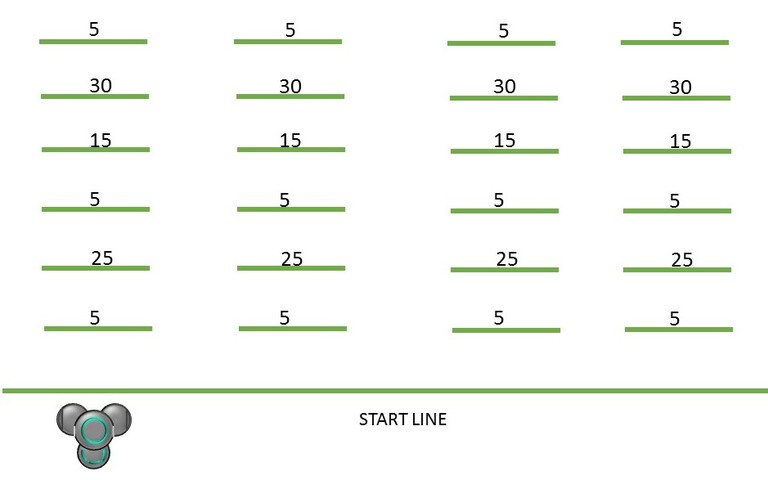
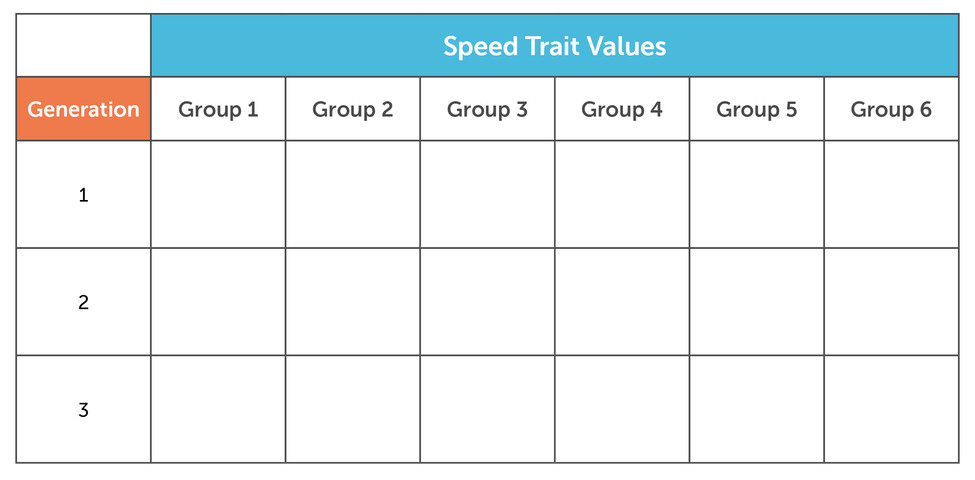
Create a chart on the board for recording trait values and foraging amounts such as the one below:
1. Ask, “What is a loop?” (Sample response: “A set of instructions programmed to repeat x number of times.”)
Ask, “Why can it be helpful to use loops in your programs?” (Sample response: “They can make my programs shorter and more efficient.”)
Ask, “How would you program a loop in the Cue app?” (Sample response: “I would place the blocks I want to loop inside the repeat X block and set X to the number of times I want the code to repeat.”)
2. Ask, “What is a variable in programming?” (Sample response: “A variable is basically an empty box. We can put letters, numbers, or even words into the box. We can also change what is in the box at any time or add things to the box.”)
Ask, “When would it be useful to use a variable in programming?” (Sample response: “Perhaps we require some setting (such as color) to gradually change over time. Instead of changing the color manually, we could create a variable that represents color and program this variable to change over time.”)
Ask, “How would you create a variable in the Cue app?” (Sample response: “In the Variables tab, I would select the “Make a Variable” button, give the variable a name, then use the set item to X block to give the variable an initial value.”)
3. Ask, “What is an IF statement in programming?” (Sample response: “An IF statement is a powerful tool that allows the programmer to create a set of conditions, under which actions defined by the programmer will occur.”
Example: IF something is in front of Cue, THEN drive backwards.
Ask, “How would you use an IF statement in the Cue app?” (Sample response: “In the Control tab, I would use an if-then block, filling in the hexagonal space with some condition (true or false) and inserting the desired action blocks inside the if-then block.”)
4. Ask, “Why would it be useful to control Cue’s wheel speed instead of using the ‘drive forward at speed’ blocks?” (Sample response: “Controlling the wheel speeds allows for much more specific movements. For instance, if you wanted to program Cue to drive in a large circle, you could program one wheel to be slightly slower than the other.”).
Say, “The set wheel speeds block is found in the Actions menu. The wheel speeds can be adjusted simply by changing the numbers in the block to the desired speeds. The rate of speed is cm/s.”
1. Ask, "What is a biological trait?" (Sample response: “A biological trait is an attribute associated with an organism. For example, the length of an organism’s legs, the color of its hair, and the shape of its wings are all biological traits.”)
Ask, “What are some examples of trait differences between (animals) and (similar animals)?” (E.g., German shepherds vs. bulldogs, squirrels vs. chipmunks, robins vs. blue jays, lions vs. tigers, black bears vs. polar bears, etc.).
2. Say, “In plant and animal populations, biological traits that are beneficial to organisms are positively reinforced, or ‘selected’ for, because they improve an individual’s chances of reproducing and passing on their DNA, along with the resulting traits, to the next generation. In the same way, non-beneficial traits are negatively reinforced, or ‘selected’ against, because they reduce an individual’s chances of reproducing. This process is referred to as natural selection and is the way in which specific traits increase or decrease in number in a population.”
3. Say, “A selection pressure is any aspect of an ecosystem that affects whether an individual will reproduce. Let’s consider an example with a common organism: squirrels! What selection pressures do you think exist for squirrels?” Examples:
Environmental conditions: Weather, the changing seasons, toxic materials, the amount of food available, the type of food available, the availability of suitable places to sleep and raise young.
Competition: Squirrels compete for food and space with other squirrels and small mammals, as well as some birds.
Predation: Squirrels must avoid being eaten by domestic animals such as cats and dogs and wild animals such as birds of prey, coyotes, wolves, and wild cats.
4. Ask, “For squirrels, what biological traits might be positively reinforced in a population, given these selection pressures? What traits might be negatively reinforced” (Sample response: “Fur colors that provide poor camouflage might be negatively reinforced. The ability to digest a wide range of different food types might be positively reinforced.”)
1. Say, “Today you will discover how natural selection can change the proportion of specific traits in a population. In this case, the Cue robots in the classroom represent a population of organisms (species name: Makewonderae cue), and the trait of interest is speed. As we will see, the speed of our Cue robots will determine how far they can travel, which will then determine how much food they collect in the foraging area.”
2. Say, “The ability to find and collect food is extremely important for organisms to have enough energy to reproduce. Therefore, we should expect traits that allow organisms to collect more food to be positively reinforced in a population.”
Say, “Today, you will create a ‘foraging’ program for Cue. Foraging is the act of searching for, collecting, and storing or eating food. Our programs will have Cue drive forward to forage, make a ‘foraging sound’ of your choice to indicate the collection of food, then drive back to ‘store’ the food. This will be done over the ‘foraging area’ marked on the floor with tape. Each piece of tape has an amount of food written on it. If your Cue robot is touching a piece of tape when it turns and makes the foraging sound, this number tells you how many pieces of food have been collected. Once each group has created a foraging program, we will create a class-wide simulation of natural selection!”
3. Project your device’s screen and open the Cue app.
Navigate to the Code with Block & JavaScriptⓇ section.
4. Highlight the tabs and blocks that will be necessary to create your foraging program:
Actions: set wheel speeds, sounds, turn angle
Control: repeat, wait, if-then
Variables: create a variable
5. Pair students.
Distribute robots and devices.
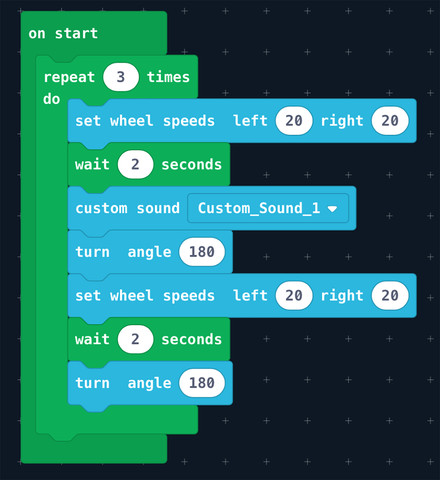
Have students follow along and begin creating their own programs as you demonstrate how to create a basic foraging pattern. (See sample program below for additional guidance.)
6. Show students how to set wheel speeds so that Cue drives in a straight line.
Add wait blocks with two second delays and a loop so that the program repeats three times.
Sample Code:
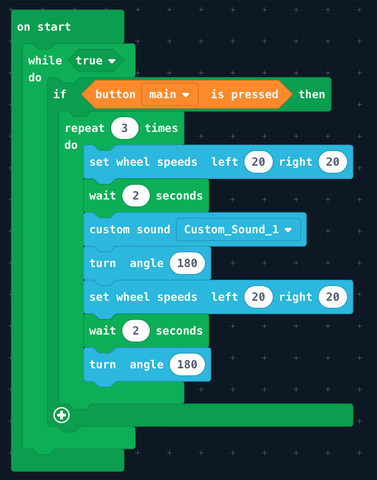
7. Show students how to add an event so that Cue starts foraging only after the main button is pushed.
Explain that this is useful because during the simulation, all of the programs should start at the same time.
Explain that students will need to use an if-then block, where the condition is that the main button is pressed. This block is found in the Events tab.
Tell students that they will need to place this block inside the while true do block in the Control tab so that Cue is continually sensing whether the main button has been pushed.
Sample Code:
8. Say, “Selection can only occur when there is variation within the population around some trait. Before we begin our own simulation of natural selection, we need to create variation in the speed trait in our population of Cue robots. Remember, the speed of the Cue robot will determine which resource spot it lands on, and how much food it will collect.”
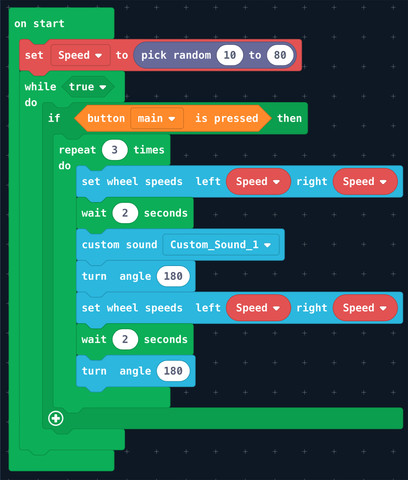
Challenge students to modify their foraging program such that the wheel speeds are chosen randomly at the beginning of the program. This will create class-wide variation in the speed trait.
Show students how to create a variable called Speed and set the variable to a random number between 10 and 80 using the pick random block in the Math tab.
The, show them how to replace their current wheel speeds with their new Speed variable.
Sample Code:
Have students test their programs on the “foraging area” marked on the floor with masking tape.
The amount of food collected depends on which piece of tape Cue was touching when it turned around and made the foraging sound. Have students note how much food was collected during each test. This information will be important for determining which robots successfully ‘reproduce’ and which robots die during the class-wide simulation of natural selection.
1. Say, “Now we are going to do an activity that involves everyone and simulates natural selection right here in the classroom! First, we will measure the variation of traits in the population.”
Have each pair run their foraging program and measure the speed trait of their organism using a meter stick or measuring tape (i.e., What is the value of the Speed variable?). Since each Cue will drive forward for two seconds, students should divide their measured distance by two to get the speed in cm/s.
Have each group write their speed on the class chart on the board under Generation 1.
2. To simulate natural selection, have the class run all of their foraging programs at once.
While the program runs, have each group keep track of the amount of food ‘collected’ by their Makewonderae cue.
3. Identify which ‘organism’ collected the least amount of food. This organism will be unable to reproduce, which means their speed traits will not be passed on to Generation 2.
Identify which ‘organism’ collected the greatest amount of food. This organism will have two offspring, which will be represented by two robots with the same speed trait in Generation 2.
The group that had the least amount of food will now use the speed value of the group with the most amount of food. This robot now represents one of the offspring of the robot with the most amount of food from Generation 1.
All other groups will keep the same trait from Generation 1.
4. Thus:
The organism with the most amount of food from Generation 1 has two offspring in Generation 2, so there will be two robots with this speed trait in Generation 2.
The organism with the least amount of food from Generation 1 has zero offspring in Generation 2, so there will be no robots with this speed trait in Generation 2.
All other organisms have 1 offspring in Generation 2 (because they have the same speed trait).
5. Repeat this process of foraging and reproducing for 3 or 4 Generations.
Have students add a unique color to go along with their randomly chosen speed trait. Run the class activity again and watch as both the speed and color traits change in the population.
During Generation 2 or 3, add a “mutation” feature where you choose one group to run their full program again, thus randomly choosing a different speed trait. This may be beneficial or harmful to their robot’s ability to collect food and the trait may be positively or negatively reinforced in the population (just like a real mutation).
During Generation 2 or 3, change the food landscape by switching around the food values on the pieces of tape. This will likely favor different organisms than are currently favored and change the number of each trait in the population over the next few generations (just like in a real environmental change).
How did the number of specific traits increase or decrease across generations? (Sample response: “The speed traits that caused Cue robots to land on the highest resource values increased, while those that caused Cue to land on the lowest resource values decreased.”)
Was the fastest organism always the one with the most amount of food? (Sample response: “No, because the amount food did not necessarily increase as distance increased. That is, one of the best food spots (25) was located close to the start, so some slow Cue robots were able to obtain lots of food in this spot.”)
What type of selection pressure (environmental conditions, competition, or predation) caused a change in the number of specific traits in our simulated population? (Sample response: “Environmental conditions. Speed traits that best suited the arrangement of resource spots were positively reinforced.”)
What might happen if the distribution of food in our ecosystem were suddenly changed? (Sample response: “The speed traits that are positively or negatively reinforced would also change, just like in natural populations that experience environmental change.”)
Use our Evaluation Rubric to review students’ work and presentations.
[Optional] Share your students’ work with the world using @logicsacademy and #Cue
MS-LS4-4: Construct an explanation based on evidence that describes how genetic variations of traits in a population increase some individuals’ probability of surviving and reproducing in a specific environment.
MS-LS4-6: Use mathematical representations to support explanations of how natural selection may lead to increases and decreases of specific traits in populations over time.
CCSS.ELA-LITERACY.RST.6-8.3: Follow precisely a multistep procedure when carrying out experiments, taking measurements, or performing technical tasks.
CCSS.ELA-LITERACY.RST.6-8.4: Determine the meaning of symbols, key terms, and other domain-specific words and phrases as they are used in a specific scientific or technical context relevant to grades 6-8 texts and topics.
CCSS.ELA-LITERACY.RST.6-8.7: Integrate quantitative or technical information expressed in words in a text with a version of that information expressed visually (e.g., in a flowchart, diagram, model, graph, or table).
5a: Formulate problem definitions suited for technology-assisted methods such as data analysis, abstract models and algorithmic thinking in exploring and finding solutions.
5c: Break problems into component parts, extract key information, and develop descriptive models to understand complex systems or facilitate problem-solving.
5d: Understand how automation works and use algorithmic thinking to develop a sequence of steps to create and test automated solutions.
6c: Communicate complex ideas clearly and effectively by creating or using a variety of digital objects such as visualizations, models or simulations
1B-AP-10: Create programs that include sequences, events, loops, and conditionals.
1B-AP-15: Test and debug (identify and fix errors) a program or algorithm to ensure it runs as intended.
1B-AP-16: Take on varying roles, with teacher guidance, when collaborating with peers during the design, implementation, and review stages of program development.
2-AP-15: Seek and incorporate feedback from team members and users to refine a solution that meets user needs.
2-AP-13: Decompose problems and subproblems into parts to facilitate the design, implementation, and review of programs.
2-AP-17: Systematically test and refine programs using a range of test cases.
SCIENCE INQUIRY
Students will:
identify one or more ways of finding answers to given questions
identify variables: identify the variable to be manipulated, identify variables to be held constant, identify the variable that will be observed (responding variable)
select appropriate materials and identify how they will be used
modify the procedures as needed
work individually or cooperatively in planning and carrying out procedures
PROBLEM SOLVING THROUGH TECHNOLOGY
General Learner Expectations:
6–3 Design and carry out an investigation of a practical problem, and develop a possible solution.
Students will:
communicate effectively with group members in sharing and evaluating ideas, and assessing progress
evaluate procedures used and identify possible improvements
evaluate a design or product, based on a given set of questions or criteria. The criteria/questions may be provided by the teacher or developed by the students. Example criteria include: effectiveness—Does it work?; reliability—Does it work every time; durability—Does it stand up to repeated use?; effort—Is it easy to construct? Is it easy to use?
CTF is planning, creating, appraising and communicating in response to challenges.
I plan in response to challenges.
I make decisions in response to challenges.
I adapt to change and unexpected events.
I solve problems in response to challenges.
I create products, performances or services in response to challenges.
I appraise the skills, knowledge and technologies used to respond to challenges.
I communicate my learning.
CTF is working independently and with others while exploring careers and technology.
I determine how my actions affect learning.
I develop skills that support effective relationships.
I collaborate to achieve common goals.
Questioning and Predicting:
Demonstrate a sustained curiosity about a scientific topic or problem of personal interest
Make observations in familiar or unfamiliar contexts
Planning and Conducting:
With support, plan appropriate investigations to answer their questions or solve problems they have identified
Use equipment and materials safely, identifying potential risks
Processing and Analyzing Data and Information:
Construct and use a variety of methods, including tables, graphs, and digital technologies, as appropriate, to represent patterns or relationships in data
Identify patterns and connections in data
Compare data with predictions and develop explanations for results
Demonstrate an openness to new ideas and consideration of alternatives
Communicating:
Communicate ideas, explanations, and processes in a variety of ways
Express and reflect on personal, shared, or others’ experiences of place
Applied Technologies:
- Select, and as needed learn about, appropriate tools and technologies to extend their capability to complete a task.
- Identify the personal, social, and environmental impacts, including unintended negative consequences, of the choices they make about technology use.
- Identify how the land, natural resources, and culture influence the development and use of tools and technologies.
Appreciation of Science
422 appreciate the role and contribution of science and technology in our understanding of the world
423 appreciate that the applications of science and technology can have advantages and disadvantages
Interest in Science
425 show a continuing curiosity and interest in a broad scope of science-related fields and issues
Scientific Inquiry
428 consider observations and ideas from a variety of sources during investigations and before drawing conclusions
429 value accuracy, precision, and honesty
430 persist in seeking answers to difficult questions and solutions to difficult problems
Collaboration
431 work collaboratively in carrying out investigations, as well as in generating and evaluating ideas
identify the theory of natural selection as one that has been developed based on the gradual accumulation of evidence (105-5)
301-16 identify changes in animals over time, using fossils (this class has students create a model of natural selection to observe evolution in real time using robots).
Appreciation of Science
422 appreciate the role and contribution of science and technology in our understanding of the world
423 appreciate that the applications of science and technology can have advantages and disadvantages
Interest in Science
425 show a continuing curiosity and interest in a broad scope of science-related fields and issues
Scientific Inquiry
428 consider observations and ideas from a variety of sources during investigations and before drawing conclusions
429 value accuracy, precision, and honesty
430 persist in seeking answers to difficult questions and solutions to difficult problems
Collaboration
431 work collaboratively in carrying out investigations, as well as in generating and evaluating ideas
Appreciation of Science
422 appreciate the role and contribution of science and technology in our understanding of the world
423 appreciate that the applications of science and technology can have advantages and disadvantages
Interest in Science
425 show a continuing curiosity and interest in a broad scope of science-related fields and issues
Scientific Inquiry
428 consider observations and ideas from a variety of sources during investigations and before drawing conclusions
429 value accuracy, precision, and honesty
430 persist in seeking answers to difficult questions and solutions to difficult problems
Collaboration
431 work collaboratively in carrying out investigations, as well as in generating and evaluating ideas
2.4 use appropriate science and technology vocabulary, including classification, biodiversity, natural community, interrelationships, vertebrate, invertebrate, stability, characteristics, and organism, in oral and written communication
3.2 demonstrate an understanding of biodiversity as the variety of life on earth, including variety within each species of plant and animal, among species of plants and animals in communities, and among communities and the physical landscapes that support them
3.3 describe ways in which biodiversity within species is important for maintaining the resilience of those species (e.g., because of genetic differences, not all squirrels are affected equally by infectious diseases such as mange; some species of bacteria have become resistant to antibiotics because resistant
Algebra
C3.1 solve problems and create computational representations of mathematical situations by writing and executing code, including code that involves conditional statements and other control structures
C3.2 read and alter existing code, including code that involves conditional statements and other control structures, and describe how changes to the code affect the outcomes and the efficiency of the code
Algebra
C3.1 solve problems and create computational representations of mathematical situations by writing and executing code, including code that involves events influenced by a defined count and/or sub-program and other control structures
C3.2 read and alter existing code, including code that involves events influenced by a defined count and/or sub-program and other control structures, and describe how changes to the code affect the outcomes and the efficiency of the code
Algebra
C3.1 solve problems and create computational representations of mathematical situations by writing and executing code, including code that involves the analysis of data in order to inform and communicate decisions
C3.2 read and alter existing code involving the analysis of data in order to inform and communicate decisions, and describe how changes to the code affect the outcomes and the efficiency of the code
Initiating and Planning
with support (e.g., as a class or in small groups), generates a list of possible solutions to a practical problem and determines which are realistic in the classroom and/or the real world
outlines (individually or in small groups) the steps of a plan, including labelled drawings and/or diagrams, to solve the problem
establishing general criteria for evaluating objects or devices designed to solve the problem
Performing and Recording
carries out the pre-determined plan (individually or in pairs or small groups)
designs, builds, and tests (on the basis of pre-determined criteria) a device or an object to solve the problem
Analyzing and Interpreting
identifies and explains what changes could be made to the plan and how to improve the solution to the problem, and gives reasons for the changes
Communicating
describes orally, and/or using drawings, pictures, and/or simple sentences, the problem and how he or she solved it
Show interest and curiosity in learning about organisms’ adaptations to different environments by journaling, participating in a nature walk, or sharing science-related information about adaptations (gathered from print or video resources or personal experience) with classmates.
Describe examples of structures and behaviours, including seasonal changes, which help living things survive in their environments during the lifetime of the organism.
Describe examples of adaptations to structures and behaviours (e.g., flippers, webbed feet, night-time vision, wide wings, camouflage colouring, migration, and hibernation) that have enabled living things to adapt to their environments in the long term.
Initiating and Planning
with support (e.g., as a class or in small groups), generates a list of possible solutions to a practical problem and determines which are realistic in the classroom and/or the real world
outlines (individually or in small groups) the steps of a plan, including labelled drawings and/or diagrams, to solve the problem
establishing general criteria for evaluating objects or devices designed to solve the problem
Performing and Recording
carries out the pre-determined plan (individually or in pairs or small groups)
designs, builds, and tests (on the basis of pre-determined criteria) a device or an object to solve the problem
Analyzing and Interpreting
identifies and explains what changes could be made to the plan and how to improve the solution to the problem, and gives reasons for the changes
Communicating
describes orally, and/or using drawings, pictures, and/or simple sentences, the problem and how he or she solved it
Describe examples of how scientists collect evidence, search for patterns and relationships in data, and propose explanations to further the development of scientific knowledge about energy and matter flow in ecosystems.
Initiating and Planning
with support (e.g., as a class or in small groups), generates a list of possible solutions to a practical problem and determines which are realistic in the classroom and/or the real world
outlines (individually or in small groups) the steps of a plan, including labelled drawings and/or diagrams, to solve the problem
establishing general criteria for evaluating objects or devices designed to solve the problem
Performing and Recording
carries out the pre-determined plan (individually or in pairs or small groups)
designs, builds, and tests (on the basis of pre-determined criteria) a device or an object to solve the problem
Analyzing and Interpreting
identifies and explains what changes could be made to the plan and how to improve the solution to the problem, and gives reasons for the changes
Communicating
describes orally, and/or using drawings, pictures, and/or simple sentences, the problem and how he or she solved it
74.0 compare the adaptations from closely related animals living in different parts of the world and discuss reasons for any differences 75.0 identify changes in animals over time, using fossils
301-15 compare the adaptations of closely related animals living in different parts of the world and discuss reasons for any differences
301-16 identify changes in animals over time, using fossils
6-1-13 Compare and contrast the adaptations of closely related vertebrates living in different habitats, and suggest reasons that explain these adaptations.
6-1-14 Identify, based on evidence gathered by paleontologists, similarities and differences in animals living today and those that lived in the past. Examples: archaeopteryx and modern birds...
6-1-15 Identify and describe contributions of scientists and naturalists who have increased our understanding of the diversity of living things.
Describes the main stages of the evolution of life forms
301-15, 104-5, 204-6 classify and compare the adaptations of closely related animals and plants living in their local habitat and in different parts of the world and discuss reasons for any differences
P2: Students will be expected to use digital tools to develop ideas and original works in innovative ways.
TOC1: Students will be expected to
safely use many forms of current technology for learning with growing competence
demonstrate conceptual understanding of how information and communication technology, digital tools, and authorized networks support their learning
use terminology related to information and communication technology