Loading…
Loading…
Cue robot (1 per pair)
tablet or compatible devices (1 per pair)
projector or interactive display with mirroring capability
Before this lesson, it is recommended that students:
understand ratios.
have had practice solving ratios with tables.
understand that a ratio compares two quantities (e.g., time to distance).
be able to explain what a ratio represents.
understand how to solve for rate in centimeters.
understand how to program distance and time in the Cue app.
understand how to program the set wheel speeds block.
understand how to program variables.
Fully charge the tablets and robots.
Install the Wonder Workshop Cue app on each device.
1. Practice finding the missing values in ratio problems using a table as a strategy.
2. Draw the following table on the board.
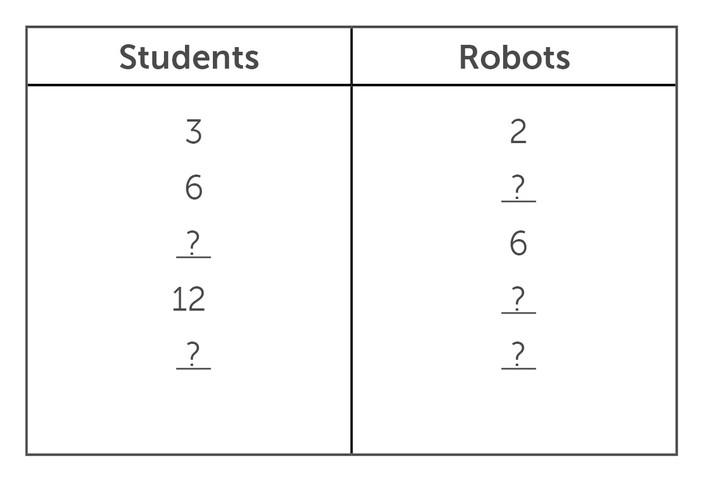
3. Ask, “If the ratio of students to Cue robots is 3 to 2 and you know there are 10 robots, what is the number of students?”
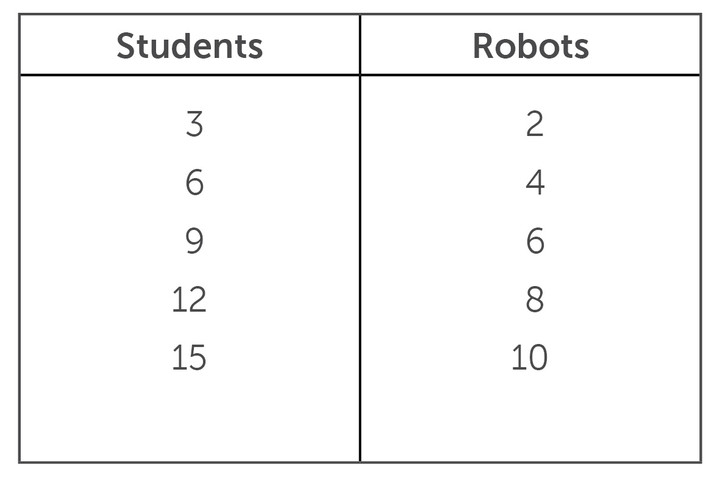
4. [Optional] Review other ratio strategies including cross multiplication, division, and graphing.
1. Assemble students as a whole group and explain the goal of the lesson.
Say, “During this lesson, you will work in small groups to act as Cue's Olympic coach. You will program Cue to speed skate and then figure skate through four practice sessions. You will need to understand the relationship between ratios to be able to solve for missing values such as time, distance, and rate of speed.”
2. Project the Coaching Cue worksheet and review the four challenges students will be working on with their partners and Cue.
3. Share the goal: “Solve each scenario using a selected ratio strategy (e.g., creating a table) and check your results by programming Cue for time, distance, or rate per the stated ratio.”
Note that there is more than one way to program each challenge from the Coaching Cue worksheet.
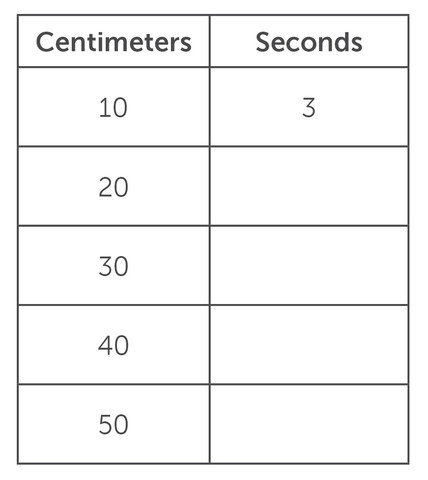
4. Before getting started, draw a table on the board and substitute different values in the table for practice. See example below:
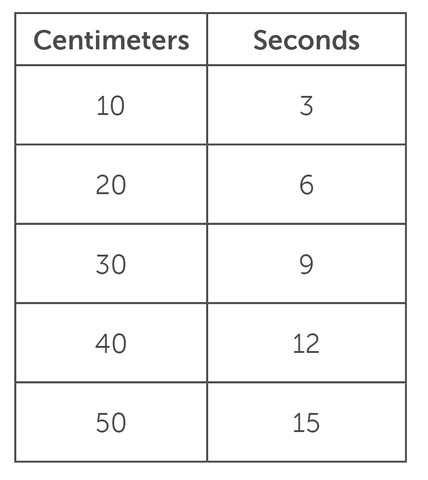
Ask, "If Cue can skate 30 centimeters per 3 seconds, how many seconds will it take for Cue to skate a distance of 50 centimeters?"
Call students to the board to identify and insert the missing values in the table, comparing distance (centimeters) to time (seconds). State the solution as a ratio. "Cue will skate 50 centimeters at a rate of 50 cm / 15 seconds.”
Solution:
1. Project your device screen and open the Cue app.
Navigate to the Code with Block and JavaScriptⓇ section.
2. Say, “In this lesson, you will act as an Olympic skating coach, coding Cue to run four skating programs. What are some blocks from the Actions menu that could help you achieve this?” (Sample response: "Move distance, set wheel speed, and turn angle blocks.”)
3. Ask, “In your program, what blocks could be used to reflect the increasing values in a table?”
Sample response: “Variable blocks.”
4. Tell students, "Once you and your partners have completed a practice program successfully, Cue will be thrilled! Show the fans how elated Cue is feeling by programming a victory exclamation like, ‘Go for the gold!’ or ‘America, I salute you!’ You may include lights, face patterns, or animations in Cues victory dance."
Ask, "Which blocks can be used to add pizzazz to Cue's figure skating programs? (Sample responses: “Set light, set face pattern, custom sound, and animate blocks.”)
Solutions based on a baseline ratio of 20 cm / 2 sec. Your students' baseline ratios may vary. Note: Times will be approximate.
Challenge #1: Solve for distance.
Answer: 120 cm / 12 sec
Challenge #2: Solve for time.
Answer: 300 cm / 30 seconds
Sample Program
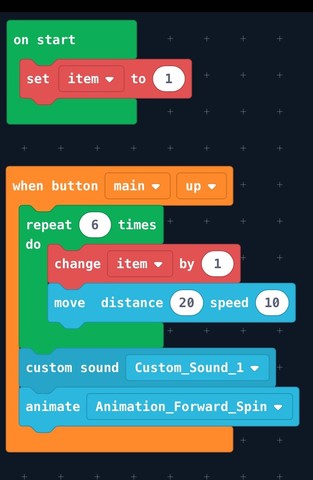
Challenge #3: Solve for distance.
Song # 1 is 80s long.
Cue travels 20 cm/s for 40s.
20 cm/s x 40s = 800 cm
This will be the target distance for Song #2, as well.
Answer: Cue will travel 20 cm/s over 800 cm.
Sample Program
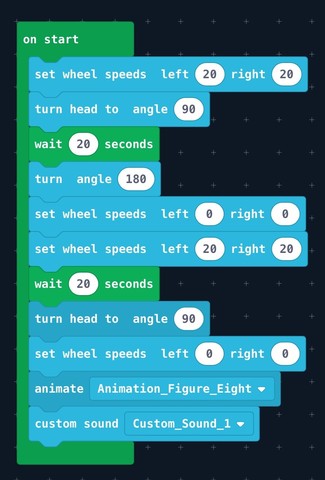
Challenge #4: Solve for rate. Use the same distance to solve for the rate as used in Song #1.
Song #2 is 100s long.
Cue travels ? cm/s for 100s
d = r x t (distance = rate x time)
800 = r x 100s (Solve for rate. Divide each side by 100.)
Answer: Cue will travel 8 cm/s for 800 cm
What are the objectives of this assignment? (Sample response: “Solve the challenges on the worksheet for time and distance. Test your results by coding each practice problem in the Cue app and running the program with Cue.”)
Divide students into pairs.
Distribute robots, devices, rulers, and Coaching Cue worksheets.
Circulate to assist and assess as students work together.
Instruct students to think of other situations where ratios come into play and enact them by programming Cue to demonstrate. Suggestions: amusement parks, baseball stadiums, aquariums.
Have students write their own word problems involving ratios for their peers to program and solve using Cue.
After students are finished, have each group share their solutions and programs with the class.
What challenges did you encounter? How did you overcome them?
If you could do this challenge over again, what would you do differently?
Use our Evaluation Rubric to review students’ work and presentations.
[Optional] Share your students’ work with the world using @logicsacademy and #cue
CCSS.MATH.CONTENT.6.RP.A.1: Understand the concept of a ratio and use ratio language to describe a ratio relationship between two quantities. For example, "The ratio of wings to beaks in the bird house at the zoo was 2:1, because for every 2 wings there was 1 beak." "For every vote candidate A recieved, candidate C received nearly three votes."
CCSS.MATH.CONTENT.6.RP.A.3: Use ratio and rate reasoning to solve real-world and mathematical problems, e.g., by reasoning about tables of equivalent ratios, tape diagrams, double number line diagrams, or equations.
CCSS.MATH.CONTENT.6.RP.A.3.B: Solve unit rate problems including those involving unit pricing and constant speed. For example, if it took 7 hours to mow 4 lawns, then at that rate, how many lawns could be mowed in 35 hours? At what rate were lawns being mowed?
MS-ETS1-1: Define the criteria and constraints of a design problem with sufficient precision to ensure a successful solution,
MS-ETS1-2: Evaluate competing design solutions using a systematic process to determine how well they meet the criteria and constraints of the problem.
1B-AP-10: Create programs that include sequences, events, loops, and conditionals.
1B-AP-15: Test and debug (identify and fix errors) a program or algorithm to ensure it runs as intended.
1B-AP-16: Take on varying roles, with teacher guidance, when collaborating with peers during the design, implementation, and review stages of program development.
1B-AP-17: Describe choices made during program development using code comments, presentations, and demonstrations.
2-AP-13: Decompose problems and subproblems into parts to facilitate the design, implementation, and review of programs.
2-AP-15: Seek and incorporate feedback from team members and users to refine a solution that meets user needs.
2-AP-17: Systematically test and refine programs using a range of test cases.
1A: Articulate and set personal learning goals, develop strategies leveraging technology to achieve them and reflect on the learning process itself to improve learning outcomes.
1B: Build networks and customize their learning environments in ways that support the learning process.
1C: Use technology to seek feedback that informs and improves their practice and to demonstrate their learning in a variety of ways.
4D: Exhibit a tolerance for ambiguity, perseverance and the capacity to work with open-ended problems.
5A: Formulate problem definitions suited for technology-assisted methods such as data analysis, abstract models and algorithmic thinking in exploring and finding solutions.
5C: Break problems into component parts, extract key information, and develop descriptive models to understand complex systems or facilitate problem-solving.
6C: Communicate complex ideas clearly and effectively by creating or using a variety of digital objects such as visualizations, models or simulations.
6D: Students publish or present content that customizes the message and medium for their intended audiences.
7A: Use collaborative technologies to work with others, including peers, experts or community members, to examine issues and problems from multiple viewpoints.
7C: Contribute constructively to project teams, assuming various roles and responses.
Number
5. Demonstrate an understanding of ratio, concretely, pictorially and symbolically.
7. Demonstrate an understanding of integers, concretely, pictorially and symbolically.
Patterns and Relations
1. Represent and describe patterns and relationships, using graphs and tables.
2. Demonstrate an understanding of the relationships within tables of values to solve problems.
Patterns and Relations
1. Demonstrate an understanding of oral and written patterns and their equivalent linear relations.
2. Create a table of values from a linear relation, graph the table of values, and analyze the graph to draw conclusions and solve problems
CTF is planning, creating, appraising and communicating in response to challenges.
I plan in response to challenges.
I make decisions in response to challenges.
I adapt to change and unexpected events.
I solve problems in response to challenges.
I create products, performances or services in response to challenges.
I appraise the skills, knowledge and technologies used to respond to challenges.
I communicate my learning.
CTF is working independently and with others while exploring careers and technology.
I determine how my actions affect learning.
I develop skills that support effective relationships.
I collaborate to achieve common goals.
Reasoning and analyzing
Use logic and patterns to solve puzzles and play games
Use reasoning and logic to explore, analyze, and apply mathematical ideas
Estimate reasonably
Demonstrate and apply mental math strategies
Use tools or technology to explore and create patterns and relationships, and test conjectures
Model mathematics in contextualized experiences
Understanding and solving
Apply multiple strategies to solve problems in both abstract and contextualized situations
Develop, demonstrate, and apply mathematical understanding through play, inquiry, and problem solving
Visualize to explore mathematical concepts
Engage in problem-solving experiences that are connected to place, story, cultural practices, and perspectives relevant to local First Peoples communities, the local community, and other cultures
Communicating and representing
Use mathematical vocabulary and language to contribute to mathematical discussions
Represent mathematical ideas in concrete, pictorial, and symbolic forms
Connecting and reflecting
Reflect on mathematical thinking
Connect mathematical concepts to each other and to other areas and personal interests
Applied Technologies:
- Select, and as needed learn about, appropriate tools and technologies to extend their capability to complete a task.
- Identify the personal, social, and environmental impacts, including unintended negative consequences, of the choices they make about technology use.
- Identify how the land, natural resources, and culture influence the development and use of tools and technologies.
Number
SCO: N5: Demonstrate an understanding of ratio, concretely, pictorially and symbolically.
Patterns and Relations
SCO: PR1: Demonstrate an understanding of the relationships within tables of values to solve problems.
SCO: PR2: Represent and describe patterns and relationships using graphs and tables.
Patterns and Relations
PR1: Demonstrate an understanding of oral and written patterns and their equivalent linear relations.
PR2: Create a table of values from a linear relation, graph the table of values, and analyze the graph to draw conclusions and solve problems.
Number
B1.6 describe relationships and show equivalences among fractions and decimal numbers up to thousandths, using appropriate tools and drawings, in various contexts
Algebra
C1.2 create and translate repeating, growing, and shrinking patterns using various representations, including tables of values, graphs, and, for linear growing patterns, algebraic expressions and equations
C3.1 solve problems and create computational representations of mathematical situations by writing and executing code, including code that involves conditional statements and other control structures
C3.2 read and alter existing code, including code that involves conditional statements and other control structures, and describe how changes to the code affect the outcomes and the efficiency of the code
Number
B1.7 convert between fractions, decimal numbers, and percents, in various contexts
Algebra
C1.1 identify and compare a variety of repeating, growing, and shrinking patterns, including patterns found in real-life contexts, and compare linear growing patterns on the basis of their constant rates and initial values
C3.1 solve problems and create computational representations of mathematical situations by writing and executing code, including code that involves events influenced by a defined count and/or sub-program and other control structures
C3.2 read and alter existing code, including code that involves events influenced by a defined count and/or sub-program and other control structures, and describe how changes to the code affect the outcomes and the efficiency of the code
Number
B1.4 use fractions, decimal numbers, and percents, including percents of more than 100% or less than 1%, interchangeably and flexibly to solve a variety of problems
Algebra
C3.1 solve problems and create computational representations of mathematical situations by writing and executing code, including code that involves the analysis of data in order to inform and communicate decisions
C3.2 read and alter existing code involving the analysis of data in order to inform and communicate decisions, and describe how changes to the code affect the outcomes and the efficiency of the code
Number Strand
N6.8 Demonstrate an understanding of ratio concretely, pictorially, and symbolically.
Patterns and Relations
P6.1 Extend understanding of patterns and relationships in tables of values and graphs.
a. Create and describe a concrete or visual model of a table of values.
b. Create a table of values to represent a concrete or visual pattern.
c. Determine missing values and correct errors found within a table of values and describe the strategy used.
d. Analyze the relationship between consecutive values within each of the columns in a table of values and describe the relationship orally and symbolically.
e. Analyze the relationship between the two columns in a table of values and describe the relationship orally and symbolically.
Patterns and Relations Strand
P7.1 Demonstrate an understanding of the relationships between oral and written patterns, graphs and linear relations.
f. Create a table of values for a linear relation by evaluating the relation for different variable values.
g. Create a table of values using a linear relation and graph the table of values (limited to discrete points).
6N5 Demonstrate an understanding of ratio, concretely, pictorially and symbolically
7PR1 Demonstrate an understanding of oral and written patterns and their equivalent linear relations.
7PR2 Create a table of values from a linear relation, graph the table of values, and analyze the graph to draw conclusions and solve problems.
8N5 Solve problems that involve rates, ratios and proportional reasoning.
N5 Demonstrate an understanding of ratio, concretely, pictorially and symbolically.
PR2 Create a table of values from a linear relation, graph the table of values, and analyse the graph to draw conclusions and solve problems
6.N.5 Demonstrate an understanding of ratio, concretely, pictorially, and symbolically.
8.N.5 Solve problems that involve rates, ratios, and proportional reasoning.
represent ratios concretely, pictorially, and symbolically
identify and describe ratios
solve problems involving ratios
determine equivalent ratios using concrete materials
understand the relationship between ratio and percent
P2: Students will be expected to use digital tools to develop ideas and original works in innovative ways.
TOC1: Students will be expected to
safely use many forms of current technology for learning with growing competence
demonstrate conceptual understanding of how information and communication technology, digital tools, and authorized networks support their learning
use terminology related to information and communication technology
Create a table of values from a linear relation, graph the table of values, and analyze the graph to draw conclusions and solve problems.
GCO1: Students will be expected to design, develop, evaluate, and articulate technological solutions
GCO2: Students will be expected to operate and manage technological systems
Solve problems that involve rates, ratios, and proportional reasoning.
GCO1: Students will be expected to design, develop, evaluate, and articulate technological solutions
GCO2: Students will be expected to operate and manage technological systems
Matches a decimal or percentage to a fraction