Loading…
Loading…
Cue robots (1 per group)
Tablets or compatible devices (1 per group)
Masking tape (1 roll per group)
Before this lesson, it is recommended that students:
understand the behavior of water molecules in each state of matter.
practice programming loops and events in the Cue app.
Fully charge the tablets and robots.
Install the Wonder Workshop Cue app on each tablet.
Tape off a section on the floor to represent the container that will hold the water molecules as a solid and a liquid. This space should be large enough to contain all of the robots in the class with some room around them.
1. Ask, "What is a water molecule?" (Sample response: “A water molecule is made up of two hydrogen atoms and one oxygen atom.”)
2. Ask, “What are the three states of matter?” (Sample response: “Solid, liquid, and gas.”)
Watch this YouTube video animation of water molecules as are they are heated through the states of solid, liquid, and gas.
3. Discuss the behavior of water molecules in each state:
Water: Molecules are in a liquid state. The attraction between water molecules weakens and they are able to slip and slide around each other, taking on the form of the container into which they are poured.
Ice: When water is cooled below freezing temperatures (0°Celsius, 32°Fahrenheit), water molecules pack closely together and are hardly able to move at all. The water molecules are set apart from one another and attached only by their hydrogen bonds.
Gas: When water is heated to a temperature at or above 100°C or 212°F, it forms a gaseous state in the air called water vapor. Water molecules spread further and further apart in this state, taking on the shape of the room they are in.
1. Ask, “What is a loop?” (Sample response: “A set of instructions programmed to repeat x number of times.”)
Ask, “Why can it be helpful to use loops in your programs?” (Sample response: “They can make my programs shorter and more efficient.”)
Ask, “How would you program a loop in the Cue app?” (Sample response: “I would place the blocks I want to loop inside the repeat X block and set X to the number of times I want the code to repeat.”)
2. Ask, “What is an event?” (Sample response: “An action that triggers Cue to perform the next statement in a program.”)
Ask, “When would it be useful to program an event?” (Sample response: “When I want to have control over when Cue performs the next statement.”)
Ask, “What blocks are used to program events in the Cue app?” (Sample response: “Obstacle sensors, sound sensors, and buttons.”)
Explain the goal of the lesson: Say, “During this lesson, you will program Cue to behave like a water molecule in each of the three different states of matter. Then, you will coordinate your group's robot with all of the other robots in this classroom so that it behaves like one water molecule within a larger group of water molecules going through each state of matter.”
1. Ask, “How do water molecules behave in ice?” (Sample response: “Water molecules pack closely together and are hardly able to move at all.”)
Ask, “Why is it so important for groups to work together during this stage?”
2. Ask, “How does the movement of molecules change when heated into a liquid?” (Sample response: “Water molecules are able to slip and slide around each other, taking on the form of the container they’re in.”)
Ask, “How will each group need to coordinate the programming of their robot with the robots of other groups? Will their robots need to remain within the taped-in area? Why?”
3. Ask, “How does the movement of molecules change as it is heated into a gas/water vapor?” (Sample response: “Water molecules spread further apart in this state, taking on the shape of the room they are in.”)
Ask, “Is it as important to coordinate movements with other robots in this stage? Should the water molecules remain in the taped-in area? Why or why not?”
4. Discuss why loops and events could be helpful in students’ programs. (Sample response: “A loop could be programmed to make Cue could repeat the set of instructions for each of the states over and over. An event could initiate the next state in the program.”)
5. Ask, “What are some blocks that could be looped to make Cue behave like a water molecule in ice, liquid water, and water vapor (gas), along with other Cue robots?” (Sample response: “Move distance, turn angle, and set wheel speed blocks.”)
Ask, “What could be adjusted in these blocks to illustrate the differences between each state?” (Sample response: “Distance and speed.”).
Note that the severity of turns, degree of angles, and speed should increase from solid to liquid to gas.
6. Establish a time frame for Cue to behave like a molecule in each state of matter (e.g., 60 seconds, with a five-second transition between states).
7. Project your device’s screen and open the Cue app.
Navigate to the Code with Block and JavaScriptⓇ section.
Have students help you program Cue while other students observe and offer suggestions.
8. Test and run your program.
Fix and retest.
Stress the importance of testing, fixing, and retesting.
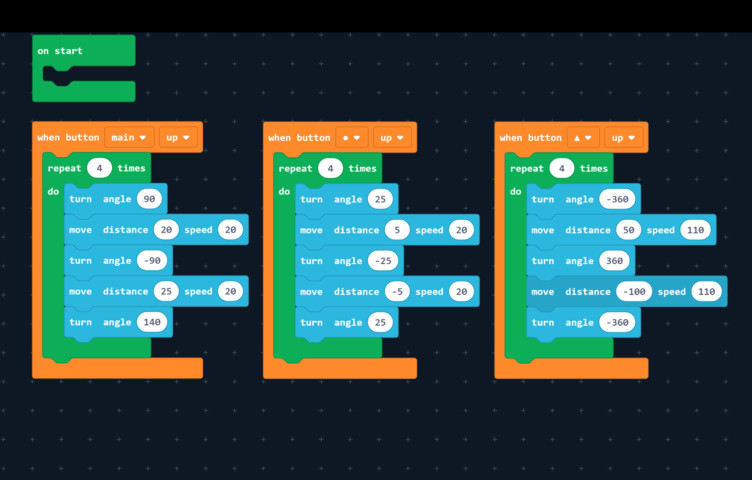
Sample Program:
What are the three states of matter? (Sample response: “Solid, liquid, and gas.”)
In what order will you be programming your robot to behave like matter in those states? (Sample response: “We will begin with ice, change to liquid, and then change to gas.”)
What are the variables in the program? (Sample responses: “Distance, speed, turns.”)
How will you avoid your Cue syncing with another group's Cue? (Sample response: “Discuss a programming plan as a whole group and then spread out to program.”)
What clues give away each state? (Sample responses: “The movement of the molecules, whether they stay inside the contained space, the speed at which the water molecules move, etc.”)
How will you use events in your program? (Sample response: “We will program event blocks to initiate the first state in each of the three parts of our program replicating Cue as a water molecule in the solid, liquid, and gas states.”)
How will you program loops in your program? (Sample response: “We will program loops to repeat each state four times before moving onto the next one.”)
1. Instruct the class to work together first as a whole group to discuss and coordinate how to program each state.
2. Divide students into small groups.
Distribute robots and devices.
3. Instruct students to test each state of their program before moving on to the next state.
4. Remind students to program each state to be 60 seconds long with a 5-second transition.
5. Guide students through each of the three stages, assisting and assessing.
6. After students are finished, have them run their programs simultaneously as a class.
[Optional]: Record this presentation as a video.
Have students edit the video that was recorded of their program with narration to explain each of the three states.
Have students record their own music or find royalty-free music to score their video. Ask them how should the music change in order to illustrate each state. Encourage them to think about the tempo, register, and mood of the music selected.
What was challenging about coordinating the programs of multiple Cue robots?
What strategies did you use to simplify the process?
Which state was most challenging to coordinate with other groups? Explain why.
In which form were the molecules packed most closely together? How did this affect coordinating multiple programs?
Use our Evaluation Rubric to review students’ work and presentations.
[Optional] Share your students’ work with the world using @logicsacademy and #Cue
CCSS.ELA-LITERACY.SL.6.1: Engage effectively in a range of collaborative discussions (one-on-one, in groups, and teacher-led) with diverse partners on grade 6 topics, texts, and issues, building on others' ideas and expressing their own clearly.
CCSS.ELA-LITERACY.SL.6.2: Interpret information presented in diverse media and formats (e.g., visually, quantitatively, orally) and explain how it contributes to a topic, text, or issue under study.
P5.1: Design projects that combine hardware and software components to collect and exchange data.
P5.2: Design and iteratively develop programs that combine control structures, including nested loops and compound conditionals.
P3.2 Decompose problems and subproblems into parts to facilitate the design, implementation, and review of programs.
1A-AP-08: Model daily processes by creating and following algorithms (sets of step-by-step instructions) to complete tasks.
1A-AP-12: Develop a plan that describes a program’s sequence of events, goals, and expected outcomes.
1A-AP-10: Develop programs with sequences and simple loops, to express ideas or address a problem.
1A: Articulate and set personal learning goals, develop strategies leveraging technology to achieve them and reflect on the learning process itself to improve learning outcomes.
1B: Build networks and customize their learning environments in ways that support the learning process.
1C: Use technology to seek feedback that informs and improves their practice and to demonstrate their learning in a variety of ways.
4D: Exhibit a tolerance for ambiguity, perseverance and the capacity to work with open-ended problems.
5A: Formulate problem definitions suited for technology-assisted methods such as data analysis, abstract models and algorithmic thinking in exploring and finding solutions.
5C: Break problems into component parts, extract key information, and develop descriptive models to understand complex systems or facilitate problem-solving.
6C: Communicate complex ideas clearly and effectively by creating or using a variety of digital objects such as visualizations, models or simulations.
6D: Students publish or present content that customizes the message and medium for their intended audiences.
7A: Use collaborative technologies to work with others, including peers, experts or community members, to examine issues and problems from multiple viewpoints.
7C: Contribute constructively to project teams, assuming various roles and responses.
SCIENCE INQUIRY
Students will:
identify one or more ways of finding answers to given questions
identify variables: identify the variable to be manipulated, identify variables to be held constant, identify the variable that will be observed (responding variable)
select appropriate materials and identify how they will be used
modify the procedures as needed
work individually or cooperatively in planning and carrying out procedures
PROBLEM SOLVING THROUGH TECHNOLOGY
General Learner Expectations:
6–3 Design and carry out an investigation of a practical problem, and develop a possible solution.
Students will:
communicate effectively with group members in sharing and evaluating ideas, and assessing progress
evaluate procedures used and identify possible improvements
evaluate a design or product, based on a given set of questions or criteria. The criteria/questions may be provided by the teacher or developed by the students. Example criteria include: effectiveness—Does it work?; reliability—Does it work every time; durability—Does it stand up to repeated use?; effort—Is it easy to construct? Is it easy to use?
CTF is planning, creating, appraising and communicating in response to challenges.
I plan in response to challenges.
I make decisions in response to challenges.
I adapt to change and unexpected events.
I solve problems in response to challenges.
I create products, performances or services in response to challenges.
I appraise the skills, knowledge and technologies used to respond to challenges.
I communicate my learning.
CTF is working independently and with others while exploring careers and technology.
I determine how my actions affect learning.
I develop skills that support effective relationships.
I collaborate to achieve common goals.
Questioning and Predicting:
Demonstrate a sustained curiosity about a scientific topic or problem of personal interest
Make observations in familiar or unfamiliar contexts
Planning and Conducting:
With support, plan appropriate investigations to answer their questions or solve problems they have identified
Use equipment and materials safely, identifying potential risks
Processing and Analyzing Data and Information:
Construct and use a variety of methods, including tables, graphs, and digital technologies, as appropriate, to represent patterns or relationships in data
Identify patterns and connections in data
Compare data with predictions and develop explanations for results
Demonstrate an openness to new ideas and consideration of alternatives
Communicating:
Communicate ideas, explanations, and processes in a variety of ways
Express and reflect on personal, shared, or others’ experiences of place
Applied Technologies:
- Select, and as needed learn about, appropriate tools and technologies to extend their capability to complete a task.
- Identify the personal, social, and environmental impacts, including unintended negative consequences, of the choices they make about technology use.
- Identify how the land, natural resources, and culture influence the development and use of tools and technologies.
Appreciation of Science
422 appreciate the role and contribution of science and technology in our understanding of the world
423 appreciate that the applications of science and technology can have advantages and disadvantages
Interest in Science
425 show a continuing curiosity and interest in a broad scope of science-related fields and issues
Scientific Inquiry
428 consider observations and ideas from a variety of sources during investigations and before drawing conclusions
429 value accuracy, precision, and honesty
430 persist in seeking answers to difficult questions and solutions to difficult problems
Collaboration
431 work collaboratively in carrying out investigations, as well as in generating and evaluating ideas
Appreciation of Science
422 appreciate the role and contribution of science and technology in our understanding of the world
423 appreciate that the applications of science and technology can have advantages and disadvantages
Interest in Science
425 show a continuing curiosity and interest in a broad scope of science-related fields and issues
Scientific Inquiry
428 consider observations and ideas from a variety of sources during investigations and before drawing conclusions
429 value accuracy, precision, and honesty
430 persist in seeking answers to difficult questions and solutions to difficult problems
Collaboration
431 work collaboratively in carrying out investigations, as well as in generating and evaluating ideas
308-4 explain changes of state, using the particle model of matter
Appreciation of Science
422 appreciate the role and contribution of science and technology in our understanding of the world
423 appreciate that the applications of science and technology can have advantages and disadvantages
Interest in Science
425 show a continuing curiosity and interest in a broad scope of science-related fields and issues
Scientific Inquiry
428 consider observations and ideas from a variety of sources during investigations and before drawing conclusions
429 value accuracy, precision, and honesty
430 persist in seeking answers to difficult questions and solutions to difficult problems
Collaboration
431 work collaboratively in carrying out investigations, as well as in generating and evaluating ideas
Algebra
C3.1 solve problems and create computational representations of mathematical situations by writing and executing code, including code that involves conditional statements and other control structures
C3.2 read and alter existing code, including code that involves conditional statements and other control structures, and describe how changes to the code affect the outcomes and the efficiency of the code
3.2 state the postulates of the particle theory of matter (all matter is made up of particles; all particles are in constant motion; all particles of one substance are identical; temperature affects the speed at which particles move; in a gas, there are spaces between the particles; in liquids and solids, the particles are close together and have strong forces of attraction between them)
Algebra
C3.1 solve problems and create computational representations of mathematical situations by writing and executing code, including code that involves events influenced by a defined count and/or sub-program and other control structures
C3.2 read and alter existing code, including code that involves events influenced by a defined count and/or sub-program and other control structures, and describe how changes to the code affect the outcomes and the efficiency of the code
Algebra
C3.1 solve problems and create computational representations of mathematical situations by writing and executing code, including code that involves the analysis of data in order to inform and communicate decisions
C3.2 read and alter existing code involving the analysis of data in order to inform and communicate decisions, and describe how changes to the code affect the outcomes and the efficiency of the code
Initiating and Planning
with support (e.g., as a class or in small groups), generates a list of possible solutions to a practical problem and determines which are realistic in the classroom and/or the real world
outlines (individually or in small groups) the steps of a plan, including labelled drawings and/or diagrams, to solve the problem
establishing general criteria for evaluating objects or devices designed to solve the problem
Performing and Recording
carries out the pre-determined plan (individually or in pairs or small groups)
designs, builds, and tests (on the basis of pre-determined criteria) a device or an object to solve the problem
Analyzing and Interpreting
identifies and explains what changes could be made to the plan and how to improve the solution to the problem, and gives reasons for the changes
Communicating
describes orally, and/or using drawings, pictures, and/or simple sentences, the problem and how he or she solved it
Initiating and Planning
with support (e.g., as a class or in small groups), generates a list of possible solutions to a practical problem and determines which are realistic in the classroom and/or the real world
outlines (individually or in small groups) the steps of a plan, including labelled drawings and/or diagrams, to solve the problem
establishing general criteria for evaluating objects or devices designed to solve the problem
Performing and Recording
carries out the pre-determined plan (individually or in pairs or small groups)
designs, builds, and tests (on the basis of pre-determined criteria) a device or an object to solve the problem
Analyzing and Interpreting
identifies and explains what changes could be made to the plan and how to improve the solution to the problem, and gives reasons for the changes
Communicating
describes orally, and/or using drawings, pictures, and/or simple sentences, the problem and how he or she solved it
Create a visual or dramatic representation to explain changes of state of matter (e.g., melting, freezing, evaporation, condensation, and sublimation) according to the particle model of matter.
Initiating and Planning
with support (e.g., as a class or in small groups), generates a list of possible solutions to a practical problem and determines which are realistic in the classroom and/or the real world
outlines (individually or in small groups) the steps of a plan, including labelled drawings and/or diagrams, to solve the problem
establishing general criteria for evaluating objects or devices designed to solve the problem
Performing and Recording
carries out the pre-determined plan (individually or in pairs or small groups)
designs, builds, and tests (on the basis of pre-determined criteria) a device or an object to solve the problem
Analyzing and Interpreting
identifies and explains what changes could be made to the plan and how to improve the solution to the problem, and gives reasons for the changes
Communicating
describes orally, and/or using drawings, pictures, and/or simple sentences, the problem and how he or she solved it
307-3 describe the characteristics of solutions using the particle theory of matter
PS1 Distinguish between pure substances and mixtures using the particle theory of matter
7-2-01 Use appropriate vocabulary related to their investigations of the particle theory of matter.
7-2-06 Describe the particle theory of matter and use it to explain changes of state.
Demonstrates that chemical changes (e.g. cooking, combustion, oxidation, acid-base reactions) change the properties of matter
Distinguish between pure substances and mixtures, using the particle theory of matter
GCO1: Students will be expected to design, develop, evaluate, and articulate technological solutions
GCO2: Students will be expected to operate and manage technological systems