Loading…
Loading…
Cue robot (1 per group)
tablets or compatible devices (1 per group)
Robots vs. Humans Worksheet (1 per student)
The Great Debate Slides
Before this lesson, it is recommended that students:
practice programming movement and custom sounds in the Cue app.
understand basic grammar and sentence structure.
Fully charge the devices and robots.
Install the Wonder Workshop Cue app on each device.
Arrange desks so that the Cue robot can move freely in the middle of the classroom
1. Project your device screen and open the Cue app.
Open the Code with Block & JavaScriptⓇ section.
Place Cue in the middle of the classroom.
2. Show students where to find Sound blocks in the Actions menu.
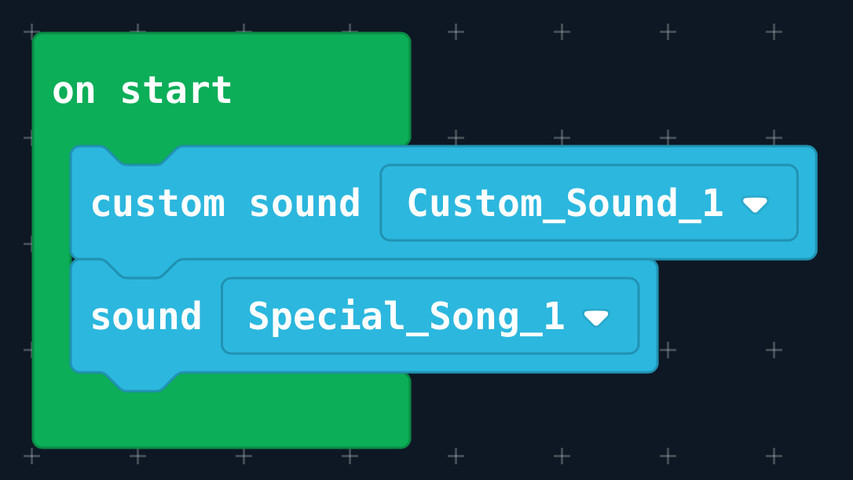
Say, “There are two kinds of Sound blocks: pre-recorded sounds and custom sounds. We’ll be using both in our project today. Right now, let’s program Cue to sing a song.”
Select the sound block from the Actions menu and place it in the on start block.
Select the gift box icon from the menu at the right and then select a song block.
3. Say, “I want Cue to greet me before singing. How do we add a custom greeting to our program?”
Sample response: “Add a Custom Sound block, record a greeting as Custom_Sound_1, and place it before Special_Song_1 in your program.”
Remind students that there are ten different Custom Sound blocks and each block can save up to ten seconds of audio.
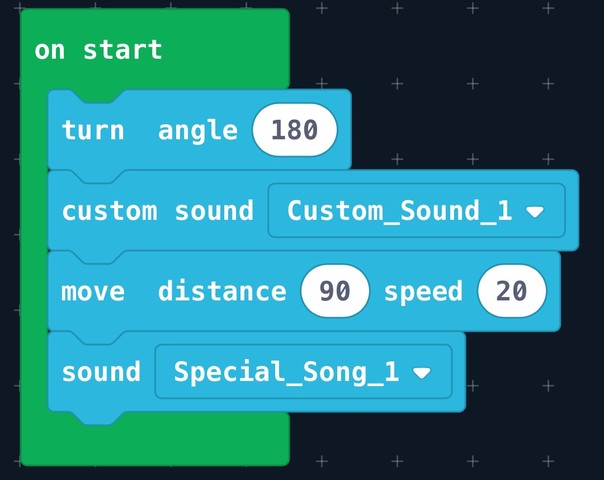
4. Stand about three feet behind the robot and ask, “What can we add to our program so that Cue turns around, greets me, moves toward me, and starts singing?”
Sample response: “Add a turn angle 180 block before the custom sound block and a move distance 90block before the sound (Special_Song_1) block.”
1. Say, “Today we will be programming Cue to argue in a debate. A debate is a formal argument where two people—or in our case, robots—defend opposing viewpoints about a particular subject. What are some examples of debates that you’ve seen in the media?”
Sample response: “Politicians running for office debate campaign issues on television prior to election day.”
2. Say, “When you argue in a debate, you have to first develop a strong claim. The claim must clearly state your position on the debate topic and then provide some evidence to support that claim.”
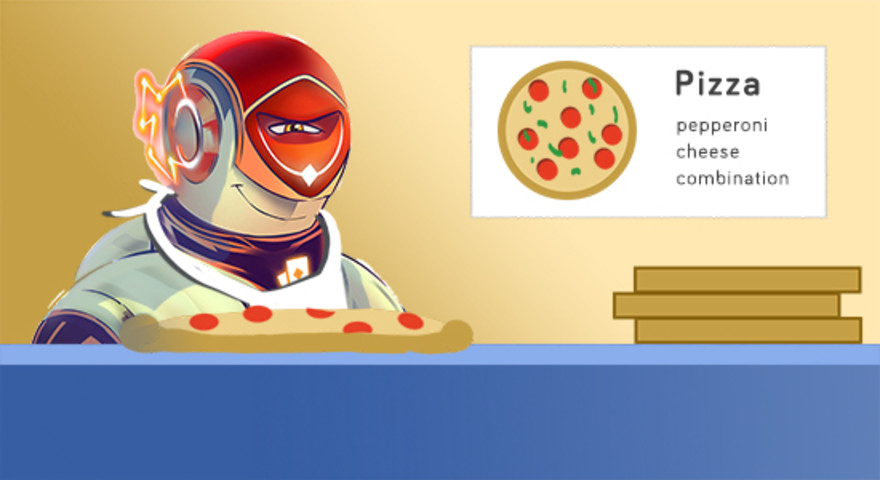
3. Say, “There’s a pizza start-up in California that uses robots to help make its pizza pies. Do you think that a robot could make pizza better than a human? Before you develop a position, let’s first watch a news video about the startup and learn a little bit more about their pizza-making process.”
4. Project The Great Debate slides.
Watch the Zume Pizza video on Slide 2.
Guide students through Slides 3, 4, and 5, highlighting the evidence in favor of and against pizza-making robots.
Survey students to see how many students think that robots can make pizza better than a human and how many think they cannot.
5. Distribute Page 1 of the Robots vs. Humans Worksheet.
Ask students to jot down 2–3 points in favor of and against pizza-making robots.
Ask the class to share their responses and record 4–5 of them on the board.
Sample Response:
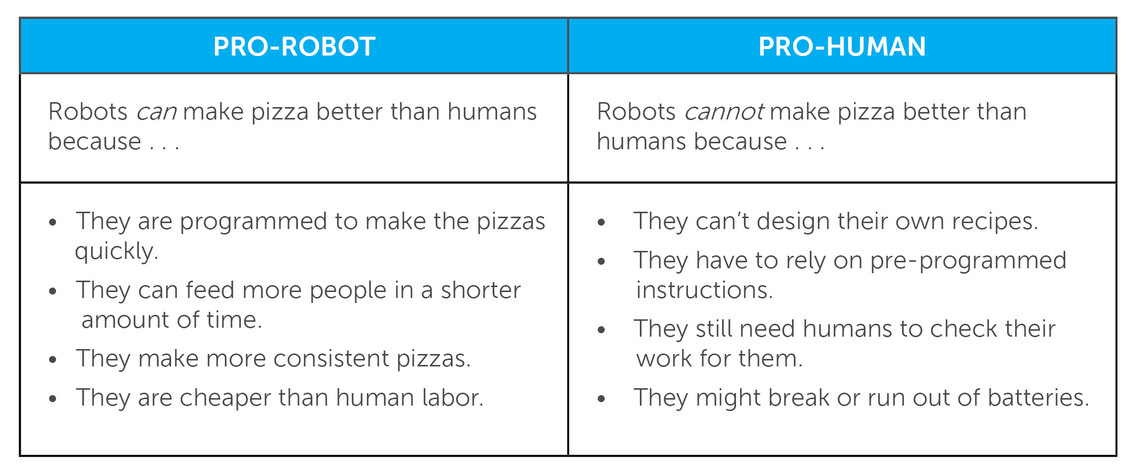
6. Say, “Now let’s practice combining some of these reasons into a single sentence in support of pizza-making robots. When writing a claim, you want to make sure that your position is very clear and that you include a couple of the strongest reasons from the table on the board. For example, I might write: Robots are better at making pizza than humans because they are designed to produce more pizzas at a quicker rate and can feed a lot of people very cheaply. However, you may choose to write it differently with a different set of reasons.”
Ask students to practice writing a claim in favor of or opposed to pizza-making robots on their Humans vs. Robots worksheet and share it with a partner.
Sample response: “Humans are better at making pizza than robots because they can be creative and improvise toppings or fix mistakes in the moment.”
1. Say, “To win a debate, you not only need an argument with a claim, but you also need a counter-argument that disproves some of the evidence in the other team’s claim. For example, if I were on the pro-robot team, I might write a counter-argument against the pro-human team like this: Even though they can’t design their own recipes, robots can still make pizza better than humans because they can follow the steps of human-designed recipes more consistently than humans.”
2. Ask students to practice writing their own counter-argument against the pro-human or pro-robot side.
Sample response: “Even though they are more efficient at making pizza, robots don’t make pizza better than humans because efficiency is not the same as quality.”
What is the difference between a claim and a counter-argument? (Sample response: “A claim is a part of an argument that includes your position and a summary of reasons supporting your claim, whereas a counter-argument tries to disprove your opponent’s argument.”)
1. Say, “Now that we have our claims and counter-arguments written, we need to program our robots to convincingly argue for our team. I’m going to program Cue to read my argument. Cue can save ten custom sounds that can be up to ten seconds long each. You will need to use multiple custom sound blocks to state your claim and counter-argument.”
2. Ask for a volunteer to record the claim sentence on his or her Humans vs. Robots worksheet as custom sound blocks.
Depending on how fast the student reads, he or she may need to use multiple custom sound blocks.
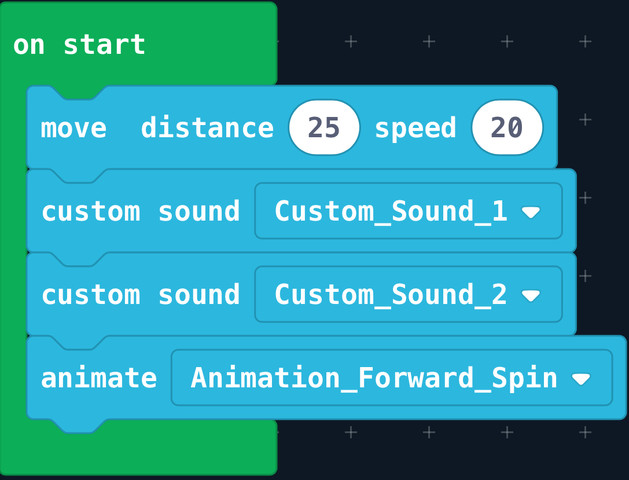
3. Say, “When you watch great debaters, you’ll see them move their bodies to emphasize their arguments. In our debate, your team will not only get points for a well-written claim and well-recorded audio, but also for how stylishly the robot moves across the stage during the debate. For my argument, I want Cue to move to the center of the debate stage at the beginning and do a fancy spin move at the end of the claim. How could we achieve this?”
Sample response: “Add a move distance block to the beginning of the program that is half the length of the debate stage and add an animate block at the end.”
Sample Program:
4. Distribute robots and devices.
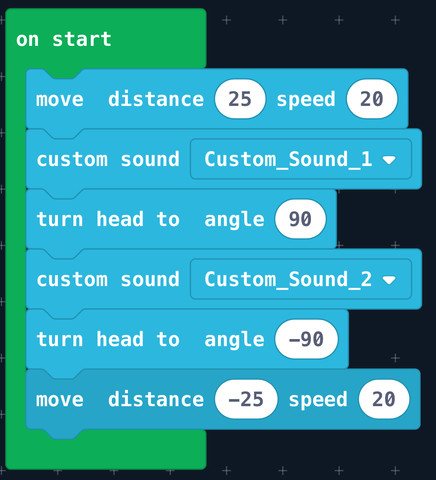
Ask pairs to program Cue to broadcast one of their counter-arguments and move at least two times during the debate performance.
Sample Program:
5. Ask a few pairs to share their counter-argument program with the class.
1. Say, “During the debate, you’ll want to program your robot to broadcast its opening claim, then wait for the other robot to finish its argument before broadcasting the counter-argument. To do this, you’ll need to set separate trigger events for your claim and your counter-argument. Looking at the options in the Events menu of the Cueapp, what are some different ways we could trigger Cue to begin different parts of the program?”
Sample response: “We could trigger Cue to run a program with a button press, a clap or sound, or an obstacle in front of its sensors.”
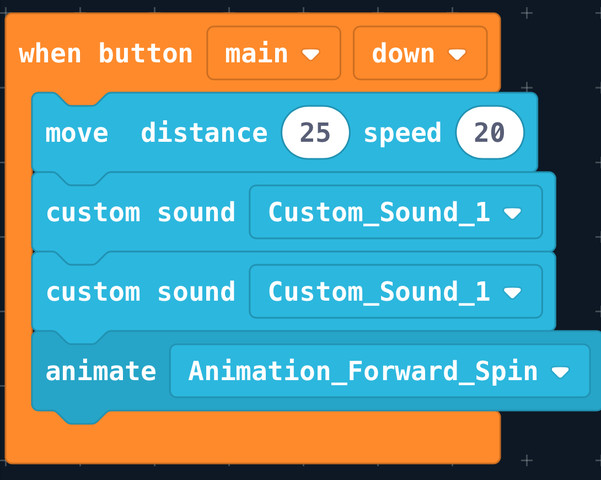
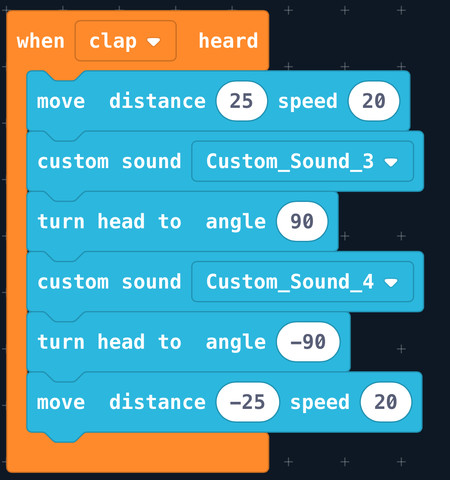
2. Say, “I’m going to use a Button event to trigger my claim and a Sound Sensor event to trigger my counter-argument. To do this, I’m going to drag the claim portion of my program into the when button block and the counter-argument portion into the when heard block.”
Sample Program:
3. Ask pairs to program their own trigger events for their claims and counter-arguments.
Select a pair’s program to test and debug in front of the class.
What kinds of code blocks can you add to your program to make Cue move stylishly during the debate? (Sample response: “You can add movement blocks or animation blocks.”)
What is the purpose of the Events blocks? (Sample response: “The Events blocks trigger certain portions of our program to begin.”)
1. Pass out Page 2 of the Robots vs. Humans worksheet and the Research Bibliography to each pair.
2. Project Slide 6 of The Great Debate slides.
Say, “For our debate, we will take a step back from pizza-making and decide whether we think it’s good for humans to give jobs to robots. In your pairs, you will research the issue, develop a position based on evidence, write a claim and counter-argument, and program your robot to deliver your argument stylishly.”
3. Ask the students in each pair to select a different article from the Research Bibliography and summarize the article to their partner.
4. Have pairs work together to:
complete the table on Page 2 of their worksheet based on their research.
write a claim and a counter-argument in favor of or opposed to giving jobs to robots.
program their robot to deliver their claim and counter argument.
include at least two different ways for their robot to move during their claim and counter-argument.
5. Circulate around and assist students with writing their arguments and debugging their programs
Once all pairs have finished programming their robots, put pairs with opposing claims together to present their programs in front of the class as a debate.
1. After doing research on robots in the workforce, did your position stay the same or change? Why?
2. Did anyone’s position change after hearing other group’s claims and counter-arguments? How? (Sample response: “At the beginning of the debate, I thought it was obviously a good thing for robots to replace human workers, but after hearing another team’s argument, I think it might lead to increasing income inequality.”)
3. What kinds of movements or special animations made the robots deliver their arguments most realistically? (Sample response: “Moving the robot’s head made it seem like it was making eye contact with the audience while it was debating.”)
Use our Evaluation Rubric to review students’ work and presentations.
[Optional] Share your students’ work with the world using @logicsacademy and #Cue
CCSS.ELA-LITERACY.W.6.1: A Introduce claim(s) and organize the reasons and evidence clearly.
CCSS.ELA-LITERACY.W.6.1.B: Support claim(s) with clear reasons and relevant evidence, using credible sources and demonstrating an understanding of the topic or text.
3-5-ETS1-2: Generate and compare multiple possible solutions to a problem based on how well each is likely to meet the criteria and constraints of the problem.
MS-ETS1-3: Analyze data from tests to determine similarities and differences among several design solutions to identify the best characteristics of each that can be combined into a new solution to better meet the criteria for success.
1B-AP-10: Create programs that include sequences, events, loops, and conditionals.
1B-AP-16: Take on varying roles, with teacher guidance, when collaborating with peers during the design, implementation, and review stages of program development.
1B-AP-17: Describe choices made during program development using code comments, presentations, and demonstrations.
2-AP-13: Decompose problems and subproblems into parts to facilitate the design, implementation, and review of programs.
2-AP-15: Seek and incorporate feedback from team members and users to refine a solution that meets user needs.
2-AP-17: Systematically test and refine programs using a range of test cases.
4D: Exhibit a tolerance for ambiguity, perseverance and the capacity to work with open-ended problems.
5A: Formulate problem definitions suited for technology-assisted methods such as data analysis, abstract models and algorithmic thinking in exploring and finding solutions.
5C: Break problems into component parts, extract key information, and develop descriptive models to understand complex systems or facilitate problem-solving.
6C: Communicate complex ideas clearly and effectively by creating or using a variety of digital objects such as visualizations, models or simulations.
7C: Contribute constructively to project teams, assuming various roles and responsibilities to work effectively toward a common goal.
distinguish among facts, supported inferences and opinions
decide on and select the information needed to support a point of view
develop and follow own plan for accessing and gathering ideas and information, considering guidelines for time and length of investigation and presentation
CTF is planning, creating, appraising and communicating in response to challenges.
I plan in response to challenges.
I make decisions in response to challenges.
I adapt to change and unexpected events.
I solve problems in response to challenges.
I create products, performances or services in response to challenges.
I appraise the skills, knowledge and technologies used to respond to challenges.
I communicate my learning.
CTF is working independently and with others while exploring careers and technology.
I determine how my actions affect learning.
I develop skills that support effective relationships.
I collaborate to achieve common goals.
consider audience, purpose, point of view and form when focusing topics for investigation
discuss the types and sources of information appropriate for topic, audience, form, purpose and point of view
plan and organize data collection based on instructions, explanations and pre-established parameters
CTF is planning, creating, appraising and communicating in response to challenges.
I plan in response to challenges.
I make decisions in response to challenges.
I adapt to change and unexpected events.
I solve problems in response to challenges.
I create products, performances or services in response to challenges.
I appraise the skills, knowledge and technologies used to respond to challenges.
I communicate my learning.
CTF is working independently and with others while exploring careers and technology.
I determine how my actions affect learning.
I develop skills that support effective relationships.
I collaborate to achieve common goals.
experiment with several ways to focus a topic, and select a form appropriate to audience and purpose
identify and trace the development of arguments, opinions or points of view in oral, print and other media texts
select the most appropriate information sources for topic, audience, purpose and form
choose a plan to access, gather and record information, according to self-selected parameters
CTF is planning, creating, appraising and communicating in response to challenges.
I plan in response to challenges.
I make decisions in response to challenges.
I adapt to change and unexpected events.
I solve problems in response to challenges.
I create products, performances or services in response to challenges.
I appraise the skills, knowledge and technologies used to respond to challenges.
I communicate my learning.
CTF is working independently and with others while exploring careers and technology.
I determine how my actions affect learning.
I develop skills that support effective relationships.
I collaborate to achieve common goals.
Comprehend and connect (reading, listening, viewing)
Access information and ideas for diverse purposes and from a variety of sources and evaluate their relevance, accuracy, and reliability
Apply appropriate strategies to comprehend written, oral, and visual texts, guide inquiry, and extend thinking
Synthesize ideas from a variety of sources to build understanding
Recognize and appreciate how different features, forms, and genres of texts reflect different purposes, audiences, and messages
Think critically, creatively, and reflectively to explore ideas within, between, and beyond texts
Recognize and identify the role of personal, social, and cultural contexts, values, and perspectives in texts
Recognize how language constructs personal, social, and cultural identity
Construct meaningful personal connections between self, text, and world
Respond to text in personal, creative, and critical ways
Recognize how literary elements, techniques, and devices enhance and shape meaning
Create and communicate (writing, speaking, representing)
Exchange ideas and viewpoints to build shared understanding and extend thinking
Use writing and design processes to plan, develop, and create engaging and meaningful literary and informational texts for a variety of purposes and audiences
Assess and refine texts to improve their clarity, effectiveness, and impact according to purpose, audience, and message
Use an increasing repertoire of conventions of Canadian spelling, grammar, and punctuation
Transform ideas and information to create original texts.
Applied Technologies:
- Select, and as needed learn about, appropriate tools and technologies to extend their capability to complete a task.
- Identify the personal, social, and environmental impacts, including unintended negative consequences, of the choices they make about technology use.
- Identify how the land, natural resources, and culture influence the development and use of tools and technologies.
contribute thoughts, ideas, and questions to discussion and compare their own ideas with those of peers and others
ask and respond to questions to seek clarification or explanation of ideas and concepts defend and/or support their opinions with evidence
listen critically to others’ ideas or opinions and points of view
contribute to and respond constructively in conversation, small-group and whole-group discussion
use word choice and emphasis, making a conscious attempt to produce a desired effect
give and follow instructions and respond to a variety of questions and instructions
engage in, respond to, and evaluate a variety of oral presentations and other texts
extend personal responses, either orally or in writing, to print and non-print texts by explaining in some detail initial or basic reactions to those texts
make evaluations or judgments about texts and learn to express personal points of view
while learning to express personal points of view, develop the ability to find evidence and examples in texts to support personal views about themes, issues, and situations
state a point of view in a convincing manner, offering relevant information to support that viewpoint
contribute to small-group conversation and whole-group discussion, choosing appropriate strategies that contribute to effective talk
access appropriate print and nonprint sources with increasing independence and select information to meet specific needs with increasing speed, accuracy, and confidence
1.8 identify the point of view presented in oral texts, determine whether they agree with the point of view, and suggest other possible perspectives
2.3 communicate orally in a clear, coherent manner, using appropriate organizing strategies and formats to link and sequence ideas and information (e.g., present an argument in favour
2.7 use a variety of appropriate visual aids, (e.g., video images, maps, posters, charts, costumes) to support or enhance oral presentations
1.5 develop interpretations about texts using stated and implied ideas to support their interpretations
1.9 identify the point of view presented in texts; determine whether they can agreewith the view, in whole or in part; and suggest some other possible perspectives
1.3 gather information to support ideas for writing, using a variety of strategies and a range of print and electronic resources
Algebra
C3.1 solve problems and create computational representations of mathematical situations by writing and executing code, including code that involves conditional statements and other control structures
1.2 demonstrate an understanding of appropriate listening behaviour by adapting active listening strategies tosuit a wide variety of situations, including work in groups
1.5 develop and explain interpretations of increasingly complex or difficult texts using stated and implied ideas from the texts to support their interpretations
Algebra
C3.1 solve problems and create computational representations of mathematical situations by writing and executing code, including code that involves events influenced by a defined count and/or sub-program and other control structures
1.2 demonstrate an understanding of appropriate listening behaviour by adapting active listening strategies tosuit a wide variety of situations, including work in groups
1.5 develop and explain interpretations of increasingly complex or difficult texts using stated and implied ideas from the texts to support their interpretations
2.2 demonstrate an understanding of appropriate speaking behaviour in most situations, using a variety of speaking strategies and adapting them to suit the purpose and audience
Algebra
C3.1 solve problems and create computational representations of mathematical situations by writing and executing code, including code that involves the analysis of data in order to inform and communicate decisions
CR6.5 Listen purposefully to understand, respond, and analyze oral information and ideas from a range of texts including narratives, instructions, oral explanations and reports, and opinions.
CC6.4 Create and present a variety of representations that communicate ideas and information to inform or persuade and to entertain an audience, including illustrations, diagrams, posters, displays, and cartoons.
CC7.3 Select and use the appropriate strategies to communicate meaning before (e.g., planning and organizing ideas to fit format), during(e.g. using transition words), and after (e.g., revising to eliminate unnecessary repetition) speaking, writing, and other representing activities.
CC7.7 Use oral language to express effectively information and ideas of some complexity in formal and informal situations (e.g., a procedural description based on personal experience, a demonstration, a persuasive speech, a dramatization).
CR8.5 Listen critically to understand, gather information, follow directions, form an opinion, and analyze oral presentations for diverse opinions, presenter’s point of view, values, and biases, stereotypes, or prejudices.
CC8.5 Create and present a variety of visual and multimedia presentations including an illustrated report, a role play that ends with a tableau, a dramatization, presentation software, a newscast with adequate detail, clarity, and organization to explain (e.g., an important concept), to persuade (e.g., an opinion on an issue, a mini-debate), and to entertain (e.g., a humourous incident).
Speaking and Listening
GCO 1: Students will be expected to speak and listen to explore, extend, clarify, and reflect on their thoughts, ideas, feelings, and experiences.
GCO 2: Students will be expected to communicate information and ideas effectively and clearly, and to respond personally and critically.
Speaking and Listening
speak and listen to explore, extend, clarify, and reflect on their thoughts, ideas, feelings, and experiences
communicate information and ideas effectively and clearly, and to respond personally and critically
Language as System
Recognize, apply, and adapt rules and conventions.
Identify, analyze, and apply understandings of whole-part-whole relationships.
Language as Exploration and Design
Manage information and ideas.
Invent, take risks, and reflect to create possibilities
Postproduction
Presents text to intended audience
Evaluates the effectiveness of the text given audience and purpose
GCO 1: Students will speak and listen to explore, extend, clarify, and reflect on their thoughts, ideas, feelings, and experiences.
GCO 2: Students will speak and listen to communicate information and ideas effectively and clearly, and to respond personally and critically.
P2: Students will be expected to use digital tools to develop ideas and original works in innovative ways.
TOC1: Students will be expected to
safely use many forms of current technology for learning with growing competence
demonstrate conceptual understanding of how information and communication technology, digital tools, and authorized networks support their learning
use terminology related to information and communication technology
GCO 1: Students will speak and listen to explore, extend, clarify, and reflect on their thoughts, ideas, feelings, and experiences.
GCO 2: Students will speak and listen to communicate information and ideas effectively and clearly, and to respond personally and critically.
GCO1: Students will be expected to design, develop, evaluate, and articulate technological solutions
GCO2: Students will be expected to operate and manage technological systems