Loading…
Loading…
Cue robot (1 per group)
tablets or compatible devices (1 per group)
Sketch Kit marker attachment (1 per group)
Sketch Kit dry erase markers (1 set per group)
Wonder Whiteboard Mat and/or butcher paper (1 per every 2 groups)
colored pencils (1 set per group)
Weaving and Woven Patterns Slides
Programming Woven Patterns Worksheet (1 per group)
Before this lesson, it is recommended that students:
complete the Introduction to Sketch Kit lesson.
be able to accurately identify and measure distances and angles.
know how to program loops and create functions in the Cue app.
practice programming Cue to draw lines using the Sketch Kit.
Fully charge the devices and robots.
Install the Wonder Workshop Cue app on each device.
Arrange the classroom to make room for the Whiteboard Mat or butcher paper and accommodate partner and small-group work.
Review how to attach the Sketch Kit marker attachment to Cue and insert a marker.
Refer to the Start Here Card that came with your Sketch Kit or visit the Wonder Workshop website for instructions and images to guide you.
1. Project the following two shapes onto the board:
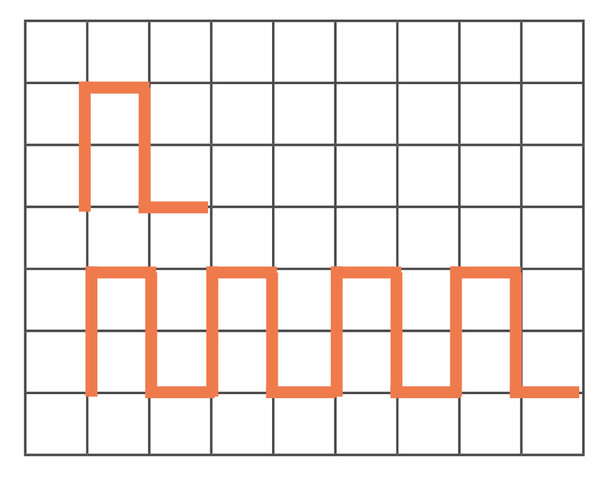
2. Ask, “What is one way to program Cue to sketch the top shape in the Cue app?”
Have students write their responses.
Sample response: “Move distance (20, 25), Turn angle (90), Move distance (10, 20), Turn angle (90), Move distance (25, 20), Turn angle (-90), Move distance (10, 20).”
3. Ask, “What is one way to program Cue to sketch the bottom shape using at least one function?”
Sample response: “Save the top shape code as a new function and repeat that function four times.”
1. Project the Jacquard Loom image from the Weaving and Woven Patterns Slides (page 2).
2. Say, “Today we will be programming our robots to sketch designs based on woven patterns. Textile manufacturing actually plays a major role in the history of modern computers. This video shows us how some of the weaving machines from the early 19th century influenced computer science.”
3. Show the How Weaving Pioneered Machine Programming video from Your Discovery Science about the Jacquard Loom: https://www.youtube.com/watch?v=7lZLygjqJBQ.
4. Ask, “How was operating the Jacquard Loom similar to programming a computer?”
Sample response: “Weavers stored their designs on punch cards, which the Jacquard Loom could then read in order to reproduce the pattern. These punch cards were early versions of code.”
1. Project the Loom Shapes and Sizes image from the Weaving and Woven Patterns Slides (page 3).
2. Say, “The Jacquard Loom is one of many styles of loom. A loom is a tool used to manufacture fabric that can be made out of various materials in different shapes and sizes—from giant industrial machines to small, DIY hand looms made from cardboard and wooden scraps.”
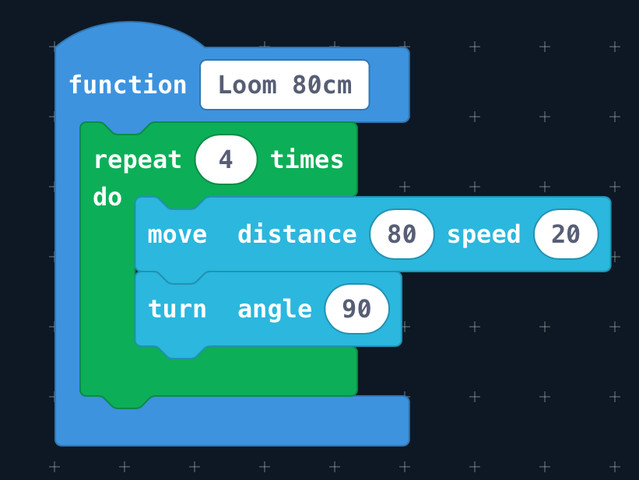
3. Say, “For our project with Cue, we will be sketching square looms with a length and width of 80 cm. How could we program the robot to sketch a loom with those dimensions?”
Sample response: “Loop the following Actions blocks four times: move distance (80, 20), turn angle (90).”
4. Project your device screen and open the Cue app.
Navigate to the Code with Block and JavaScriptⓇ section.
Program Cue to sketch a square on the Whiteboard Mat or butcher paper.
5. Say, “Let’s create a function so we can call this code later.”
Move the code inside a function block and name the function “Loom 80cm.”
1. Project the Plain-Weave Pattern image from the Weaving and Woven Patterns Slides (page 4).
2. Say, “Weavers make fabric by interlacing, or crossing, two different kinds of threads: the warp and the weft. If the two threads are perpendicular to each other, what kinds of angles are made at their intersection?”
Sample response: “90° or right angles.”
3. Point to the weave image and say, “The weave in this image is called plain-weave, where the weft thread alternates going above and below the warp thread. Weavers often use grid paper to plan their patterns. Let’s sketch the plain-weave pattern using the robot.”
What is a loom? (Sample response: “A loom is a tool used to manufacture fabric.”)
What are the shape and dimensions of the loom we sketched with Cue? (Sample response: “The loom we sketched with Cue is 80 cm long and wide.”)
What does perpendicular mean? (Sample response: “When two lines intersect to create 90° angles.”)
1. Arrange students into small groups around the Whiteboard Mats (or butcher paper).
Distribute robots, Sketch Kit marker attachments, Sketch Kit dry erase markers, and devices to each group.
2. Project the Pattern Design Template image from the Weaving and Woven Patterns Slides (page 5).
3. Say, “The weavers who operated the Jacquard Loom used punch cards to program their patterns. We’re going to be using our pattern design template to communicate our designs. Let’s create the program for the pattern together.”
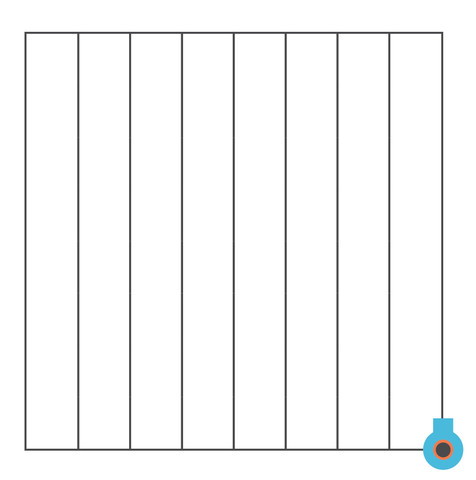
4. Say, “First, we’ll need to sketch the warp lines, which run vertically every 10 cm. Remember that the warp lines run vertically.” Point to the two grids on the Pattern Design Template slide and ask, “What color does the template tell us to use for our warp lines?” (Sample response: “Purple.”)
5. Insert a purple Sketch Kit dry erase marker into the marker attachment.
Position the robot at the bottom-right corner of your loom sketch facing the square.

6. Ask, “How can we program the robot to sketch our first warp line, which needs to travel the width of our loom?”
Sample response: “Move distance (80, 20).”
7. Say, “We need that repeated every 10 cm until the robot reaches the top of the loom.”
Demonstrate how to repeat the warp line, using the code sample below. Save the sample as a new function called “Warp.”
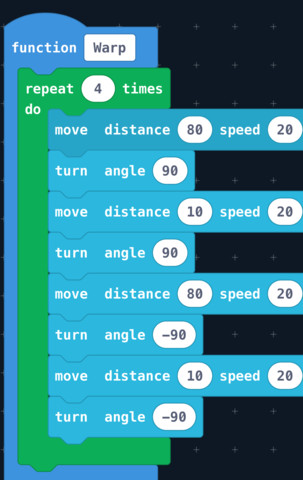
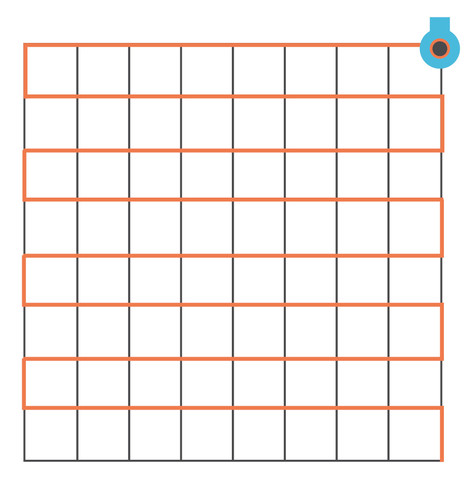
8. Say, “Now that we have all of our warp lines sketched, let’s swap out our marker and program the weft lines which run horizontally across our loom.”
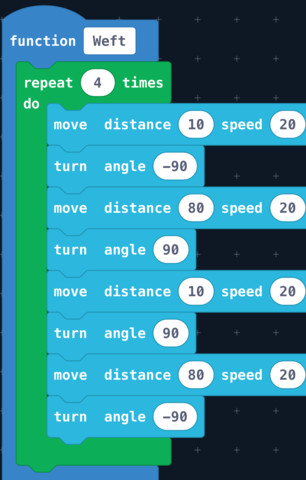
Have students work with their groups to create another function called ‘Weft,’ using the fewest number of code blocks possible.
1. Distribute the Programming Woven Patterns Worksheet and colored pencils.
2. Have groups practice programming Cue to sketch the two woven patterns on the top half of the worksheet.
Once Cue has sketched both patterns, have them design their own patterns using the pattern grids on the bottom of the worksheet.
Then have them program Cue to sketch those patterns.
3. Circulate around the room and assist groups as needed.
Have students program multiple robots, each holding a different colored marker, to create a collaborative giant pattern on the Whiteboard Mat.
Have students experiment with designing and sketching different numbers of warp and weft lines or different shaped looms (eg. circular, hexagonal).
When you weave, you can select yarn with different thicknesses. How could we simulate yarn thickness with the Sketch Kit? (Sample response: “You could sketch two lines next to each other to simulate a double strand of yarn.”)
What other kinds of designs could we program Cue to sketch? (Sample response: “We could program Cue to sketch squares, circles, or X’s.”)
Use our Evaluation Rubric to review students’ work and presentations.
[Optional] Share your students’ work with the world using @logicsacademy and #Cue
CCSS.MATH.CONTENT.7.G.A.1: Solve problems involving scale drawings of geometric figures, including computing actual lengths and areas from a scale drawing and reproducing a scale drawing at a different scale.
CCSS.MATH.CONTENT.7.G.A.2: Draw (freehand, with ruler and protractor, and with technology) geometric shapes with given conditions. Focus on constructing triangles from three measures of angles or sides, noticing when the conditions determine a unique triangle, more than one triangle, or no triangle.
CCSS.MATH.CONTENT.4.MD.C.7: Recognize angle measure as additive. When an angle is decomposed into non-overlapping parts, the angle measure of the whole is the sum of the angle measures of the parts. Solve addition and subtraction problems to find unknown angles on a diagram in real world and mathematical problems, e.g., by using an equation with a symbol for the unknown angle measure.
1A-AP-08: Model daily processes by creating and following algorithms (sets of step-by-step instructions) to complete tasks.
1A-AP-10: Develop programs with sequences and simple loops to express ideas or address a problem.
1A-AP-11: Decompose (break down) the steps needed to solve a problem into a precise set of instructions.
1A-AP-14: Debug (identify and fix) errors in an algorithm or program that includes sequences and simple loops.
4D: Exhibit a tolerance for ambiguity, perseverance and the capacity to work with open-ended problems.
5A: Formulate problem definitions suited for technology-assisted methods such as data analysis, abstract models and algorithmic thinking in exploring and finding solutions.
5C: Break problems into component parts, extract key information, and develop descriptive models to understand complex systems or facilitate problem-solving.
6C: Communicate complex ideas clearly and effectively by creating or using a variety of digital objects such as visualizations, models or simulations.
7C: Contribute constructively to project teams, assuming various roles and responsibilities to work effectively toward a common goal.
Patterns and Relations
1. Represent and describe patterns and relationships, using graphs and tables.
Shape and Space
1. Demonstrate an understanding of angles by:
identifying examples of angles in the environment
classifying angles according to their measure
estimating the measure of angles, using 45°, 90° and 180° as reference angles
determining angle measures in degrees
drawing and labelling angles when the measure is specified.
5. Describe and compare the sides and angles of regular and irregular polygons.
6. Perform a combination of translations, rotations and/or reflections on a single 2-D shape, with and without technology, and draw and describe the image.
7. Perform a combination of successive transformations of 2-D shapes to create a design, and identify and describe the transformations.
CTF is planning, creating, appraising and communicating in response to challenges.
I plan in response to challenges.
I make decisions in response to challenges.
I adapt to change and unexpected events.
I solve problems in response to challenges.
I create products, performances or services in response to challenges.
I appraise the skills, knowledge and technologies used to respond to challenges.
I communicate my learning.
CTF is working independently and with others while exploring careers and technology.
I determine how my actions affect learning.
I develop skills that support effective relationships.
I collaborate to achieve common goals.
Shape and Space
3. Perform geometric constructions, including:
perpendicular line segments
parallel line segments
perpendicular bisectors
angle bisectors.
Perform and describe transformations (translations, rotations or reflections) of a 2-D shape in all four quadrants of a Cartesian plane (limited to integral number vertices).
CTF is planning, creating, appraising and communicating in response to challenges.
I plan in response to challenges.
I make decisions in response to challenges.
I adapt to change and unexpected events.
I solve problems in response to challenges.
I create products, performances or services in response to challenges.
I appraise the skills, knowledge and technologies used to respond to challenges.
I communicate my learning.
CTF is working independently and with others while exploring careers and technology.
I determine how my actions affect learning.
I develop skills that support effective relationships.
I collaborate to achieve common goals.
Shape and Space
Describe the characteristics of 3-D objects and 2-D shapes, and analyze the relationships among them.
Describe and analyze position and motion of objects and shapes.
CTF is planning, creating, appraising and communicating in response to challenges.
I plan in response to challenges.
I make decisions in response to challenges.
I adapt to change and unexpected events.
I solve problems in response to challenges.
I create products, performances or services in response to challenges.
I appraise the skills, knowledge and technologies used to respond to challenges.
I communicate my learning.
CTF is working independently and with others while exploring careers and technology.
I determine how my actions affect learning.
I develop skills that support effective relationships.
I collaborate to achieve common goals.
Reasoning and analyzing
Use logic and patterns to solve puzzles and play games
Use reasoning and logic to explore, analyze, and apply mathematical ideas
Estimate reasonably
Demonstrate and apply mental math strategies
Use tools or technology to explore and create patterns and relationships, and test conjectures
Model mathematics in contextualized experiences
Understanding and solving
Apply multiple strategies to solve problems in both abstract and contextualized situations
Develop, demonstrate, and apply mathematical understanding through play, inquiry, and problem solving
Visualize to explore mathematical concepts
Engage in problem-solving experiences that are connected to place, story, cultural practices, and perspectives relevant to local First Peoples communities, the local community, and other cultures
Communicating and representing
Use mathematical vocabulary and language to contribute to mathematical discussions
Represent mathematical ideas in concrete, pictorial, and symbolic forms
Connecting and reflecting
Reflect on mathematical thinking
Connect mathematical concepts to each other and to other areas and personal interests
increasing and decreasing patterns, using expressions, tables, and graphs as functional relationships
Applied Technologies:
- Select, and as needed learn about, appropriate tools and technologies to extend their capability to complete a task.
- Identify the personal, social, and environmental impacts, including unintended negative consequences, of the choices they make about technology use.
- Identify how the land, natural resources, and culture influence the development and use of tools and technologies.
SS3: Develop and apply a formula for determining the:
perimeter of polygons
area of rectangles
volume of right rectangular prisms.
SS5: Describe and compare the sides and angles of regular and irregular polygons.
SS6: Perform a combination of translation(s), rotation(s) and/or reflection(s) on a single 2-D shape, with and without technology, and draw and describe the image.
SS7: Perform a combination of successive transformations of 2-D shapes to create a design, and identify and describe the transformations.
SS3: Perform geometric constructions, including:
perpendicular line segments
parallel line segments
perpendicular bisectors
angle bisectors.
SS5: Perform and describe transformations (translations, rotations or reflections) of a 2-D shape in all four quadrants of a Cartesian plane (limited to integral number vertices).
PR1: Graph and analyze two-variable linear relations.
Spatial Sense
E2.2 use a protractor to measure and construct angles up to 360°, and state the relationship between angles that are measured clockwise and those that are measured counterclockwise
Algebra
C3.1 solve problems and create computational representations of mathematical situations by writing and executing code, including code that involves conditional statements and other control structures
C3.2 read and alter existing code, including code that involves conditional statements and other control structures, and describe how changes to the code affect the outcomes and the efficiency of the code
Spatial Sense
E1.1 describe and classify cylinders, pyramids, and prisms according to their geometric properties, including plane and rotational symmetry
Algebra
C3.1 solve problems and create computational representations of mathematical situations by writing and executing code, including code that involves events influenced by a defined count and/or sub-program and other control structures
C3.2 read and alter existing code, including code that involves events influenced by a defined count and/or sub-program and other control structures, and describe how changes to the code affect the outcomes and the efficiency of the code
Spatial Sense
E1.3 use scale drawings to calculate actual lengths and areas, and reproduce scale drawings at different ratios
Algebra
C3.1 solve problems and create computational representations of mathematical situations by writing and executing code, including code that involves the analysis of data in order to inform and communicate decisions
C3.2 read and alter existing code involving the analysis of data in order to inform and communicate decisions, and describe how changes to the code affect the outcomes and the efficiency of the code
P6.3 Extend understanding of patterns and relationships by using expressions and equations involving variables.
a. Analyze patterns arising from the determination of perimeter of rectangles and generalize an equation describing a formula for the perimeter of all rectangles.
SS6.1 Demonstrate understanding of angles including:
identifying examples
classifying angles
estimating the measure
determining angle measures in degrees
drawing angles
applying angle relationships in triangles and quadrilaterals.
SS6.2 Extend and apply understanding of perimeter of polygons, area of rectangles, and volume of right rectangular prisms (concretely, pictorially, and symbolically) including:
relating area to volume
comparing perimeter and area
comparing area and volume
generalizing strategies and formulae
analyzing the effect of orientation
solving situational questions.
SS6.5 Demonstrate understanding of single, and combinations of, transformations of 2-D shapes (with and without the use of technology) including:
identifying
describing
performing
SS7.3 Demonstrate an understanding of 2-D relationships involving lines and angles.
Identify, with justification, line segments on a diagram that are parallel or perpendicular.
Use technology to construct parallel lines, perpendicular lines, angle bisectors, and perpendicular bisectors.
Use geometric constructions to create a design or picture, and identify the constructions present in the design.
6SS1 Demonstrate an understanding of angles by:
identifying examples of angles in the environment
classifying angles according to their measure
estimating the measure of angles, using 45°, 90° and 180° as reference angles
determining angle measures in degrees
drawing and labelling angles when the measure is specified
6SS3 Develop and apply a formula for determining the:
perimeter of polygons
area of rectangles
volume of right rectangular prisms.
6SS6 Perform a combination of translations, rotations and/ or reflections on a single 2-D shape, with and without technology, and draw and describe the image.
7SS3 Perform geometric constructions, including:
perpendicular line segments
parallel line segments
perpendicular bisectors
angle bisectors.
SS1 Demonstrate an understanding of angles by:
identifying examples of angles in the environment
classifying angles according to their measure
estimating the measure of angles using 45°, 90 and 180° as reference angles
determining angle measures in degrees
drawing and labelling angles when the measure is specified
SS3 Develop and apply a formula for determining the:
perimeter of polygons
area of rectangles
volume of right rectangular prisms.
SS6 Perform a combination of translation(s), rotation(s) and/or reflection(s) on a single 2-D shape, with and without technology, and draw and describe the image.
SS3 Perform geometric constructions, including: perpendicular line segments; parallel line segments; perpendicular bisectors; angle bisectors
6.SS.1 Demonstrate an understanding of angles by
identifying examples of angles in the environment
classifying angles according to their measure
estimating the measure of angles using 45º, and 90º, and 180º as reference angles
determining angle measures in degrees
drawing and labelling angles when the measure is specified
6.SS.3 Develop and apply a formula for determining the
perimeter of polygons
area of rectangles
volume of right rectangular prisms
6.SS.6 Perform a combination of transformations (translations, rotations, or reflections) on a single 2-D shape, and draw and describe the image.
7.SS.3 Perform geometric constructions, including
perpendicular line segments
parallel line segments
perpendicular bisectors
angle bisectors
describe angles as a measure of rotation (turn)
identify and classify angles as acute, obtuse, right, straight, or reflex
explain, using models, how the perimeter of any polygon (2-D shape) can be determined
generalize a formula for calculating perimeter (distance around the outside)
model, identify, and describe a combination of transformations (flips, slides, or turns) on 2-D shapes
P2: Students will be expected to use digital tools to develop ideas and original works in innovative ways.
TOC1: Students will be expected to
safely use many forms of current technology for learning with growing competence
demonstrate conceptual understanding of how information and communication technology, digital tools, and authorized networks support their learning
use terminology related to information and communication technology
Perform geometric constructions, including:
perpendicular line segments,
parallel line segments,
perpendicular bisectors,
angle bisectors.
GCO1: Students will be expected to design, develop, evaluate, and articulate technological solutions
GCO2: Students will be expected to operate and manage technological systems
Describes quadrilaterals (e.g. parallel segments, perpendicular segments, right angles, acute angles, obtuse angles)
Observes and produces frieze patterns and tessellations
using translations