
← Back to Library
Lesson PlanFreeEN

Dash & Dot: Step By Step

Students learn that Dash and Dot complete tasks using algorithms — a series of steps in a particular order. Includes unplugged activities and an obstacle course design challenge.
Gr. 1–695 minutes
Dash & Dot: Step By Step

Lesson

Overview

Description

Every task that we complete involves a series of steps in a particular order. In this lesson, students will learn that Dash and Dot also complete tasks in this way, using the algorithms that we give them.

Objective

  • Understand the term algorithm and relate computer algorithms to everyday tasks

  • Break down a problem into meaningful steps or instructions, in the correct order

  • Write a series of steps to complete a task or event

Robots and Accessories


Other Supplies

  • Algorithmic Steps Worksheet

  • Scissors

  • Construction Telephone Worksheet (two copies)

  • Large Marshmallows

  • Uncooked spaghetti

  • Objects to create an obstacle course

  • Ruler

  • Tablets - (See Compatible Devices)

Before the Lesson

Preparation

  • Fully charge the tablets and robots.

  • Install the Wonder Workshop Blockly app on each tablet.

Class 1 - Does Order Matter? (~25 min) - Unplugged

Hook

Open by talking about recipes.

  • Discuss with students how recipes are step by step instructions one follows in order to get a specific outcome.

  • Ask students to think about their favorite recipe. Does skipping a step give you a different result? Can you perform the steps in a different order and get the same result?

Unplugged Activity: Jumbled Sequences

Divide the class into groups of 2 - 4.

Algorithmic Steps Worksheet 1: Scientific Method

Hand out a copy of Algorithmic Steps Worksheet 1: Scientific Method to each group.

Instruct students to cut out the steps of the scientific method and arrange them in the correct order.

The correct order for these items is:

  • Ask a question
  • Research a topic of your question
  • Construct a hypothesis based on your research
  • Test your hypothesis by doing an experiment
  • Analyze the data from your experiement and make a conclusion
  • Report your results

This is the only order that makes sense for the scientific method. You can’t research the topic of your question without first posing a question, you can’t construct a hypothesis based on your research without first researching, etc.

Choose one group to present their solution to the class.

Ask the rest of the class if they agree with the given order. If not, have students explain why something is out of order.

Once the class agrees on an order for the scientific method worksheet, hand out a copy of Algorithmic Steps Worksheet 2: Morning Routine to each group.

Algorithmic Steps Worksheet 2: Morning Routine

Hand out a copy of Algorithmic Steps Worksheet 2: Morning Routine to each group.

Instruct students to cut out the steps and arrange them in the order in which someone could perform them while getting ready for school.

One possible correct order for these items is:

  • Wake up

  • Get out of bed

  • Take a shower

  • Get dressed

  • Brush hair

  • Eat breakfast

  • Brush teeth

  • Pack lunch

  • Put on coat and shoes

  • Wait for bus

  • Get on bus

  • Arrive at school

Other ways to order the steps may also be correct. For example, some people may choose to brush their teeth before they eat breakfast, and others may choose to pack their lunch before showering. So long as the order makes logical sense, it is acceptable.

Choose a different group to present their solution to the class.

  • Ask the rest of the class if they agree with the given order. If not, have students explain why something is out of order.

  • Moderate the conversation.

    • Make sure students understand that there may be other ways to correctly order the steps. If you hear a student arguing for an incorrect order, point out why their order is incorrect.

    • Make sure students understand that not all ways of ordering the steps are correct. For example, you cannot wait for the bus before getting dressed, and you can’t put on your coat and shoes before having a shower.

Vocabulary and Discussion

A sequence is a set of related items that occur in a particular order.

An algorithim is a sequence of steps that should be followed in a particular order to achieve a goal.

  • Computers follow algorithms to perform tasks.

Ask students to describe some other real-life algorithms they use in their everyday lives.

  • Challenge students to include examples from school subjects, such as the standard algorithm for addition in mathematics, the water cycle in science class, etc.

  • Challenge students to include examples from their home life, such as making a sandwich, getting dressed, etc.

Class 2 - Make and Follow an Algorithm (~30 min) - Unplugged

How Do Computers Think?

Open the class by talking about how computers “think”.

Computers follow algorithms to perform all of their tasks.

Ask students what happens if a computer does not understand a step in an algorithm?

The computer will produce an error message or it will give an unexpected result.

Unplugged activity: Construction Telephone

Divide the class into 8 groups.

Print out 2 copies of the Construction Telephone Worksheet and cut out the images. Hand out 1 image to each group.

Construction Telephone Worksheet

Hand out 1 image to each group.

Instruct students to write out step by step instructions for building the figure in the given image, using marshmallows and uncooked spaghetti noodles.

Tell students not to show other groups their image!

Tell students to write their instructions as simply as possible while still being clear. For example, the instructions for Image 1 could be:

  • Make a cube with 8 marshmallows and 12 noodles.
  • Connect 2 loose marshmallows with a noodle.
  • Find the back left marshmallow on the top side of the cube.
  • Stick a noodle straight up out of the marshmallow found in the previous step.
  • Find the back right marshmallow on the top side of the cube.
  • Stick a noodle straight up out of the marshmallow found in the previous step.
  • Stick the marshmallows from step 2 onto the noodles added in steps 4 and 6.
  • Find the topmost left marshmallow on the figure.
  • Join the marshmallows found at steps 8 and 5 with a noodle.

Have each group hide their images and hand their list of instructions to a group with a different image.

Hand out marshmallows and uncooked spaghetti to each group. Instruct students to create the figure described by the list of instructions provided by the other group.

Students are not allowed to ask the other group for help or clarification. The instructions are expected to be clear enough to follow without additional information.

Once all groups have completed their figures, ask students to share their images with the group that used their instructions.

If the constructed figure is different from the image, ask students why this happened. Were the instructions not specific enough? Or where the instructions not properly followed? How would you update the instructions to make them more clear?

Class 3 - Obstacle Course Design Challenge (~40-60 min)

Vocabulary

Begin the class by reviewing the meaning of an algorithm.

An algorithm is a sequence of steps that should be followed in a particular order to achieve a goal.

Computers, such as Dash, follow algorithms to perform tasks.

Challenge: Obstacle Course Design

Divide the class into groups of 4. Give each group:

  • 1 Dash

  • 1 Dot (optional)

  • 1 Blockly compatible device

  • 1 Ruler

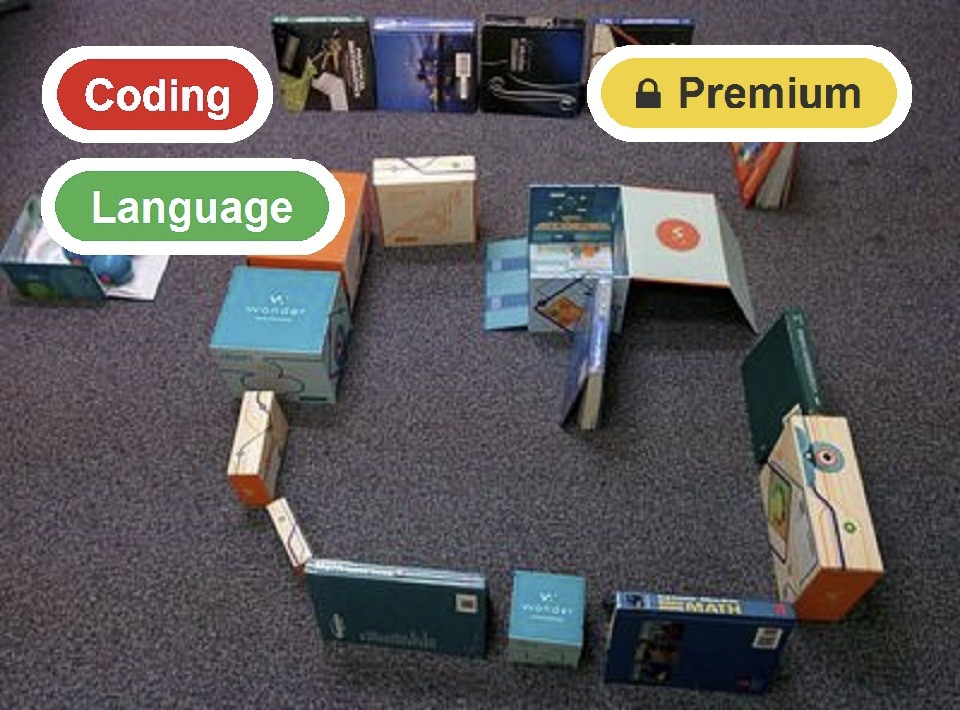
Challenge students to create an obstacle course and use Blockly to program Dash to navigate through it.

Students should start by gathering materials for their obstacle course.

Students should be encouraged to use things around the classroom, such as textbooks, building blocks, chairs, desks, etc., to make their obstacle course.

Instruct students to build an obstacle course that Dash would be able to navigate through.

  • Tell students that the obstacle course must have a clear beginning and end.

  • Encourage students to be creative with their obstacle course. (For instance, they can draw signs such as “stop” or “no left turn” to include inside the obstacle course.)

  • If there are enough Dots to go around, instruct students to place Dot somewhere in the obstacle course and program Dash to react to Dot on sight.

  • Let students know that they can adjust their obstacle course later if Dash is unable to navigate through it for some reason.

When students are finished building their obstacle course, instruct them to write in their own words how Dash will navigate through the course.

  • One student in the group can pretend to be Dash and walk through the course as another student describes what Dash is doing and a third student writes it down. The fourth student in the group can supervise, and double-check that the final narrative is correct.

  • Encourage students to be creative and add things to the code for Dash to do other than moving and turning.

Once they have completed their narrative, have the students break it up into discrete steps for Dash to complete.

  • Remind students that Dash can only do one action at a time.

  • Encourage students to measure the distances Dash will need to travel and include these distances in their steps.

Simple example:

  • Move forward 30 cm

  • Turn left 90 degrees

  • Move forward 40 cm

  • Turn right 90 degrees

  • Move forward 120 cm

  • Turn right 90 degrees

  • Move forward 100 cm

  • Turn right 90 degrees

  • Move forward 60 cm

  • Turn right 90 degrees

  • Move forward 50 cm

  • Turn right 90 degrees

  • Move forward 50 cm

Using Blockly, Dash can only move in distances that are multiples of 10 cm. Students will need to adjust their obstacle courses if more precise distances are needed for Dash.

When students have finished writing out the steps for Dash, instruct them to convert these steps into Blockly code.

  • Instruct students to write the entire algorithm before trying it out.

Sample Blockly for Above Steps

sample code

Allow students to try out their finished algorithm several times, and make adjustments to the code or obstacle course as necessary.

Have one person in the group write down their observations of what actually happens when running their program. This will make it easier to fix the code or course accordingly.

Walk around the classroom and offer help to groups that are struggling. Some groups may need to simplify their obstacle course in order to complete the challenge.

Extension Activity

Groups to program Dash to move through another group’s obstacle course.

Evaluation Rubric

Use this sheet to assess the students.

Downloadable Materials

Educational Standards

Ontario - Grade 3-4 - Language & Mathematics

Grade 3

Language

Writing

1.1 identify the topic, purpose, audience, and form for writing

1.2 generate ideas about a potential topic, using a variety of strategies and resources

1.5 identify and order main ideas and supporting details into units that could be used to develop a short, simple paragraph, using graphic organizers

Mathematics - Algebra (Coding)

C3.1 solve problems and create computational representations of mathematical situations by writing and executing code, including code that involves sequential, concurrent, repeating, and nested events

C3.2 read and alter existing code, including code that involves sequential, concurrent, repeating, and nested events, and describe how changes to the code affect the outcomes

Grade 4

Language

Writing

1.1 identify the topic, purpose, and audience for a variety of writing forms

1.2 generate ideas about a potential topic and identify those most appropriate for the purpose

Mathematics - Algebra (Coding)

C3.1 solve problems and create computational representations of mathematical situations by writing and executing code, including code that involves sequential, concurrent, and repeating events

C3.2 read and alter existing code, including code that involves sequential, concurrent, and repeating events, and describe how changes to the code affect the outcomes

Quebec - Grade 3-6 - Mathematics

Grade 3-6

Mathematics

A - Lengths

4. Estimates and measures the dimensions of an object using conventional units

b. metre, decimetre, centimetre and millimetre

c. metre, decimetre, centimetre, millimetre and kilometre

5. Establishes relationships between units of measure for length

a. metre, decimetre, centimetre and millimetre

b. metre, decimetre, centimetre, millimetre and kilometre

New Brunswick - Grade 3-4 - Mathematics & Science

Grade 3-4

Mathematics

Shapes and Space

SCO: SS3: Demonstrate an understanding of measuring length (cm, m) by:

- selecting and justifying referents for the units cm and m

- modelling and describing the relationship between the units cm and m

- estimating length using referents

- measuring and recording length, width and height.

SCO: SS7: Sort regular and irregular polygons according to the number of sides, including:

- triangles

- quadrilaterals

- pentagons

- hexagons

- octagons

Science

Plan and Perform

200-3 make predictions, based on an observed pattern

202-2 place materials and objects in a sequence or in groups according to one or more attributes

203-2 identify common objects and events, using terminology and language that others understand

Nova Scotia - Grade 3 & 5- Language, Mathematics & ICT

Grade 3

Language

  • Students will communicate effectively and clearly and respond personally and critically. (CZ, Com, CI, CT)

  • Students will be expected to use writing and other forms of representation including digital to explore, clarify and reflect on their thoughts feeling and experiences and learnings. (CZ,Com,CI,CT,TF, PCD)

ICT

  • Outcome 5: Students will be expected to select and use, with teacher support, grade-appropriate digital tools to develop and represent learning for various purposes, both individually and collaboratively

Mathematics

M03: Students will be expected to demonstrate an understanding of measuring length (cm, m) by:

▪ selecting and justifying referents for the units centimetre or metre (cm, m)

▪ modelling and describing the relationship between the units centimetre or metre (cm, m)

▪ estimating length using referents

▪ measuring and recording length, width, and height

M03.04 Show that 100 centimetres is equivalent to 1 metre by using concrete materials.

M03.05 Estimate the length of an object using personal referents.

M03.06 Determine and record the length and width of a given 2-D shape.

Grade 5

Mathematics

G05 Students will be expected to identify right angles.

Performance Indicators: 

G05.01 Provide examples of right angles in the environment.

G05.02 Sketch right angles without the use of a protractor.

G05.03 Label a right angle, using a symbol.

G05.04 Identify angles greater than or less than a right angle.

British Columbia - Grade 3 & 4 - Language & ADST

Grade 3

Language

Curricular Competencies

–  Use sources of information and prior knowledge to make meaning

–  Exchange ideas and perspectives to build shared understanding

–  Plan and create a variety of communication forms for different purposes and audiences

Content

– Metacognitive strategies

ADST

– Generate ideas from their experiences and interests

– Add to others' ideas

– Use trial and error to make changes, solve problems, or incorporate new ideas from self or others

Grade 4

Language

Curricular Competencies

–  Access and integrate information and ideas from a variety of sources and from prior knowledge to build understanding

– Show an increasing understanding of the role of organization in meaning

– Exchange ideas and perspectives to build shared understanding

–  Use writing and design process to plan, develop, and create texts for a variety of purposes and audiences

Content

– Metacognitive strategies

– Writing processes: revising and editing

ADST

– Identify the main objective for the design and any constraints

–  Construct a final version of the product while making changes to tools, materials, and procedures as needed

–  Test the product

–  Make changes and test again, repeating until satisfied with the product

Manitoba - Grade 3-5 - ELA

Grade 3-5

ELA

– Learners are choosing and using multiple styles of communication for clarity and effect.

– Learners are beginning to analyze differences in opinion.

– Learners are expressing and supporting opinions and judgments.

– Learners are recognizing that point of view has an impact on understanding.

– Learners are exploring the decision making of text creators.

Alberta - Grade 3 - ELA & ICT

Grade 3

ELA

General Outcome 2: Students will listen, speak, read, write, view and represent to comprehend and respond personally and critically to oral, print and other media texts.

– Apply a variety of strategies, such as setting a purpose, confirming predictions, making inferences and drawing conclusions

– Identify distinguishing features of a variety of oral, print and other media texts

ICT

F1: Students will demonstrate an understanding of the nature of technology.

F6: Students will demonstrate a basic understanding of the operating skills required in a variety of technologies.

C5: Students will use technology to aid collaboration during inquiry

C6: Students will use technology to investigate and/or solve problems.

Saskatchewan - Grade 3 - ELA

Grade 3

ELA

CR3.2 View and respond to grade-appropriate visual and multimedia texts (including videos, cartoons, illustrations, diagrams, charts, maps, and posters) explaining reactions and connections as well as visual features that convey humour, emotion, and mood.

  • Identify design, layout, and other features (e.g., colour, bold typeface, and sound effects) that help to understand grade appropriate visual and multimedia texts (including First Nations and Métis resources).

  • View and identify purpose for visual features used.

CR3.3 Listen to and understand information, identify main ideas and supporting details, compare different ideas and points of view, and explain connections made between texts heard.

Prince Edward Island - Grade 1-3 - ELA

Grade 1-3

ELA

Students will be expected to select, read, and view with understanding a range of literature, information, media, and visual texts.

Nunavut - Grade 3 - ELA

Grade 3

ELA

Students will listen, speak, read, write, view and represent to comprehend and respond personally and critically to oral, print, and other media texts, through a process.

  • 2.1.2 Set a purpose and discuss anticipated meaning of oral, print, and other media texts; use comprehension strategies to construct, confirm, revise, and explain understanding

  • 2.1.3 Use textual cues to construct and confirm meaning in oral, print, and other media texts

  • 2.3.1 Recognize that the same information can be represented in a variety forms or genres of texts (oral, print, and other media)

Newfoundland and Labrador - Grade 3-4 - ELA

Grade 3-4

ELA

GCO 4: Students will be expected to select, read, and view with understanding a range of literature, information, media, and visual text.