(Francais) Dash & Dot : Projet STIM : frise chronologique (4e année)
Description Les élèves travailleront seuls ou avec un partenaire pour faire une recherche sur la vie d'une personne célèbre. Ils programmeront leur robot pour qu'il chemine le long de la vie de la per

Educational Standards - New Brunswick
Grade 4 ELA
GCO: Students will be able to communicate information and ideas effectively and clearly, and to respond personally and critically.
SCO:Adapt volume, projection, facial expressions, gestures and tone of voice to the speaking occasion
Reading and viewing
GCO:Students will be able to select, read, and view with understanding a range of literature, information, media, and visual texts.
SCO: Select, independently and with teacher assistance, texts appropriate to their interests and learning needs
SCO:Use and integrate, with support, the various cueing systems (pragmatic, semantic, syntactic and graphophonic) and a range of strategies to construct meaning
Grade 4 Science
STSE (Science Technology Society Environment)
107-10 identify women and men in their community who work in science- and technology-related areas
Educational Standards - Alberta
Grade 4 – English Language Arts
1.2 Clarify and Extend
- explore ways to find additional ideas and information to extend understanding
2.4 Create Original Text
- use a variety of strategies for generating and organizing ideas and experiences in oral, print and other media texts
- select and use visuals that enhance meaning of oral, print and other media texts
3.2 Select and Process
- locate information to answer research questions, using a variety of sources, such as maps, atlases, charts, dictionaries, school libraries, video programs, elders in the community and field trips
- identify information sources that inform, persuade or entertain, and use such sources appropriately
3.3 Organize, Record and Evaluate
- organize ideas and information, using appropriate categories, chronological order, cause and effect, or posing and answering questions
- record ideas and information that are on topic
- paraphrase information from oral, print and other media sources
3.4 Share and Review
- communicate ideas and information in a variety of oral, print and other media texts, such as short reports, talks and posters
- select visuals, print and/or other media to add interest and to engage the audience
4.3 Present and Share
- present to peers ideas and information on a topic of interest, in a well-organized form
- add interest to presentations through the use of props, such as pictures, overheads and artifacts
- adjust volume, tone of voice and gestures appropriately, to suit a variety of social and classroom activities
Grade 4 (Division 2) - Information and Communication Technology
Foundational Operations, Knowledge and Concepts
F1 - 2.1 apply terminology appropriate to the technologies being used at this division level
F3 - 2.2 work collaboratively to share limited resources
F3 - 2.3 use appropriate communication language and etiquette
F6 - 2.1 power up and power down various technologies and peripherals correctly
F6 - 2.3 use peripherals, including printers and scanners
Educational Standards - British Columbia
Grade 4 – English Language Arts
Content
- text features
- evidence
- reading strategies
- oral language strategies
- writing processes
- sentence structure and grammar
- conventions
Curricular Competencies
- Access and integrate information and ideas from a variety of sources and from prior knowledge to build understanding
- Apply a variety of thinking skills to gain meaning from texts
- Exchange ideas and perspectives to build shared understanding
- Use writing and design processes to plan, develop, and create texts for a variety of purposes and audiences
- Communicate in sentences and paragraphs, applying conventions of Canadian spelling, grammar, and punctuation
- Develop and apply expanding word knowledge
- Use oral storytelling processes
- Transform ideas and information to create original texts
Grade 4 – Applied Design, Skills and Technologies
Content
Students are expected to use the learning standards for Curricular Competencies from Applied Design, Skills, and Technologies 4–5 in combination with grade-level content from other areas of learning in cross-curricular activities to develop foundational mindsets and skills in design thinking and making.
Curricular Competencies
- Use materials, tools, and technologies in a safe manner, and with an awareness of the safety of others, in both physical and digital environments
- Identify the skills required for a task and develop those skills as needed
- Use familiar tools and technologies to extend their capabilities when completing a task
- Choose appropriate technologies to use for specific tasks
- Demonstrate a willingness to learn new technologies as needed
Educational Standards - Ontario
Grade 4 - Language
Oral Communication
2.2 demonstrate an understanding of appropriate speaking behaviour in a variety of situations, including paired sharing and small- and large-group discussions (e.g., acknowledge and extend other group members’ contributions; make relevant and constructive comments on the contributions of other group members)
2.3 communicate in a clear, coherent manner, presenting ideas, opinions, and information in a readily understandable form (e.g., respond in an appropriate order to multi-part, higher-level questions in a student-teacher conference or a group discussion; explain the results of research in an oral presentation, including a statement of the research focus, the procedures followed, and the conclusions reached; use an organizational pattern such as chronological order or cause and effect to present ideas in a dialogue or discussion)
Reading
1.2 identify a variety of purposes for reading and choose reading materials appropriate for those purposes (e.g., letters and diaries for information and new ideas, leisure/hobby books and magazines for recreation and interest, print and online magazine or newspaper articles to research a current issue, instructions or information about how to play a computer game)
1.4 demonstrate understanding of a variety of texts by summarizing important ideas and citing supporting details (e.g., make an outline of a section from a textbook in another subject to prepare for a test)
1.5 make inferences about texts using stated and implied ideas from the texts as evidence
Writing
1.2 generate ideas about a potential topic using a variety of strategies and resources (e.g., brainstorm; formulate and ask questions to identify personal experiences, prior knowledge, and information needs)
1.3 gather information to support ideas for writing using a variety of strategies and oral, print, and electronic sources (e.g., identify key words to help narrow their searches; cluster ideas; develop a plan for locating information; scan texts for specific information, including teacher readalouds, mentor texts, reference texts, shared-, guided-, and independent-reading texts, and media texts)
1.4 sort and classify ideas and information for their writing in a variety of ways (e.g., by underlining key words and phrases; by using graphic and print organizers such as mind maps, concept maps, timelines, jot notes, bulleted lists)
1.5 identify and order main ideas and supporting details and group them into units that could be used to develop a summary, using a variety of graphic organizers (e.g., a Venn diagram, a paragraph frame) and organizational patterns (e.g., generalization with supporting information, cause and effect)
2.3 use specific words and phrases to create an intended impression (e.g., comparative adjectives such as faster; words that create specific effects through sound, as in alliteration for emphasis: rotten rain)
2.4 use sentences of different lengths and structures (e.g., complex sentences incorporating conjunctions such as because, so, if)
3.3 confirm spellings and word meanings or word choice using different types of resources appropriate for the purpose (e.g., locate words in online and print dictionaries using alphabetical order, entry words, guide words, pronunciation, and homographs; use a variety of dictionaries such as a dictionary of idioms or homonyms; use a thesaurus to find alternative words)
Media Literacy
3.4 produce media texts for specific purposes and audiences, using a few simple media forms and appropriate conventions and techniques (e.g.,
Leçon
Aperçu et préparation
Description
Les élèves travailleront seuls ou avec un partenaire pour faire une recherche sur la vie d'une personne célèbre. Ils programmeront leur robot pour qu'il chemine le long de la vie de la personne afin de montrer les moments importants de sa vie.
Objectifs
-
Travailler en collaboration pour programmer Dash et raconter la vie d'une personne célèbre.
-
Enregistrer les moments importants de la vie de la personne.
-
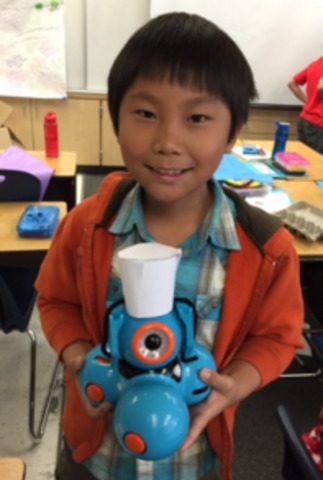
Illustrer la vie de la personne et, en option, créer un costume pour que Dash ressemble à la personne.
-
Programmer Dash pour qu'il raconte la vie de la personne en utilisant le mouvement, les sons et les lumières.
Robotique et accessoires

Autres accessoires
- Papier de boucherie
- Crayons
- Mètre
- Marqueurs
- Ruban-cache ou ruban adhésif
- Papier construction de couleur et cure pipes (pour le costume optionnel de Dash)
- Tablettes - (liste des appareils compatibles)
Classe 1 - Recherche (~60 min)
Les élèves travailleront seuls ou avec un partenaire pour effectuer une recherche sur une personne célèbre. Pour ce faire, ils pourront utiliser les tablettes ou leurs livres de classe. Ils devront ensuite rédiger 5 phrases qui relatent autant de faits importants de la vie de la personne.
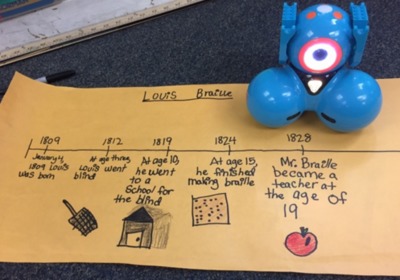
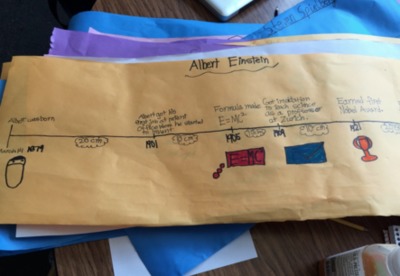
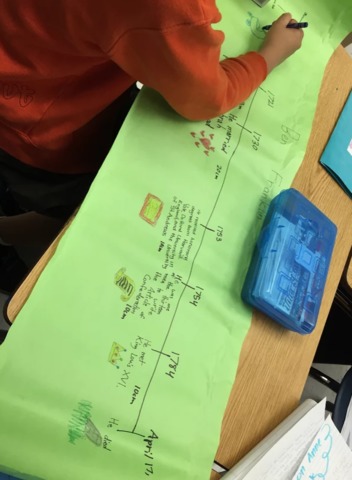
Sur du papier quadrillé ou ligné, les élèves dessineront un schéma de la vie de la personne en y plaçant sur une frise chronologique les 5 événements où ils souhaitent que Dash s'arrête.
Classe 2 - Introduction à Dash (~60 min)
Utiliser cette Présentation Google Slides pour présenter les comportements attendus du robot Dash et les divers composants d'un robot.
Les élèves utiliseront l'École de conduite dans l'application Blockly pour iPad.
Tous les robots Dash utilisés seront numérotés afin que les groupes se connectent au robot qui leur est assigné.
Les élèves travailleront avec les puzzles du niveau 1 dans École de conduite; cela dit, certains élèves pourraient être en mesure de travailler au niveau 2.
Classe 3 - Créer une frise chronologique (~60 min)
En utilisant des crayons et un mètre, les élèves créeront leur frise chronologique sur papier quadrillé.
Rappeler aux élèves que Dash ne peut se déplacer que par sections de 10 cm.
Demander aux élèves d'arrondir les événements de la vie de la personne à la dizaine la plus proche. Par exemple, si la personne est décédée à 92 ans, arrondir à 90.
Les élèves créeront ensuite une frise chronologique d'une certaine longueur en centimètres. Dans l'exemple ci-dessus, la frise chronologique aurait 90 cm de longueur.
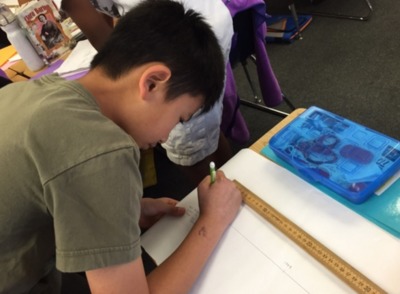
Demander aux élèves de mesurer les 5 points d'arrêt de Dash, en partant de la naissance de la personne (0 cm) jusqu'à son décès (90 cm).
Pour les points d'arrêt de Dash, les élèves doivent arrondir à la dizaine de cm la plus proche. Demander aux élèves de marquer chaque point d'arrêt en cm (cela les aidera lorsqu'ils devront coder Dash).
Pour chacun des cinq points d'arrêt, les élèves écriront une phrase expliquant l'événement sur la frise chronologique.
Classe 4 - Programmation (~60 min)
Les élèves utiliseront l'application Blockly pour programmer Dash et illustrer 5 moments marquants de la vie de la personne.
Rappeler aux élèves qu'ils doivent rédiger 5 phrases relatant ces événements importants.
Les élèves peuvent également travailler avec leur partenaire pour ajouter des détails à leur frise chronologique en utilisant les lumières, les sons, l'apparence et les actions de Dash.
Classe 5 - Présentation et activités complémentaires
Les élèves présentent leur frise chronologique au reste de la classe.
Ceux qui terminent les premiers leur frise chronologique peuvent créer un costume pour Dash pour représenter leur personnage.
Les élèves peuvent également filmer les diverses présentations de Dash.